Golden Corydalis Corydalis aurea
Also called Scrambled Eggs, Golden Smoke, Fumewort, Golden Fumewort
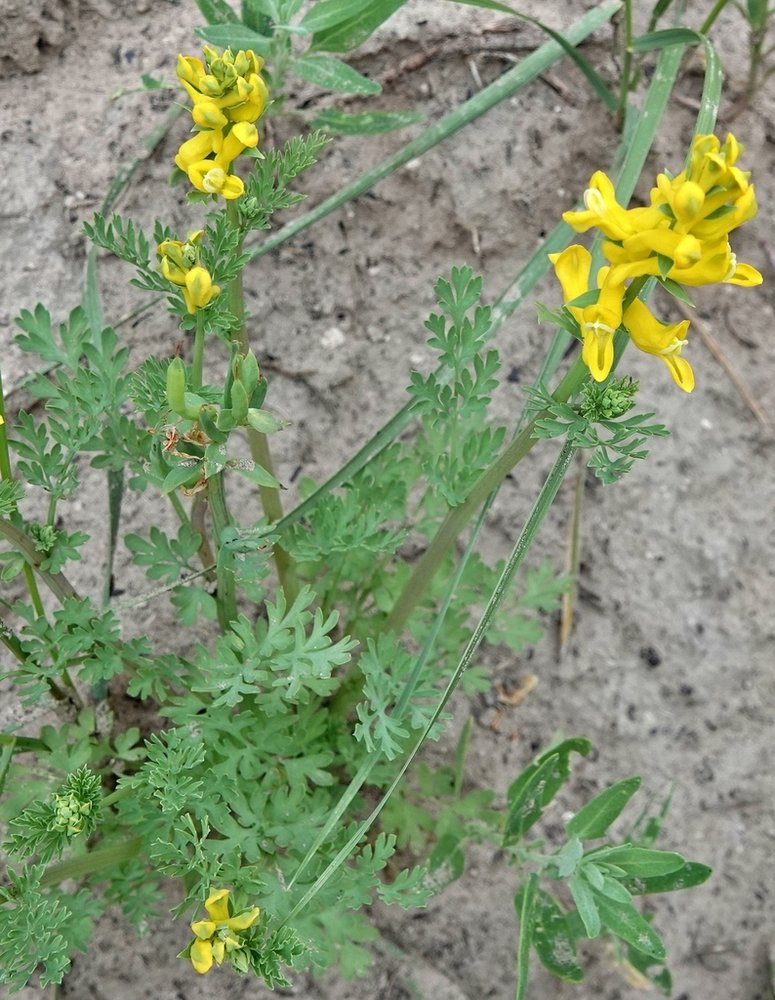
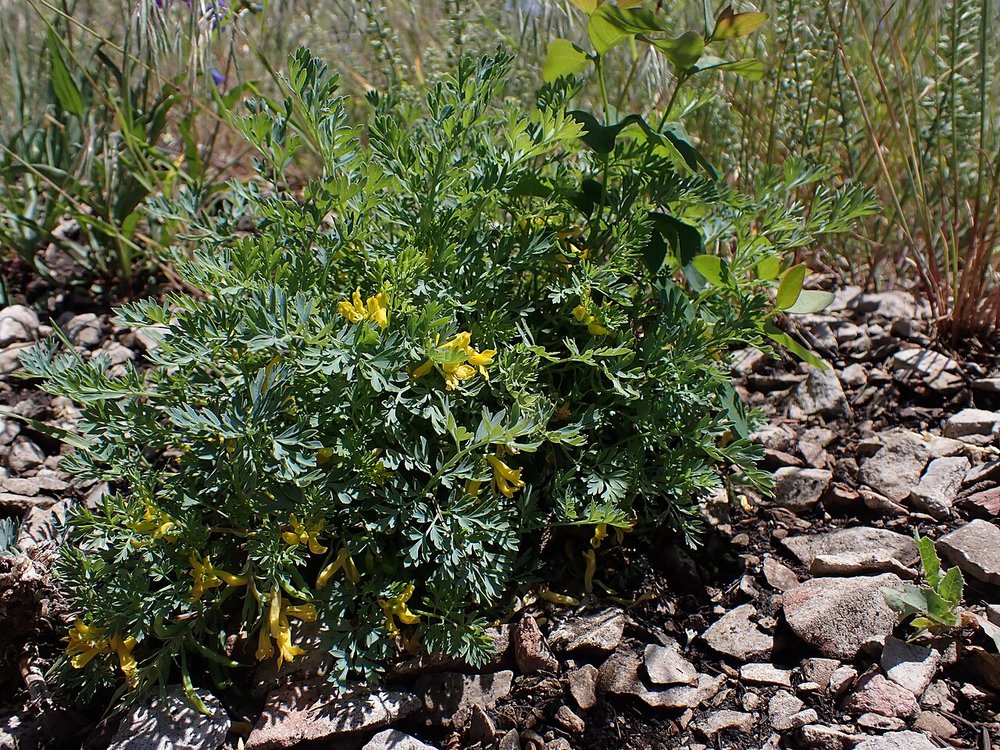
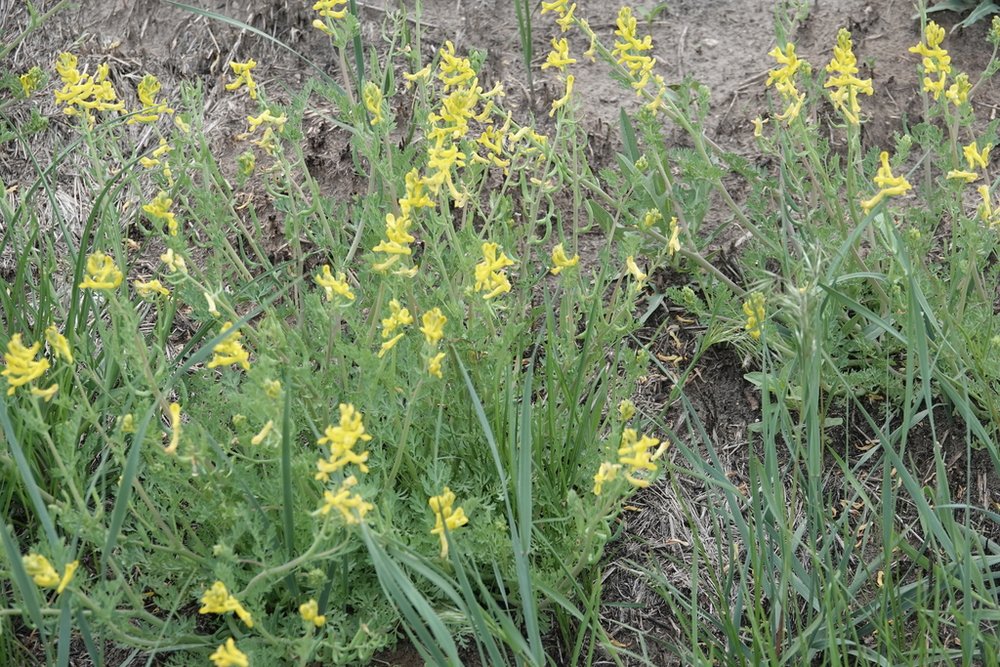
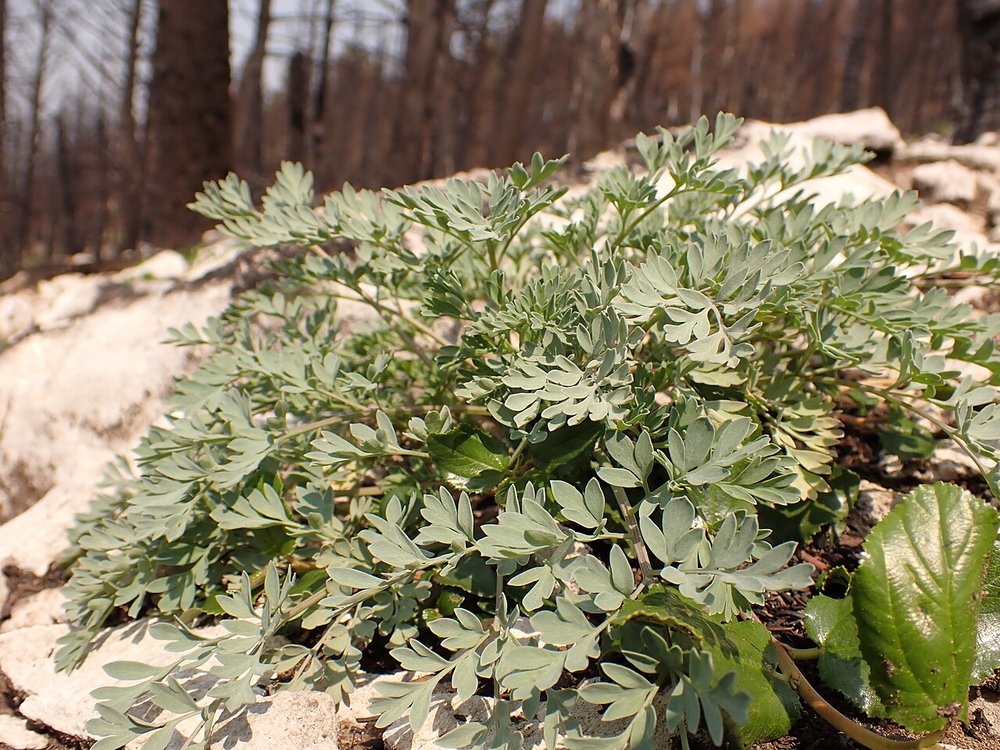
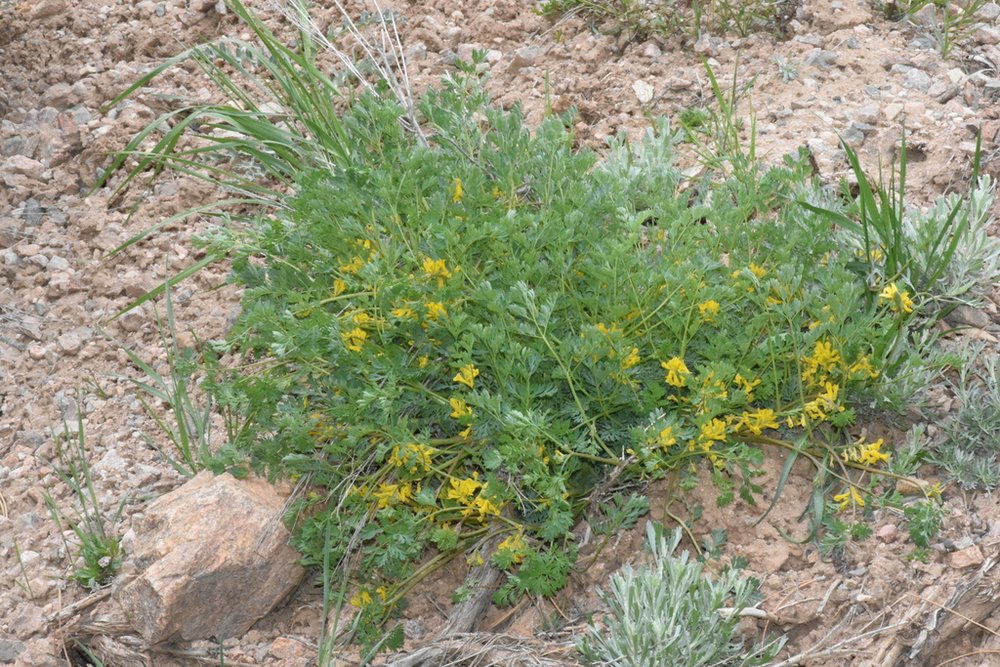
Golden Corydalis (Corydalis aurea) is a low, sprawling native plant with waxy blue-green, feathery leaves and short clusters of tubular yellow flowers, each with a small spur at the back, from April into July. It lives one or two seasons and comes up on disturbed, gravelly or rocky ground, including fresh burns, and in the Black Hills the National Park Service lists it at Wind Cave, Jewel Cave, Mount Rushmore and Devils Tower.
Free photos from other sources
| Family | Papaveraceae · Poppy |
|---|---|
| Status | Native winter annual or biennial |
| Blooms | April into July |
| Height | 10–50 cm (4–20 in) |
| Where | Disturbed, gravelly, sandy or rocky ground: roadsides, burns, rocky slopes and outcrops, stream banks and open pine woods |
| Also called | Scrambled Eggs, Golden Smoke, Fumewort, Golden Fumewort |
| Synonym | Capnoides aureum, Corydalis washingtoniana |
| Toxicity | It produces several alkaloids and may be poisonous to sheep and cattle. |
| Traditional use | Flora of North America, citing Moerman 1986, records that the Navajo used the plant as medicine for rheumatism, diarrhea, sores on the hands, stomachaches, menstrual problems and sore throats, and as a general disinfectant. Moerman's database adds that the Ojibwe inhaled smoke from the root to clear the head and revive a patient (Smith 1932). |
| Note | Wind Cave's plant list carries both subspecies, subsp. aurea and subsp. occidentalis. Botanists also file this plant under the fumitory family, Fumariaceae. |
Traditional use: first drafted by Google AI, then checked against the sources on this page.
Roots, seeds & germination
Root: A slender taproot, with the stems rising from a branched crown.
Seed: The capsule is linear and often lumpy, 12–24 mm (½–1 in) long, and holds shiny black seeds nearly 2 mm across. The Fire Effects Information System says the seed is long-lived and carried by wind, that it may lie dormant for over 160 years, and that the plant quickly moves onto recent burns by seed.
Germination: A 2019 University of Washington student propagation protocol says to surface-sow fresh seed in midsummer, soon after collection, so it sprouts in autumn as it does in the wild, and that seed can be held 6 to 8 weeks in an airtight container at 15–18 °C (59–64 °F) before sowing.
How do you identify Golden Corydalis?
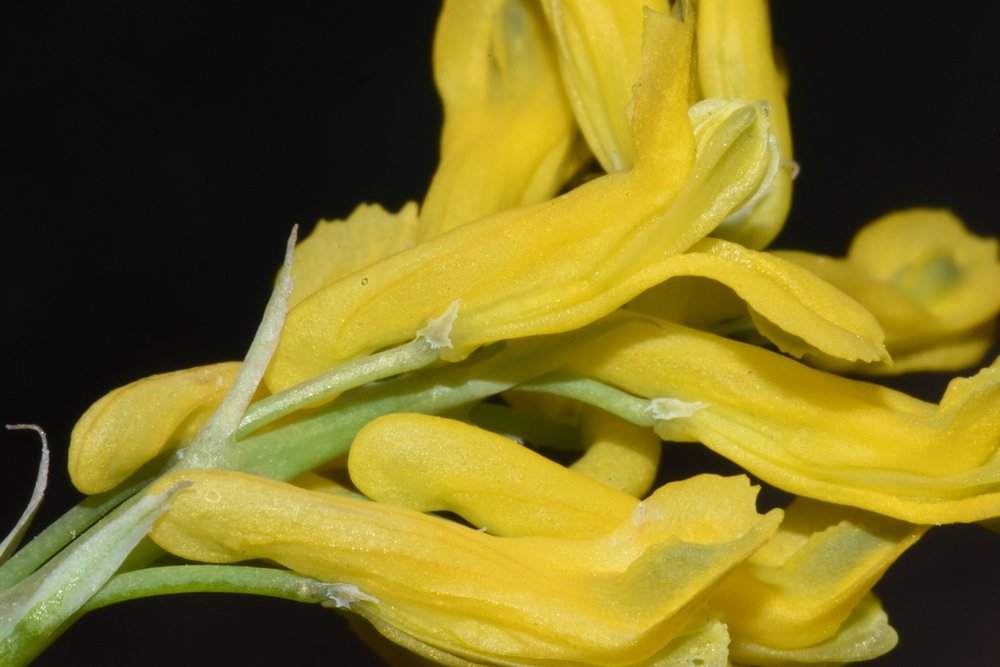
Look for many sprawling to rising stems from one base, hairless and waxy blue-green, with leaves cut three times over into narrow pointed lobes that give them a feathery look. The flowers come in short clusters of 10 to 20, each a yellow tube 13–16 mm (½–⅔ in) long with a straight or slightly curved spur 4–5 mm long sticking out the back; they stand up at first and tip over as they age, and the outer petals often have a green spot at the tip. The fruit is a pod-like capsule 12–24 mm (½–1 in) long with shiny black seeds. In subsp. aurea the leaves usually rise above the flower clusters and the capsules are slender and hang or spread; in subsp. occidentalis the clusters top the leaves and the capsules are stout and erect. Minnesota Wildflowers, describing subsp. aurea, separates it from Slender Fumewort, a relative not on the Black Hills park lists, by its larger flowers, leaves that top the clusters, and spreading to hanging rather than erect pods. Nothing else in this guide looks like it.
When does it bloom?
April into July.
Where does it grow?
Disturbed, gravelly, sandy or rocky ground on slopes, roadsides, stream banks, outcrops and open woods, in moist to dry, well-drained soil. Its seed is long-lived and wind-blown, so it can show up on a fresh burn and then fade within a few years. The National Park Service lists it at Wind Cave, Jewel Cave, Mount Rushmore and Devils Tower, and the 1986 Jewel Cave plant survey records it. Herbarium specimens come from all five Black Hills counties in South Dakota and from Crook and Weston counties in Wyoming, from about 1,080 m (3,550 ft) to 2,140 m (7,030 ft). Their labels give roadsides, stony floodplains, the base of a cliff in Custer State Park, shaded limestone talus under birches, rock rubble on a high summit, a montane meadow, white spruce forest at 1,830 m (6,000 ft), and a slope in the Black Elk Wilderness burned by the 2003 Elkhorn Fire.
Poppy family (Papaveraceae): 2 other plants in this guide
Sources: Flora of North America vol. 3: Corydalis aurea — eFloras; Fire Effects Information System: Corydalis aurea (Matthews 1993) — USDA Forest Service; Minnesota Wildflowers: Corydalis aurea (Golden Corydalis); Lady Bird Johnson Wildflower Center: Corydalis aurea (COAU2); ITIS: Corydalis aurea, TSN 18999; Kansas Wildflowers and Grasses: Corydalis aurea subsp. occidentalis; Plant propagation protocol for Corydalis aurea (student protocol, Carter 2019) — University of Washington ESRM 412; Wildflowers — Devils Tower National Monument, National Park Service; NPSpecies checklist, Wind Cave National Park vascular plants; NPSpecies checklist, Jewel Cave National Monument vascular plants; NPSpecies checklist, Mount Rushmore National Memorial vascular plants; NPSpecies checklist, Devils Tower National Monument vascular plants; Marriott and Hartman 1986, A Survey of the Vegetation of Jewel Cave National Monument; GBIF occurrence search: Corydalis aurea herbarium specimens, South Dakota and Wyoming; GBIF specimen 2562611169: Black Elk Wilderness, 2009, in the 2003 Elkhorn Fire burn; GBIF specimen 3454992944: Jewel Cave National Monument, 1985, disturbed soil in ponderosa pine forest; GBIF specimen 2512331753: Lawrence County, 2014, under white spruce, 1833 m; GBIF specimen 1928390811: Lawrence County, 1981, summit, 2141 m; GBIF specimen 1998864217: Custer State Park, 1929, rocky open ground at the base of a cliff; GBIF specimen 3454992967: Lawrence County, 1951, flowering June 29, shaded limestone talus under birches, 1935 m; Moerman, Native American Ethnobotany database (BRIT): Corydalis aurea.