Witch's Butter Tremella mesenterica
Also called Witches' Butter
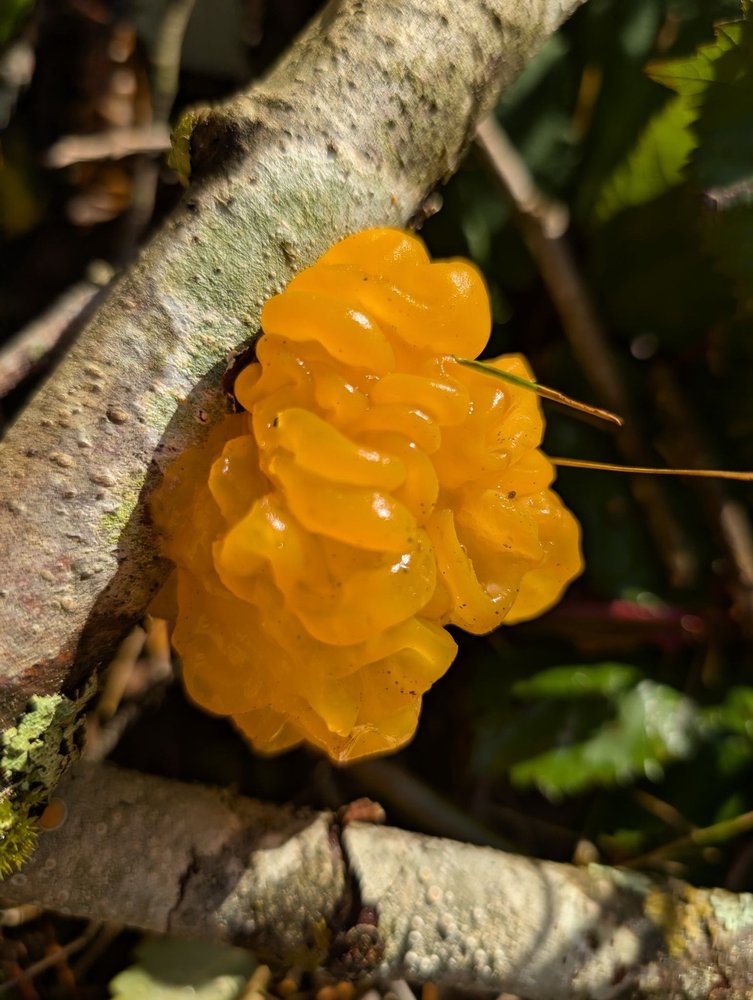
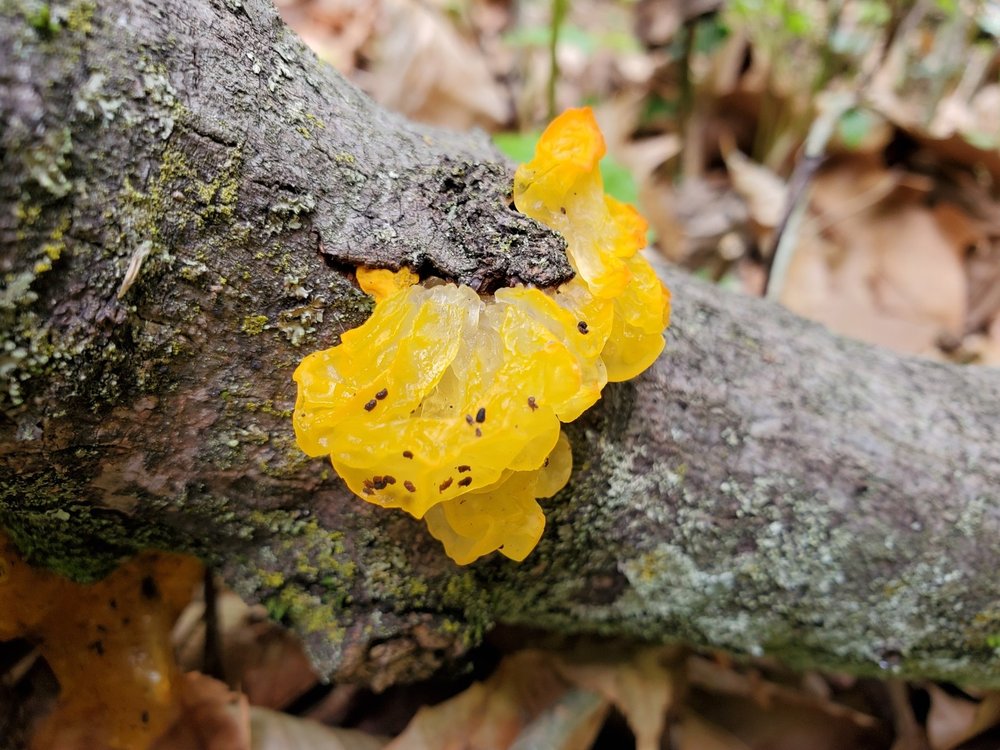
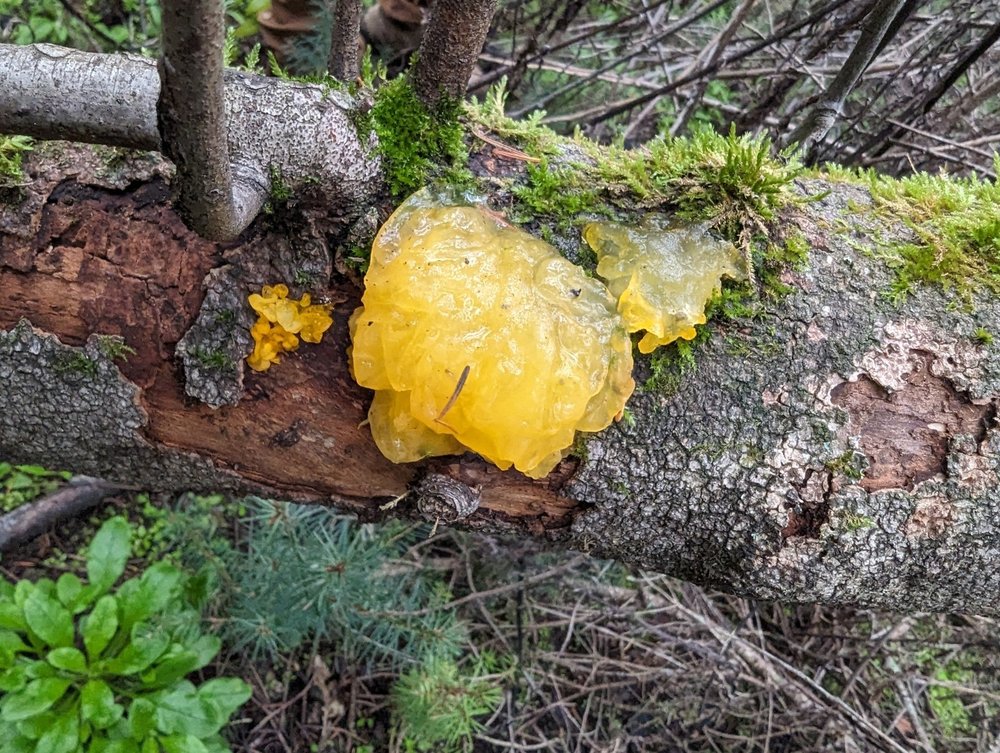
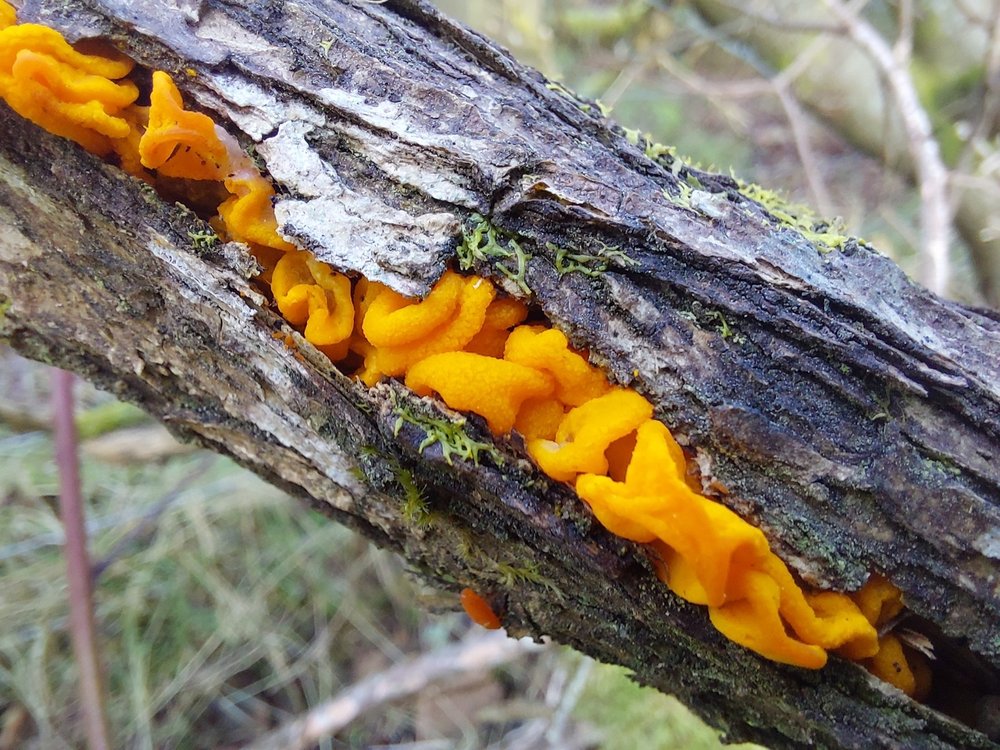
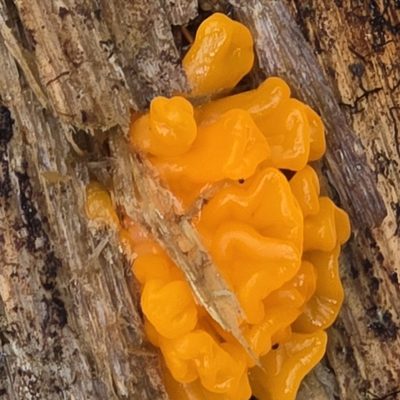
Witch's Butter (Tremella mesenterica) is a jelly fungus that forms yellow to orange-yellow, brain-like masses of gelatinous lobes on dead hardwood. It is thinly recorded in the Black Hills: iNaturalist has one research-grade record there, from Custer County in September 2023, and two more that only the people who posted them have identified.
Free photos from other sources
| Family | Tremellaceae · Tremella jelly fungi |
|---|---|
| Type | Jelly fungus |
| Season | Reported all year: the Missouri Department of Conservation and Emberger both say year-round, and the Department adds that it is sometimes found during warm spells in winter. Kuo says it usually appears in spring in temperate areas but also in summer, fall and winter; his collections are from Illinois and Indiana. iNaturalist's three Black Hills records are from April, September and December |
| Size | Mass 2–10 cm (¾–4 in) wide, 1–4 cm (½–1½ in) high |
| Grows on | Dead hardwood sticks and logs, usually with the bark still on |
| Also called | Witches' Butter |
| Synonym | Tremella lutescens |
| Eating | This guide doesn't say which mushrooms are safe to eat. The wrong one can kill you. Treat every little brown mushroom as poisonous. |
| Note | MykoWeb lists three species as "Witch's Butter": Naematelia aurantia (called Tremella aurantia in older books), Tremella mesenterica and Dacrymyces palmatus (now the Orange Jelly Spot). It also lists Tremella mesenterica as a name used for Naematelia aurantia in some field guides, and says how common Tremella mesenterica is in California is unclear. |
How it lives
Tremella mesenterica is a parasite on the usually hidden mycelium (the threadlike body) of a crust fungus in the genus Peniophora, which grows in dead hardwood (Kuo; Emberger). Kuo says the Peniophora can sometimes be found on the lower side of the stick, beneath the jelly. Emberger says all Tremella species are reported to be parasites of wood decay fungi.
How do you identify Witch's Butter?
Look for a brain-like mass of gelatinous lobes with a hairless, moist surface, dull to bright yellow or orange-yellow, and yellow jelly flesh (Kuo). Kuo gives 2–5 cm (¾–2 in) across and 1–3 cm (½–1¼ in) high; Emberger gives 2.5–10 cm (1–4 in) across and 3–4 cm (1¼–1½ in) high. It grows on dead hardwood, in Kuo's collections usually on sticks with the bark still attached. With age or in wet weather it can fade and lose its shape, and it dries to an orange-yellow crust (Kuo) that can dry down and rehydrate many times (Emberger). Dacrymyces species can look very much like yellow Tremella species to the naked eye, but they differ under the microscope (Kuo). Emberger compares Witch's Butter with Dacrymyces palmatus (now Dacrymyces chrysospermus, the Orange Jelly Spot in this guide) and says that one grows on conifer wood and has a white point of attachment; MykoWeb gives the same two marks for it and adds that it is usually more orange. Naematelia aurantia (once called Tremella aurantia) also grows on hardwood and is often confused with Witch's Butter (MykoWeb). Kuo separates the two by host: Naematelia aurantia parasitizes the crust fungus Stereum hirsutum and often grows straight out of its fruiting bodies, while Witch's Butter parasitizes a crust fungus in the genus Peniophora, usually hidden. Under the microscope Naematelia aurantia has smaller spores and spore-bearing cells (basidia) (Kuo). The Missouri Department of Conservation says the pale jelly roll (Exidia alba) can be similar in size and shape but is white.
When can you find it?
Reported all year: the Missouri Department of Conservation and Emberger both say year-round, and the Department adds that it is sometimes found during warm spells in winter. Kuo says it usually appears in spring in temperate areas but also in summer, fall and winter; his collections are from Illinois and Indiana. iNaturalist's three Black Hills records are from April, September and December.
Where does it grow?
Dead hardwood. Kuo's collections, from Illinois and Indiana, were mostly on sticks about 1–4 cm (½–1½ in) across with the bark still attached, and the Missouri Department of Conservation says it grows on dead deciduous (leaf-dropping) wood, especially oaks. Kuo calls the species widely distributed in North America but possibly less common in western North America. In the Black Hills places searched, iNaturalist has three records: one research-grade (Custer County, September 2023) and two that only the person who posted them has identified (Custer State Park, April 2024; the northern Hills, December 2025). GBIF holds two South Dakota records, both iNaturalist records and neither a specimen: one is the September 2023 Custer County record again, and the other (June 2024) is from Lake County in eastern South Dakota, outside the Black Hills.
Other mushrooms to compare
Sources: Tremella mesenterica (M. Kuo), MushroomExpert.com; Tremella mesenterica (G. Emberger, Fungi Growing on Wood), Messiah University, on MushroomExpert.com; California Fungi: Naematelia aurantia, MykoWeb; Witches' Butter, Missouri Department of Conservation field guide; Name search: Tremella mesenterica, Index Fungorum; Name search: Tremella lutescens, current name Tremella mesenterica, Index Fungorum; Name search: Tremella aurantia, current name Naematelia aurantia, Index Fungorum; Name search: Dacrymyces palmatus, current name Dacrymyces chrysospermus, Index Fungorum; Tremella mesenterica in the Black Hills (3 records), iNaturalist; Tremella mesenterica records in South Dakota (2, both iNaturalist observations), GBIF.