White-pored Chicken of the Woods
Laetiporus cincinnatus
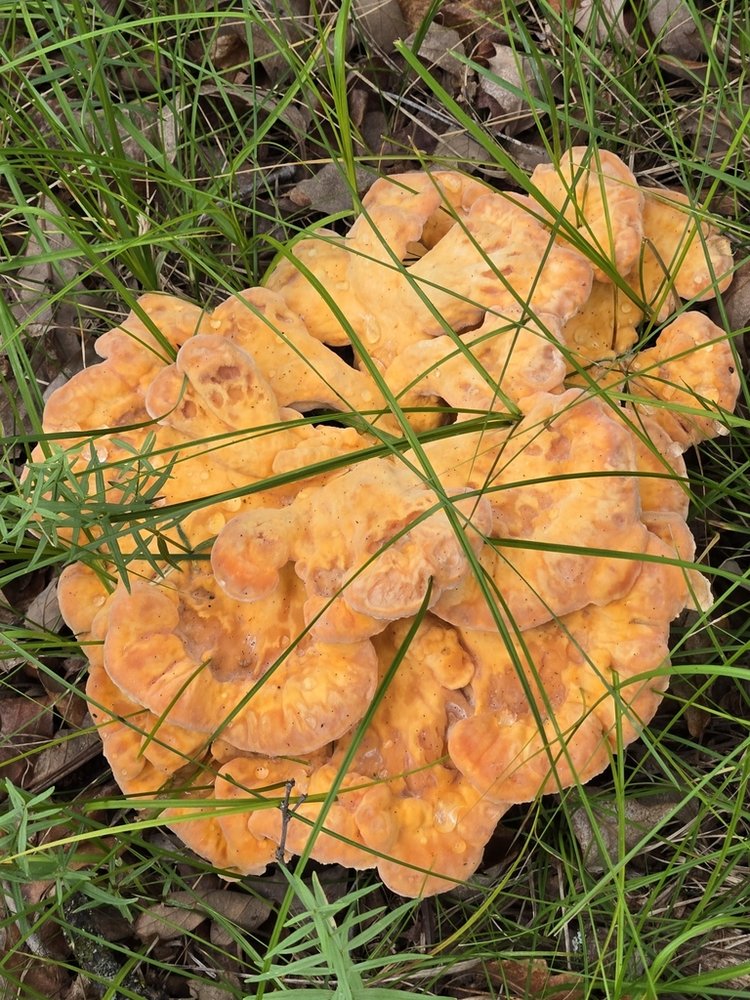
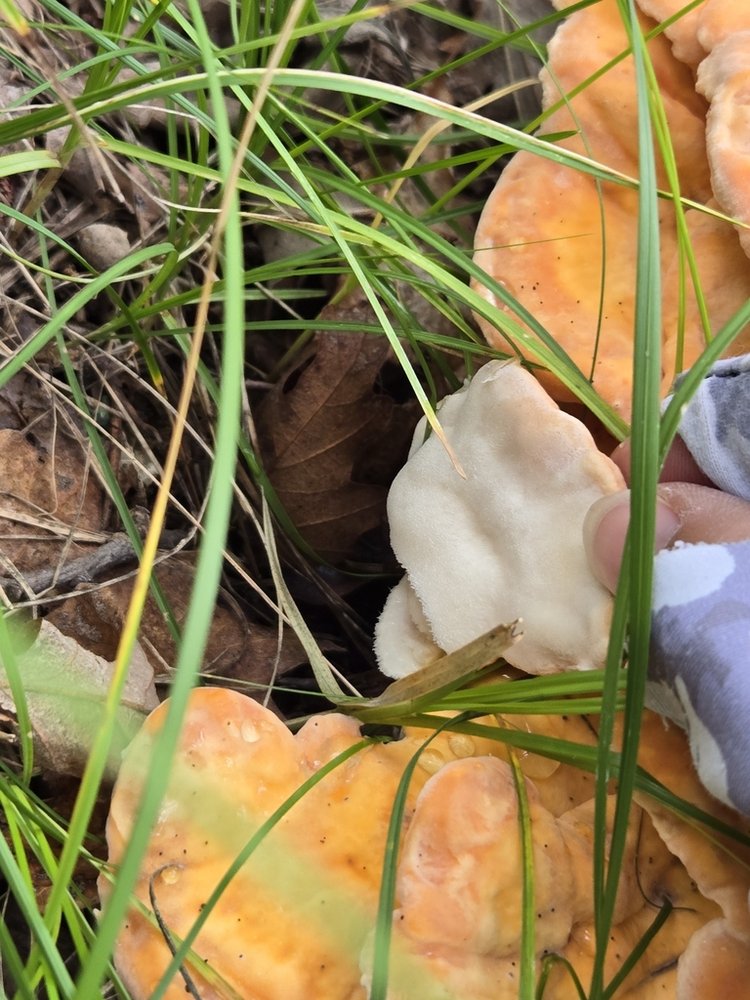
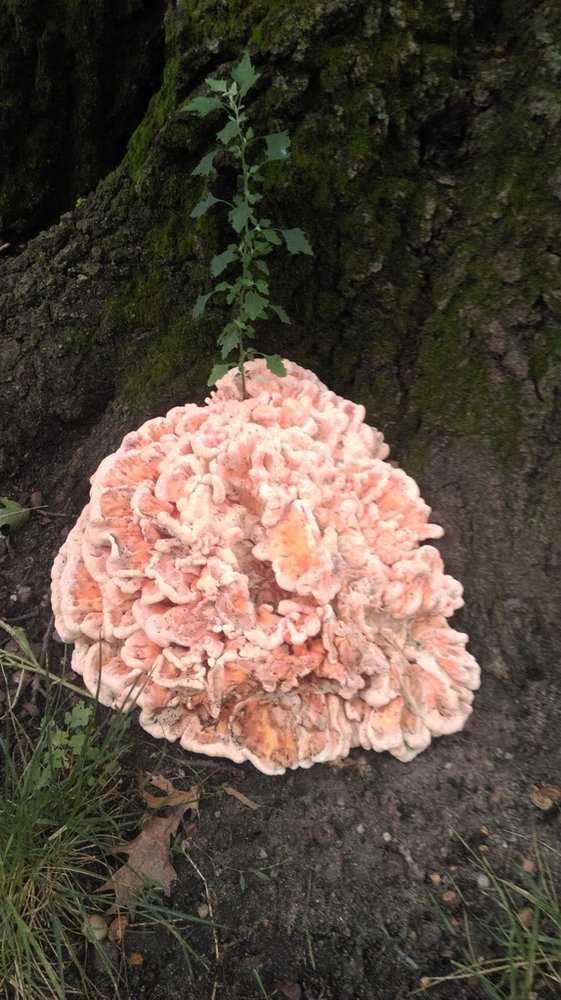
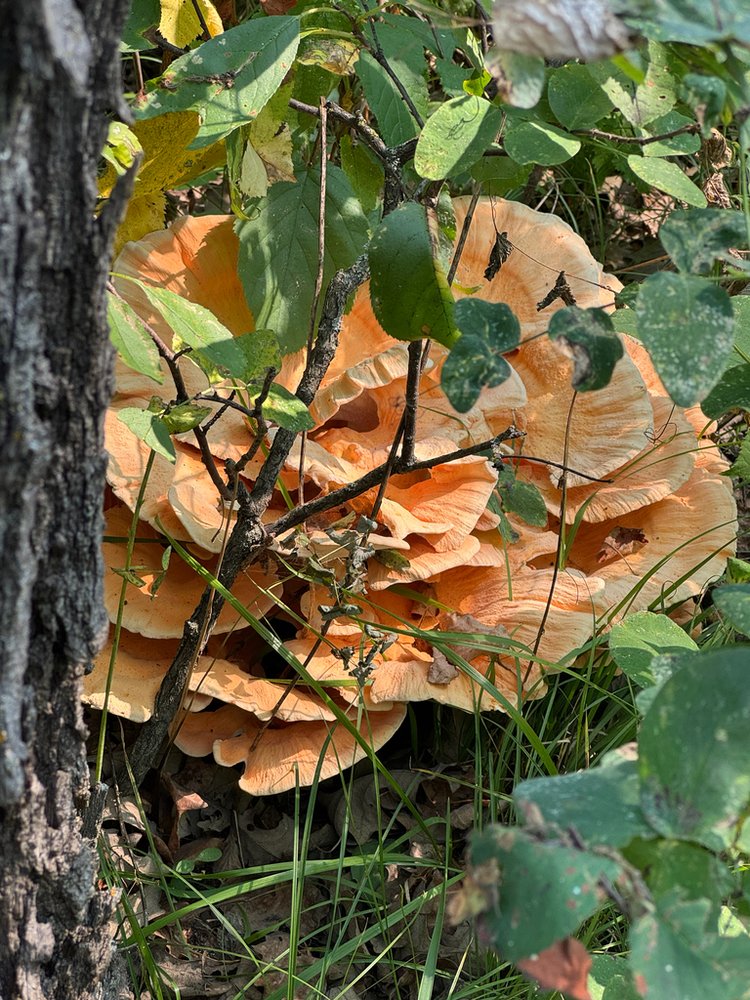
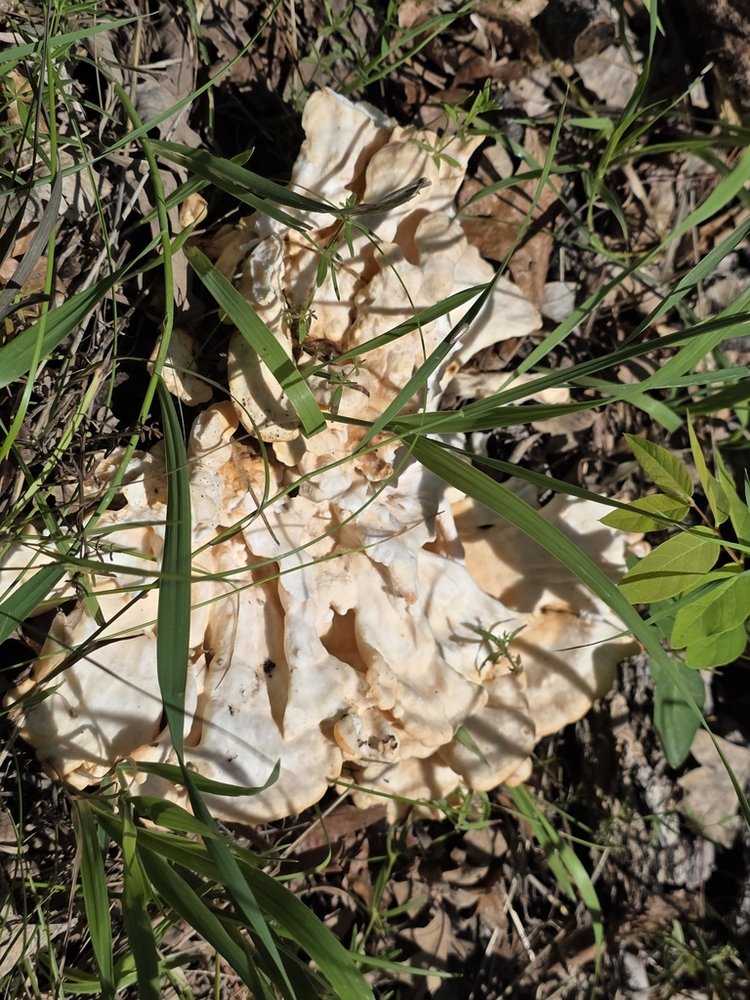
White-pored Chicken of the Woods (Laetiporus cincinnatus) is a large rosette of soft, pinkish-orange caps with a white underside that grows at the base of oak trees or up from their roots. iNaturalist has 9 research-grade Black Hills records, 2022 to 2026, mostly from July, from Custer State Park, the northern Hills and Crook County, Wyoming.
Free photos from other sources
| Family | Laetiporaceae · Chicken of the woods |
|---|---|
| Type | Shelf fungus |
| Season | Mostly July in the Black Hills: iNaturalist's 9 research-grade records here are from July (8) and August (1), and one more awaiting ID is from September. Across its range it fruits from late spring through fall |
| Size | Rosette up to 45 cm (18 in) across; caps 4–20 cm (1½–8 in) wide, up to 2 cm (¾ in) thick |
| Grows on | The base and roots of oaks (here, bur oak), or the ground nearby |
| Spore print | White |
| Also called | Chicken of the Woods |
| Synonym | Polyporus cincinnatus |
| Toxicity | It has made people sick: two cases in the North American Mycological Association's poisoning reports for 2006–2017 list nausea and vomiting in one, and in the other a red, swollen face, a racing pulse, and trouble walking for 2 days and breathing for 4 days. |
| Eating | This guide doesn't say which mushrooms are safe to eat. |
How it lives
A parasite and decomposer of oaks that causes a brown rot of the roots and the butt of the trunk. Brown rot breaks down the cellulose and leaves the lignin, so the wood turns brown, shrinks into cube-shaped cracks and crumbles. Because it fruits from roots and the base of the tree, it forms a rosette at ground level instead of shelves on the trunk.
How do you identify White-pored Chicken of the Woods?
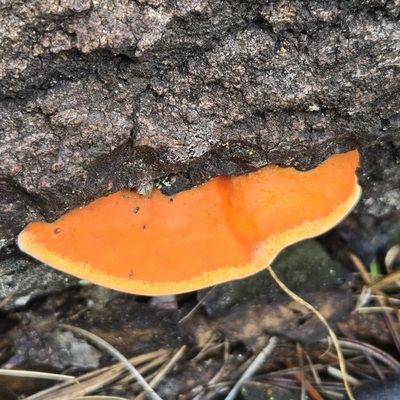
Look at the foot of an oak, or on the ground a short way from one, for a rosette up to 45 cm (18 in) across made of many overlapping, fan-shaped caps, each 4–20 cm (1½–8 in) wide and up to 2 cm (¾ in) thick. The caps are pale to bright pinkish orange, often with faint bands and a whitish edge, finely suede-like, and they fade with age and in direct sun. The pore surface underneath is whitish to cream, with tiny pores (2 or 3 per millimeter), and does not bruise. There is little or no stem. The flesh is thick and white, soft and watery when young, then chalky and crumbly. Chicken of the Woods (Laetiporus sulphureus) has a yellow pore surface and yellower caps, and it grows as shelves stacked on a trunk or log above the ground; iNaturalist has two research-grade Black Hills records of it. A chicken of the woods on conifer wood would be a conifer species such as Laetiporus conifericola, which grows from the Rocky Mountains west and has no Black Hills records on iNaturalist. Northern Cinnabar Polypore is also orange, but it grows as single tough caps 2–13 cm (¾–5 in) across on dead hardwood branches and logs, and its pores are reddish orange.
When can you find it?
Mostly July in the Black Hills: iNaturalist's 9 research-grade records here are from July (8) and August (1), and one more awaiting ID is from September. Across its range it fruits from late spring through fall.
Where does it grow?
At the base of living or dead oaks, or on the ground nearby, coming up from the roots. Its range runs from the Great Plains east. Bur oak grows in the Black Hills in ponderosa pine and bur oak forest and in bur oak stands at Wind Cave, and the one Black Hills record that names a host, a 2019 Mushroom Observer record from Lawrence County, was at the base of a bur oak. iNaturalist has 10 Black Hills records (9 research grade), 2022 to 2026, from Custer State Park, Meade, Lawrence and Pennington counties and Crook County, Wyoming.
Other mushrooms to compare
Sources: Laetiporus cincinnatus (M. Kuo, 2017) — MushroomExpert.com; Laetiporus sulphureus (M. Kuo, 2017) — MushroomExpert.com; The genus Laetiporus, key to 7 North American species (M. Kuo, 2017) — MushroomExpert.com; Pycnoporus cinnabarinus (M. Kuo, 2010) — MushroomExpert.com; Summary of the Poisoning Reports in the NAMA Case Registry for 2006 through 2017 (M.W. Beug), Table X — North American Mycological Association; 2017 Reports of Mushroom Poisoning in North America (M.W. Beug) — North American Mycological Association; Quercus macrocarpa (bur oak), Fire Effects Information System — USDA Forest Service; Field Guide to Diseases and Insects of the Rocky Mountain Region, RMRS-GTR-241 (2010), Table 3, white and brown rot — USDA Forest Service; Observation 373649, Laetiporus cincinnatus at the base of a bur oak, Lawrence County, 2019 — Mushroom Observer; Laetiporus, all records in the Black Hills places — iNaturalist; Laetiporus cincinnatus, Black Hills records by month — iNaturalist; Name search: Laetiporus cincinnatus, basionym Polyporus cincinnatus Morgan 1885 (record 444416) — Index Fungorum.