Witch's Hat
Hygrocybe conica
Witch's Hat (Hygrocybe conica) is a small waxy cap with a pointed red to orange cap and a yellow-orange stem, and nearly every part of it turns black where bruised or as it ages. iNaturalist has 6 research-grade Black Hills records, from June to August, most of them in July.
Free photos from other sources
| Family | Hygrocybaceae · Waxy cap |
|---|---|
| Type | Gilled mushroom |
| Season | June into August on iNaturalist's Black Hills records, most in July |
| Size | Cap 1–4 cm (½–1½ in) wide, rarely to 6 cm (2½ in); stem 3–8 cm (1¼–3 in) tall |
| Grows on | Soil, usually in woods, under hardwoods or conifers |
| Spore print | White |
| Also called | Blackening Waxy-cap, Conic Waxcap |
| Synonym | Hygrophorus conicus |
| Eating | This guide doesn't say which mushrooms are safe to eat. |
| Note | DNA studies treat Hygrocybe conica as a species complex: a group of closely related species that look alike. |
How it lives
How it lives is not settled. A 2014 review of the waxy cap family reports that, of its genera, only Hygrophorus forms partnerships with tree roots, and that chemical signatures suggest Hygrocybe and its relatives may get part of their food from living things, perhaps mosses, rather than only from dead matter; Kuo calls its role uncertain. The blackening of old or bruised mushrooms probably comes from melanin, a dark pigment.
How do you identify Witch's Hat?
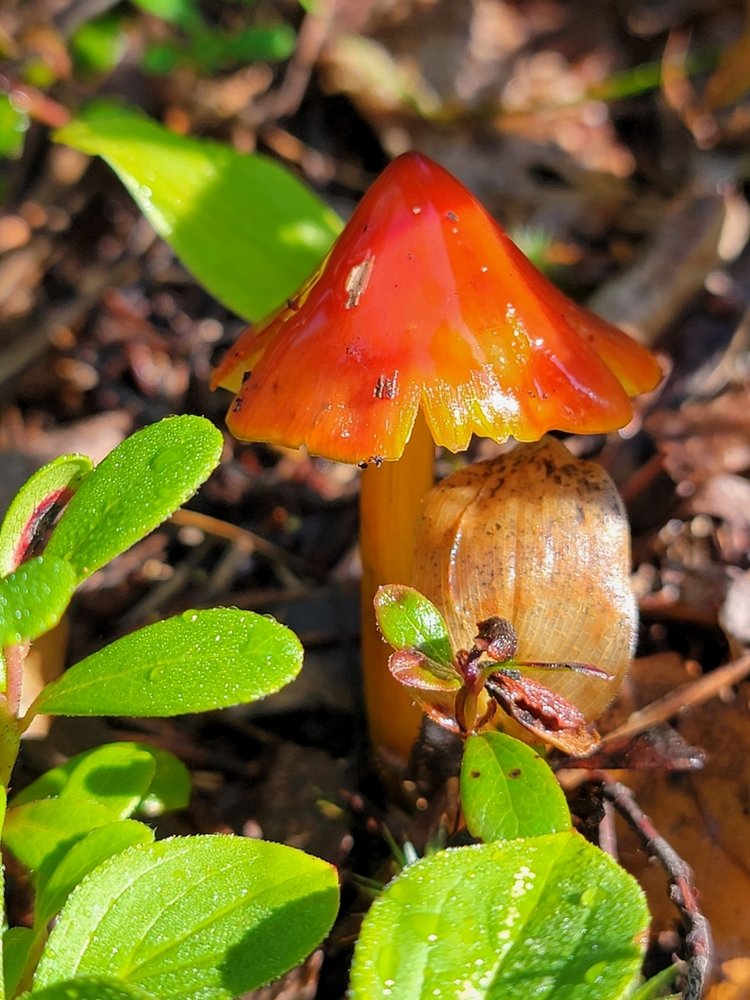
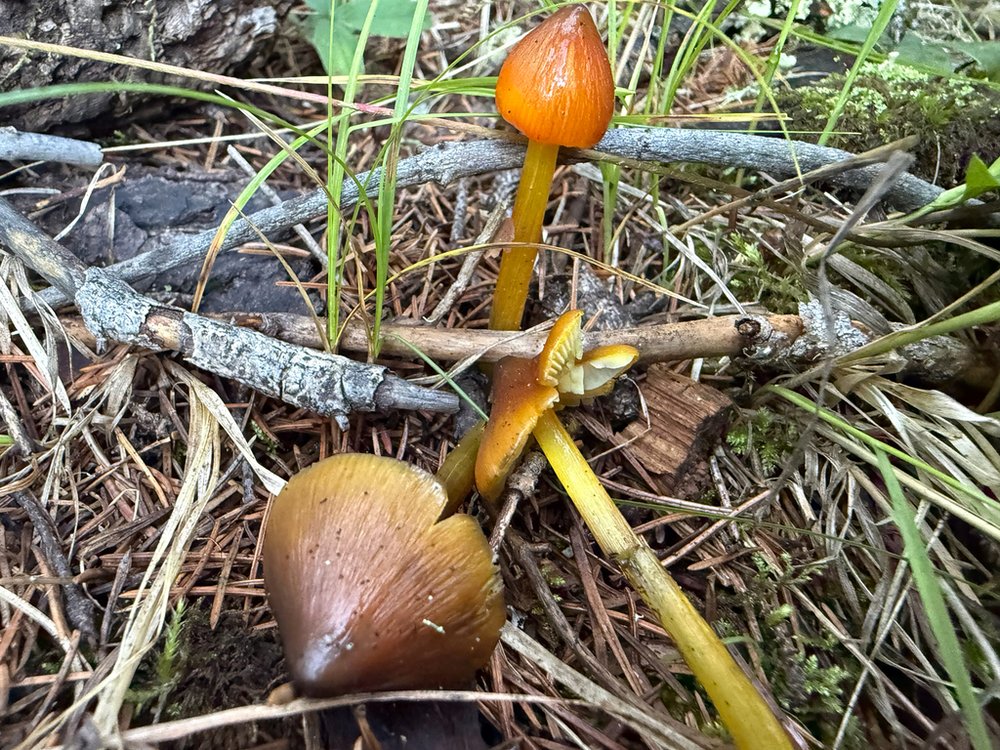
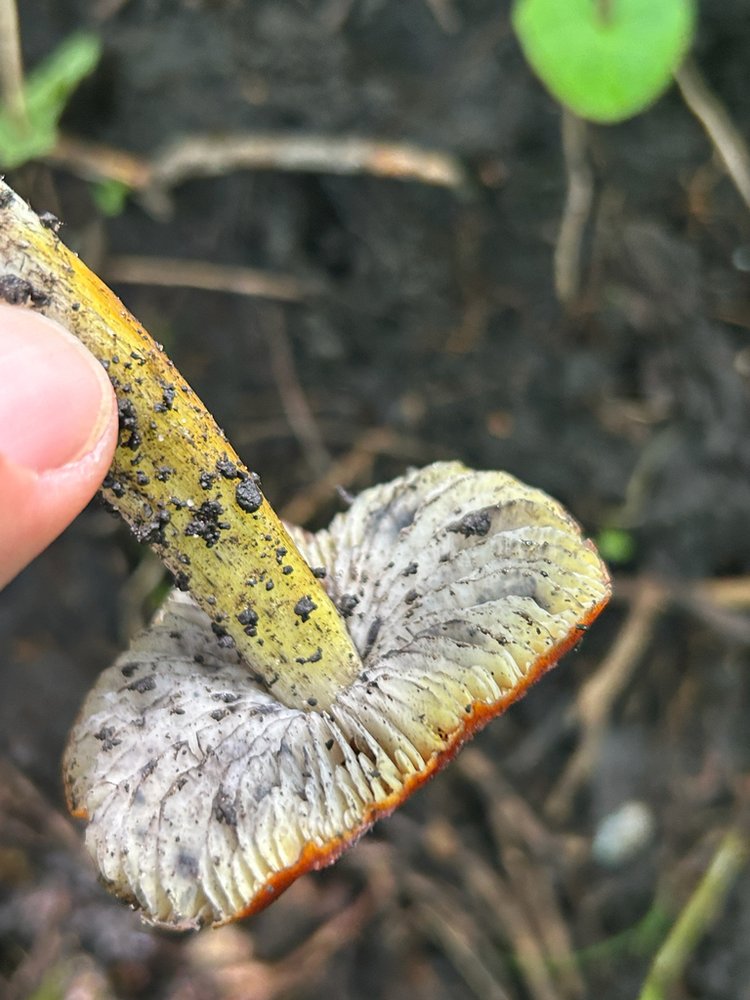
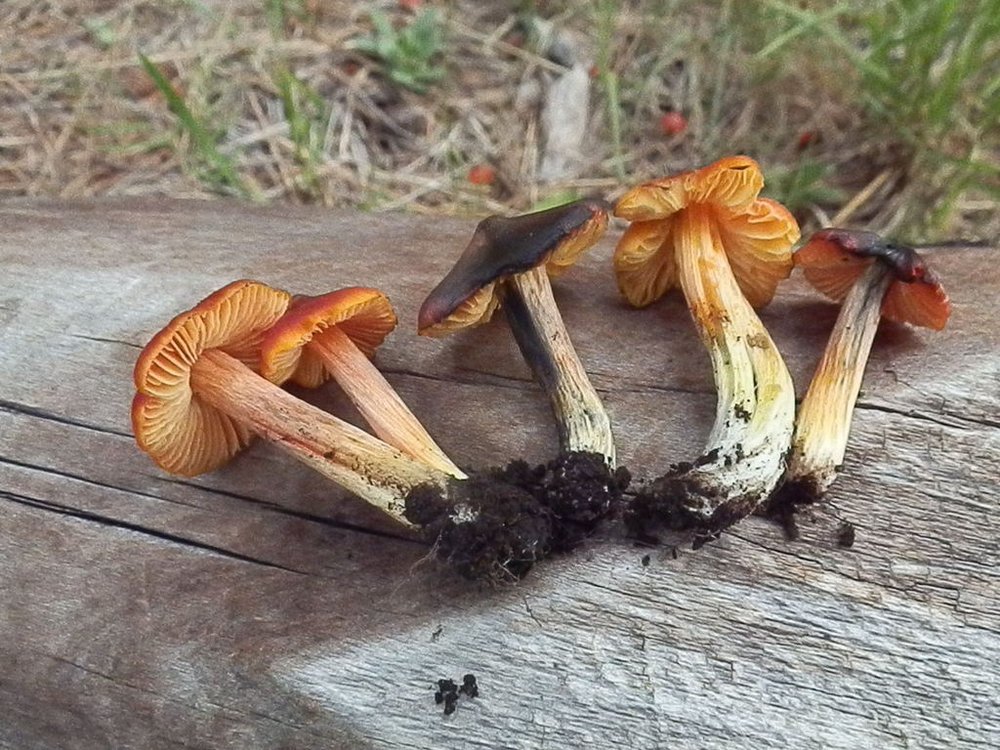
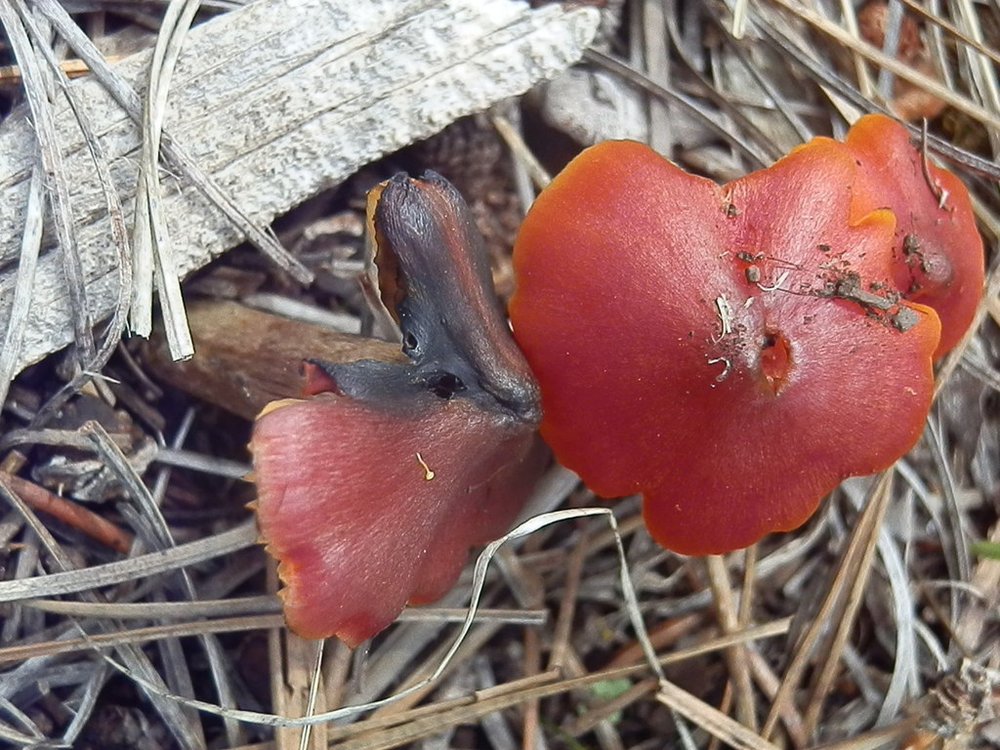
Look for a cap 1–4 cm (½–1½ in) wide that starts sharply cone-shaped and opens to a broad cone or a low dome with a point in the middle. It is bright red to orange, fading toward orange or yellow, sticky only when very fresh, and it develops olive and black stains. The gills are narrowly attached or nearly free, thick and waxy, whitish to yellow at first and later orange, and they bruise and age gray to black. The stem is yellow to orange with a white base, hollow and fragile, often twisted or grooved lengthwise, and it also bruises black. Old ones can turn black all over. The spore print (the dust the gills drop) is white. Kuo notes that this blackening sets it apart from many of the red and orange waxy caps in North America. Hygrocybe acutoconica, reported in the Black Hills from 3 iNaturalist records still awaiting confirmation, has a similar pointed yellow to orange cap, but it does not blacken, though its stem base may slowly turn gray.
When can you find it?
June into August on iNaturalist's Black Hills records, most in July.
Where does it grow?
Soil, usually in woods. Kuo finds it under hardwoods, especially oaks, in the Midwest and notes that other authors report it under conifers; Arora, quoted in the Matchmaker guide, gives damp ground, usually in woods. In the Wyoming Rockies, herbarium specimens were collected on soil under conifers, aspen and willow, and among sagebrush and grass. iNaturalist has 6 research-grade Black Hills records, 2023 to 2025: 3 from Pennington County, 2 from Lawrence County and 1 from Crook County, Wyoming. No Black Hills herbarium specimen turned up in GBIF (its South Dakota records all come from iNaturalist), and no published Black Hills source opened for this guide names it.
Sources: Hygrocybe conica (M. Kuo, 2014) — MushroomExpert.com; Hygrocybe acutoconica (M. Kuo, 2014) — MushroomExpert.com; Hygrocybe conica, Matchmaker: Mushrooms of the Pacific Northwest — Canadian Forest Service; Hygrocybe conica, the witch's hat mushroom: Fungus of the Month, October 2001 (T. Volk) — University of Wisconsin-La Crosse; Molecular phylogeny, morphology, pigment chemistry and ecology in Hygrophoraceae (Lodge et al., Fungal Diversity 64, 2014) — Springer; Hygrocybe conica: species synonyms — Species Fungorum; Witch's Hat research-grade records in the six Black Hills places — iNaturalist API; Hygrocybe acutoconica records in the Black Hills places, all needs ID — iNaturalist API; Hygrocybe conica herbarium specimens from Wyoming — GBIF; Hygrocybe conica records from South Dakota by record type (no specimens) — GBIF.