Orange Jelly Spot
Dacrymyces chrysospermus
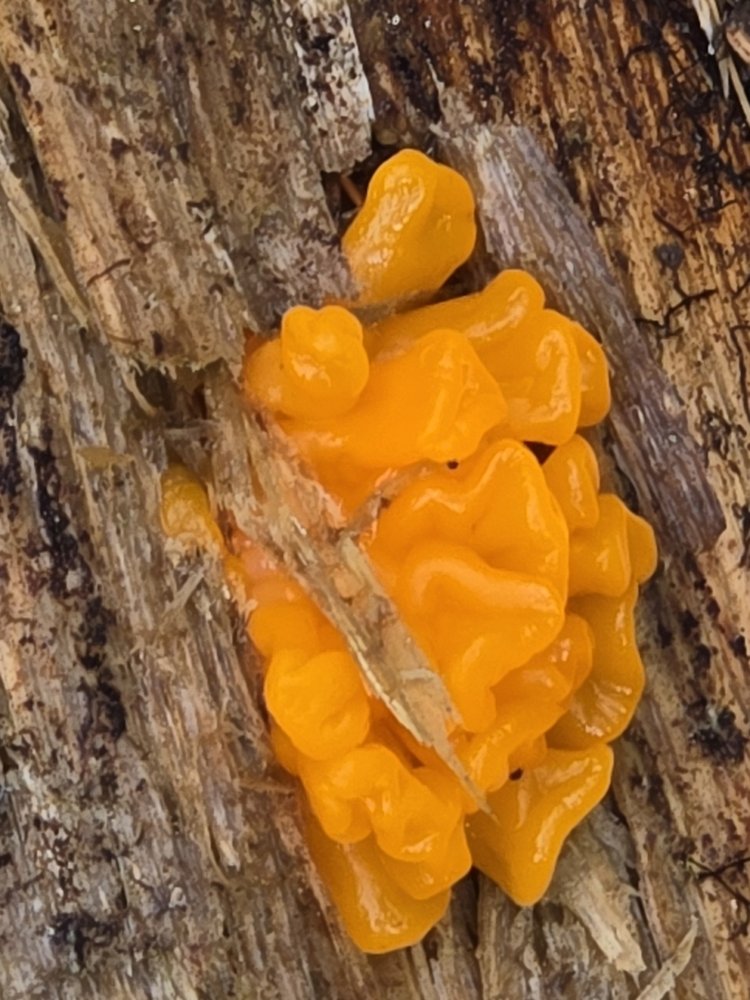
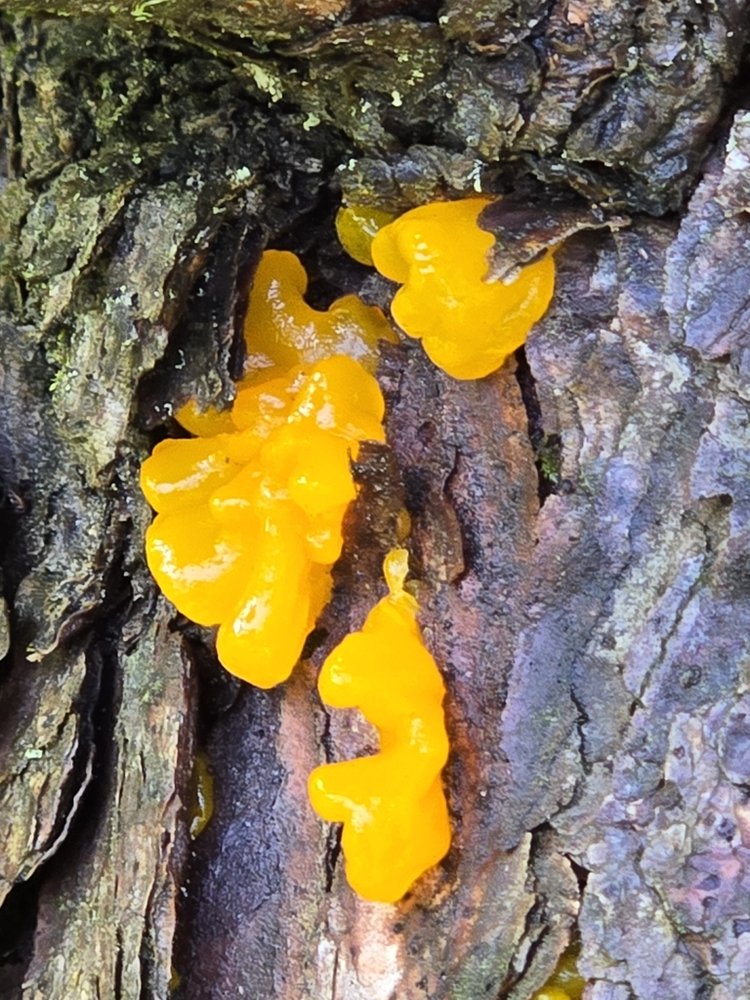
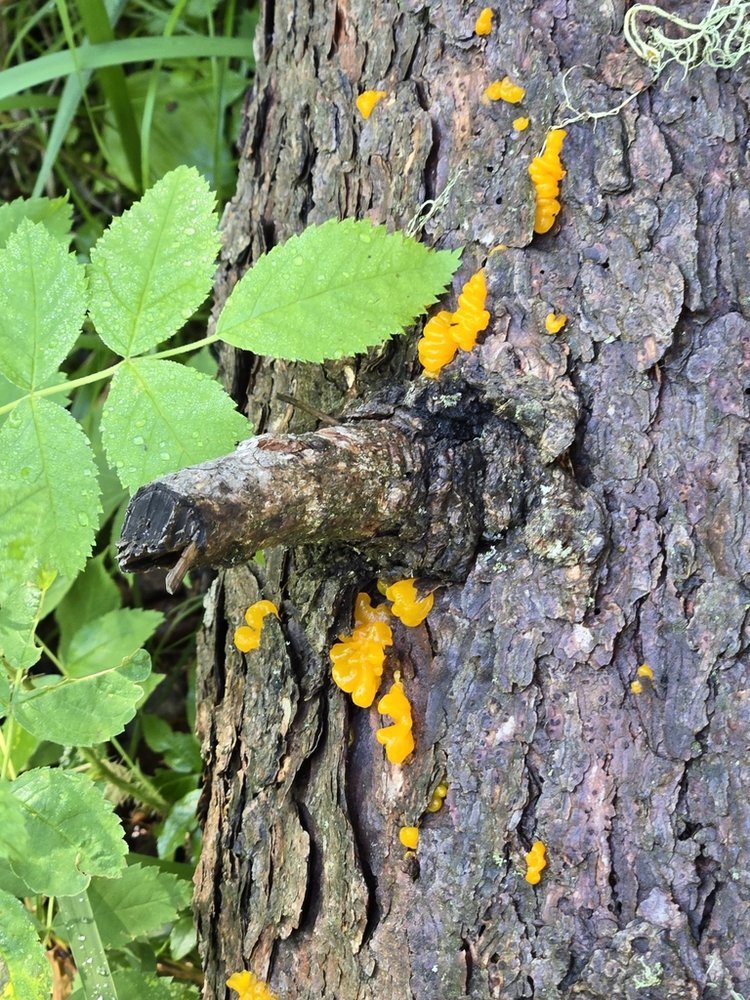
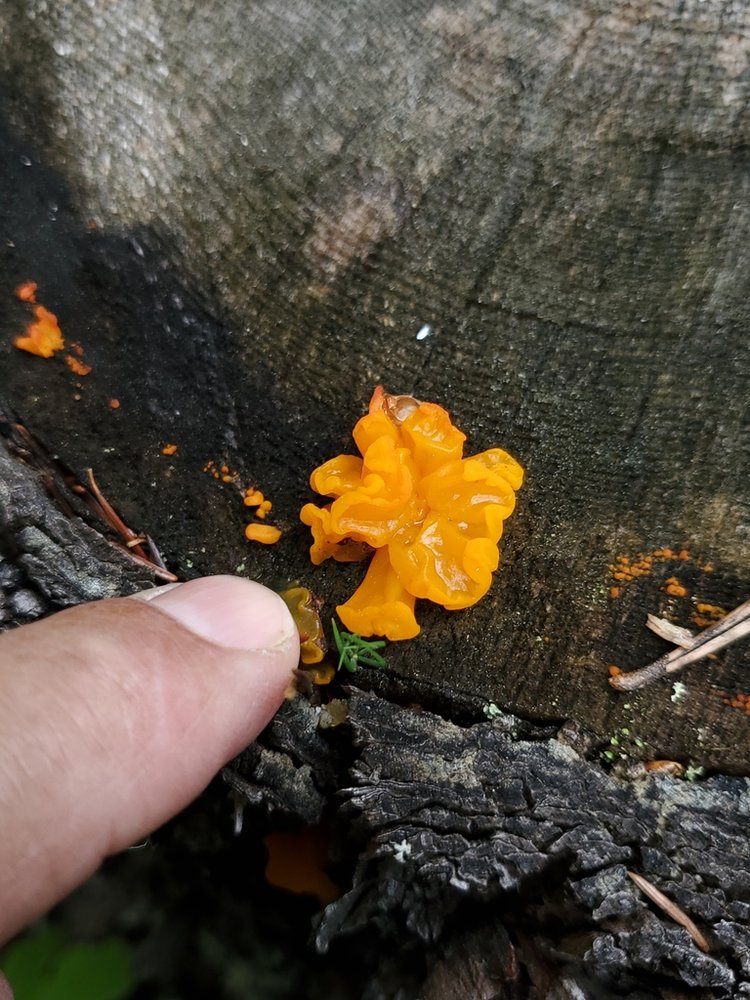
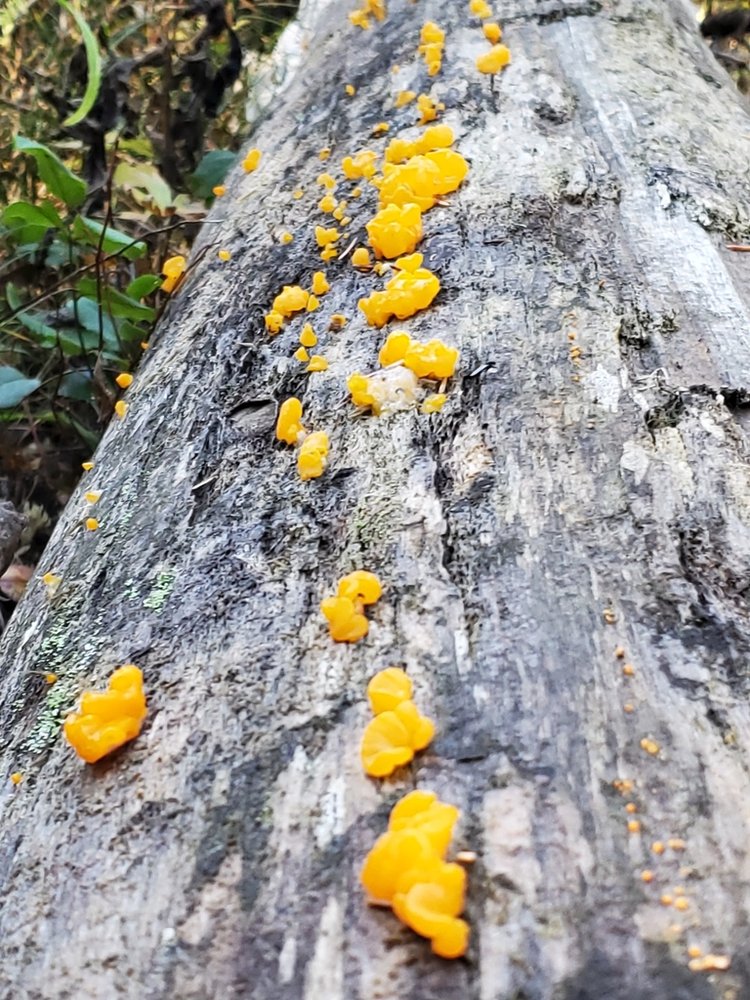
Orange Jelly Spot (Dacrymyces chrysospermus) is a jelly fungus that forms shiny, yellow-orange to orange, brain-like blobs on dead conifer wood, often bursting out of cracks in the bark. iNaturalist has 26 Black Hills records, May into October and most in July, 11 of them in Custer State Park, though only 7 are research grade.
Free photos from other sources
| Family | Dacrymycetaceae · Orange jelly fungi |
|---|---|
| Type | Jelly fungus |
| Season | May into October in Black Hills iNaturalist records, most in July; the 7 research-grade records are from July to October |
| Size | Clusters 1–6 cm (½–2½ in) wide, up to 2.5 cm (1 in) tall |
| Grows on | Dead conifer wood, bare of bark or through bark cracks |
| Spore print | Pale yellow |
| Also called | Orange Jelly, Orange Witch's Butter |
| Synonym | Dacrymyces palmatus, Tremella palmata |
| Eating | This guide doesn't say which mushrooms are safe to eat. |
How it lives
It is a saprobe, meaning it feeds on dead wood. Its class, the Dacrymycetes, are brown-rot fungi: they break down the cellulose in wood and leave the brown lignin, so the wood cracks across the grain into crumbly cubes. The jelly blobs are the fruiting bodies, where the spores form.
How do you identify Orange Jelly Spot?
Look for soft, shiny blobs of yellow-orange to orange jelly, 1–6 cm (½–2½ in) across, lobed and wrinkled like a small brain, in groups on dead conifer wood that has lost its bark, or coming out of cracks in the bark. Each blob narrows to a short base that is whitish where it attaches, a key mark you may have to pry one loose to see. Dried out, it turns reddish orange. Witch's Butter (Tremella mesenterica), which has one research-grade Black Hills record on iNaturalist, looks almost the same, but it grows on dead hardwood sticks with the bark on and has no white base. Naematelia aurantia (formerly Tremella aurantia) also grows on hardwood, often straight out of the Stereum crust fungus it lives on. A smaller relative, Dacrymyces stillatus, makes yellow-orange blobs usually under 1 cm (⅜ in) across.
When can you find it?
May into October in Black Hills iNaturalist records, most in July; the 7 research-grade records are from July to October.
Where does it grow?
Decaying conifer wood that has lost its bark, or dead wood where it pushes out through bark cracks; it was first described from tree stumps. iNaturalist has 26 Black Hills records from 2019 to 2026, 7 of them research grade, from the northern Hills to Custer County, with 11 in Custer State Park. No museum specimen from South Dakota or Wyoming turned up, and the 1991 Forest Service list of fungi on Black Hills pines doesn't name it, though it lists its smaller relative Dacrymyces stillatus on dead wood in the Wind Cave area.
Sources: Dacrymyces chrysospermus (G. Emberger, Fungi Growing on Wood) — Messiah University, on MushroomExpert.com; California Fungi: Dacrymyces chrysospermus — MykoWeb; Tremella mesenterica (M. Kuo) — MushroomExpert.com; Dacrymyces stillatus (M. Kuo) — MushroomExpert.com; Fungi Associated with Pines in the Black Hills (Lundquist 1991) — USDA Forest Service, on Internet Archive; Taxonomic study of the Japanese Dacrymycetes (Shirouzu et al. 2009, Persoonia) — Naturalis; Stem Decays, Forester Forum No. 12 (2014) — Idaho Department of Lands; Dacrymyces chrysospermus, record 141916 (holotype on tree stumps, New England) — Index Fungorum; Name search: Dacrymyces palmatus, current name Dacrymyces chrysospermus — Index Fungorum; Name search: Tremella aurantia, current name Naematelia aurantia — Index Fungorum; Dacrymyces chrysospermus in the Black Hills — iNaturalist; Dacrymyces chrysospermus, Black Hills records by month — iNaturalist; Tremella mesenterica in the Black Hills — iNaturalist; Dacrymyces chrysospermus records in South Dakota (all from iNaturalist, no specimens) — GBIF.