Mountain False Morel
Maublancomyces montanus
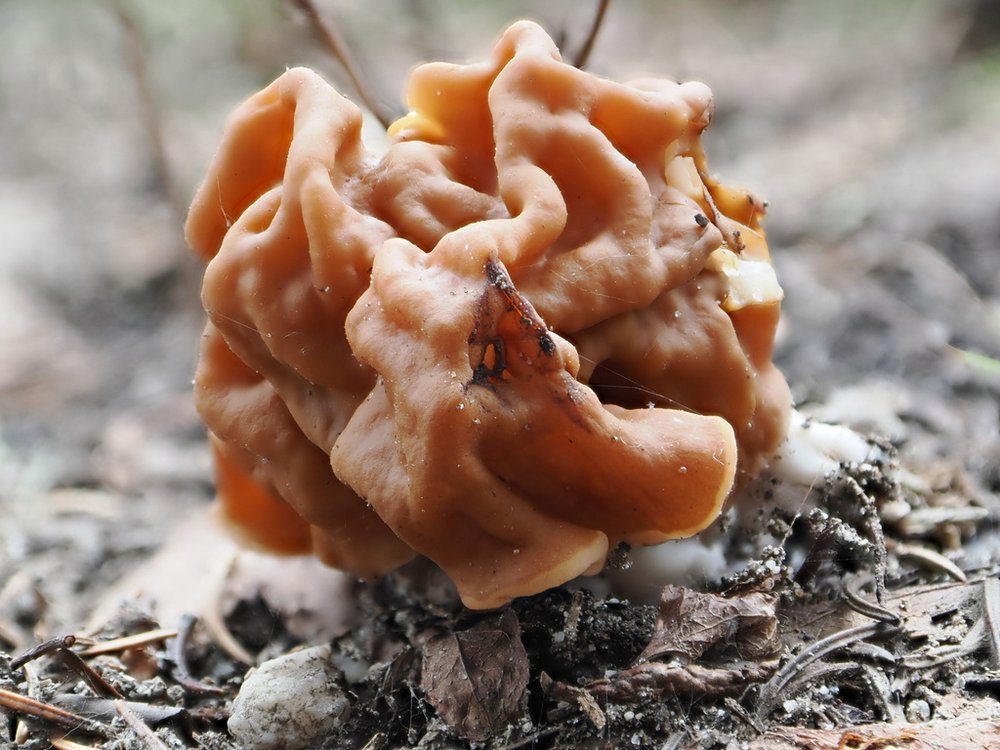
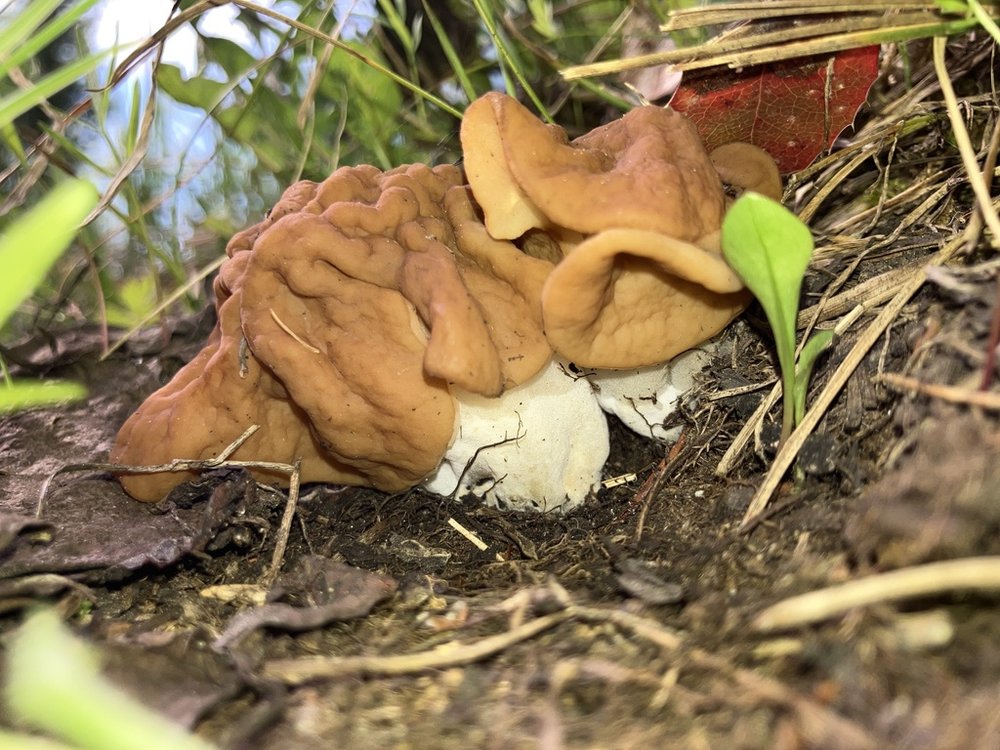
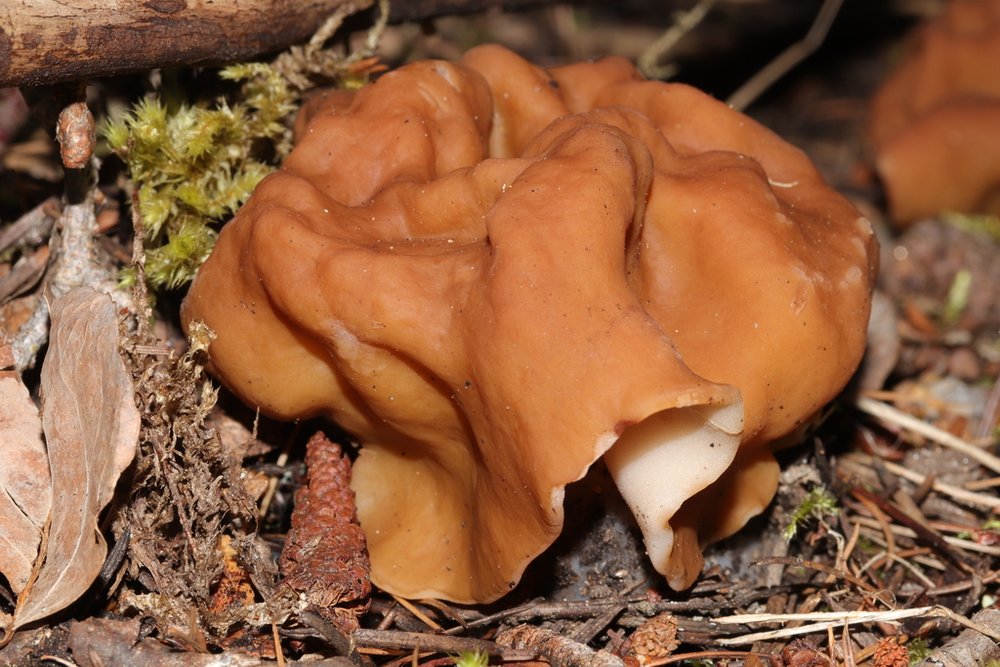
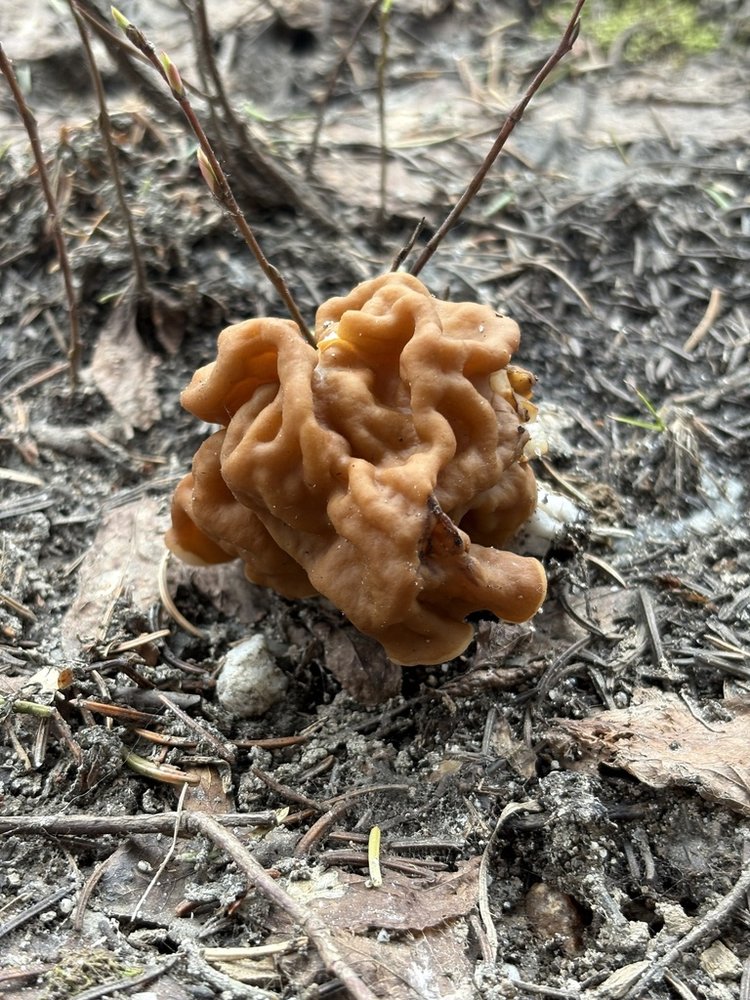
Mountain False Morel (Maublancomyces montanus) is a spring mushroom with a tan to golden brown, wrinkled and lobed cap sitting tight on a thick white stem. iNaturalist has two Black Hills records, both from May in Lawrence County in the northern Hills, the same weeks as black morels there.
Free photos from other sources
| Family | Discinaceae · False morel |
|---|---|
| Type | False morel |
| Season | May, sometimes into June |
| Size | Cap 2–9 cm (¾–3½ in) wide, stem 2–6 cm (¾–2½ in) thick |
| Grows on | Soil under conifers, often near melting snow |
| Also called | Mountain Lorchel |
| Synonym | Gyromitra montana, Discina montana |
| Toxicity | It has caused poisonings in North America, with stomach upset, and the toxin behind them isn't known. |
| Eating | This guide doesn't say which mushrooms are safe to eat. |
How it lives
Officially a saprobe, feeding on dead plant matter, but it may also be mycorrhizal (trading nutrients with tree roots), as true morels seem to be.
How do you identify Mountain False Morel?
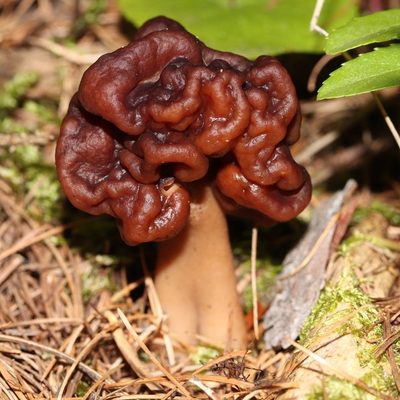
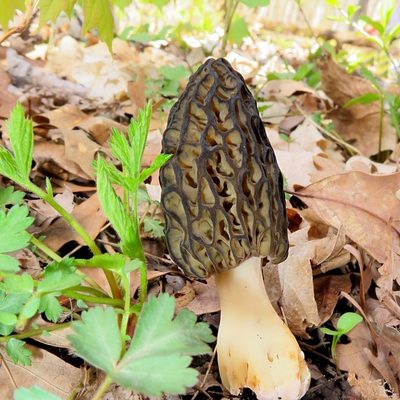
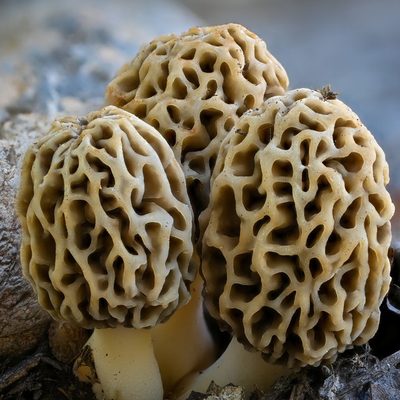
The cap is 2–9 cm (¾–3½ in) wide and up to 14 cm (5½ in) high, compact and set tight against the stem, loosely wrinkled or somewhat lobed, tan to yellow-brown and only rarely reddish. Its underside is whitish to tan. The stem is the giveaway: massive, 2–6 cm (¾–2½ in) wide, white to pale tan, sometimes with broad ribs. Inside, the flesh is whitish, brittle and chambered, not one open tube. False Morel has a reddish brown, brain-like cap on a slimmer stem. Black Morel and Yellow Morel have pitted and ridged caps fused to the stem along their whole length, and are hollow from top to bottom when cut lengthwise.
When can you find it?
May, sometimes into June.
Where does it grow?
On the ground under conifers in spring, often near melting snowbanks; Kuo gives its range as the Rocky Mountains westward and found it at the base of dead Engelmann spruce high in the Rockies. In the Black Hills, iNaturalist has two research-grade records, both from May 2020 in Lawrence County in the northern Hills. No published Black Hills source names it.
Other mushrooms to compare
Sources: Gyromitra montana (Gyromitra gigas) — MushroomExpert.com (Michael Kuo); Gyromitra: The False Morels, with key — MushroomExpert.com (Michael Kuo); Gyromitra esculenta — MushroomExpert.com (Michael Kuo); The Morchellaceae: True Morels and Verpas, with key — MushroomExpert.com (Michael Kuo); Morchella angusticeps — MushroomExpert.com (Michael Kuo); Mushroom Poisoning Syndromes — North American Mycological Association; Dirks et al. 2023, Gyromitrin has a limited distribution in the false morels — Mycologia 115(1) (University of Michigan copy); Wang et al. 2023, Phylogeny and Taxonomic Revision of the Family Discinaceae — Microbiology Spectrum 11(3); NCBI Taxonomy record: Maublancomyces montanus, basionym Gyromitra montana — National Center for Biotechnology Information; Gyromitra esculenta, the false morel: Fungus of the Month, May 2002 — Tom Volk, University of Wisconsin-La Crosse; iNaturalist: Maublancomyces montanus records in the Black Hills places (API query); iNaturalist: research-grade records by month within 500 km of the Black Hills, taxon 1613046 (API query); Species Fungorum: Gyromitra montana, a synonym of Maublancomyces montanus — Royal Botanic Gardens, Kew; Species Fungorum: Discina montana, a synonym of Maublancomyces montanus — Royal Botanic Gardens, Kew.