Wild Sarsaparilla
Aralia nudicaulis
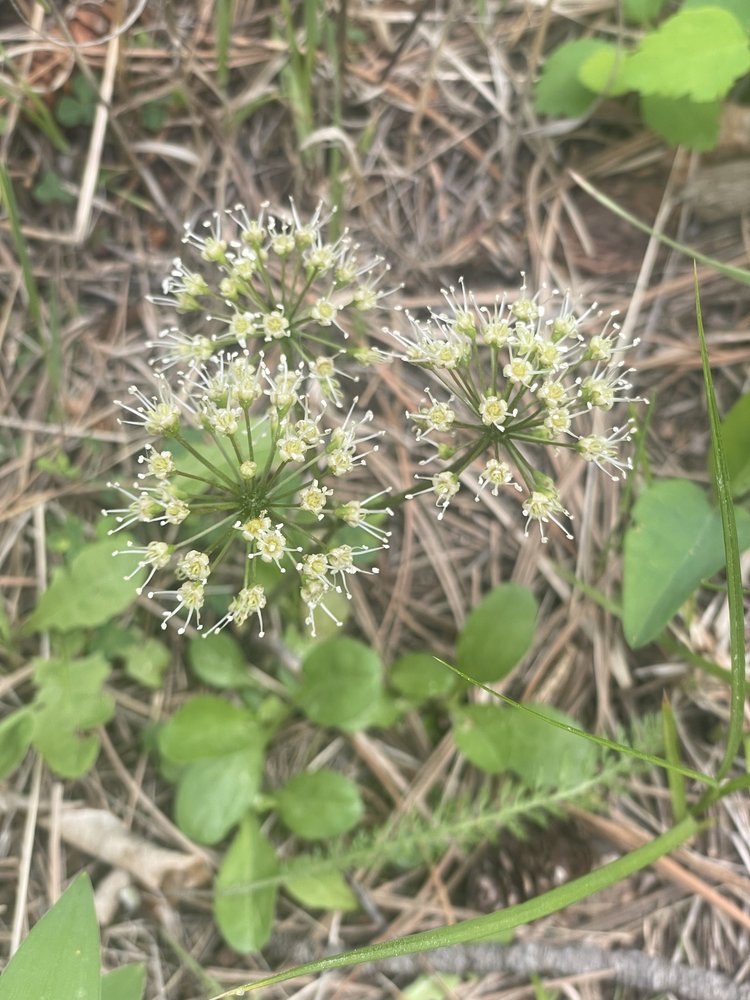
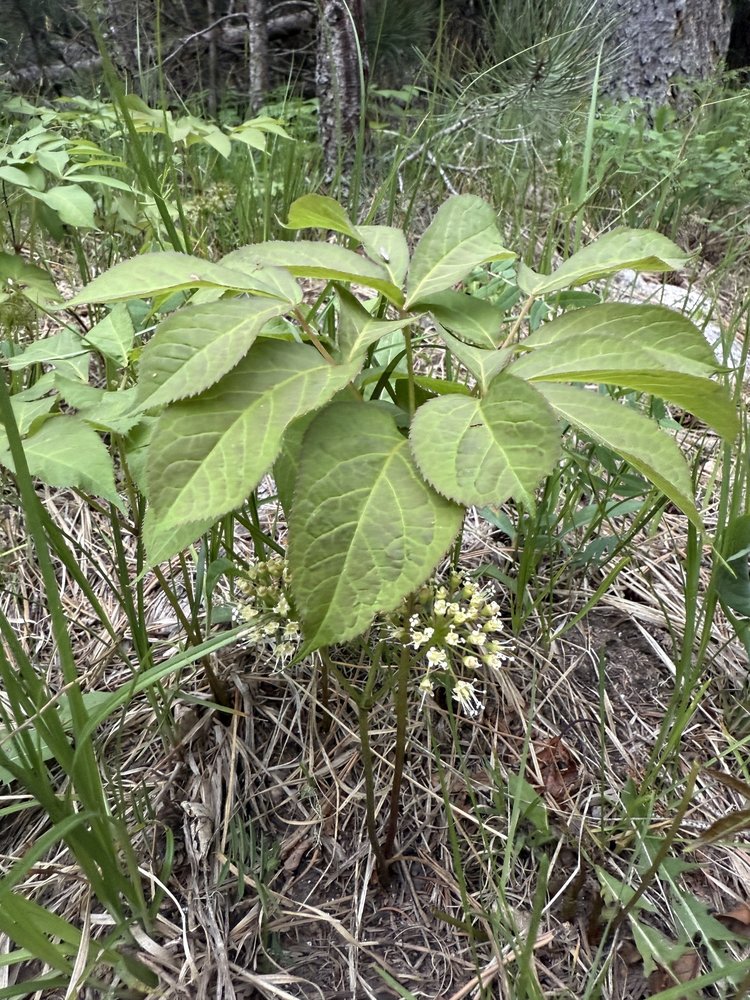
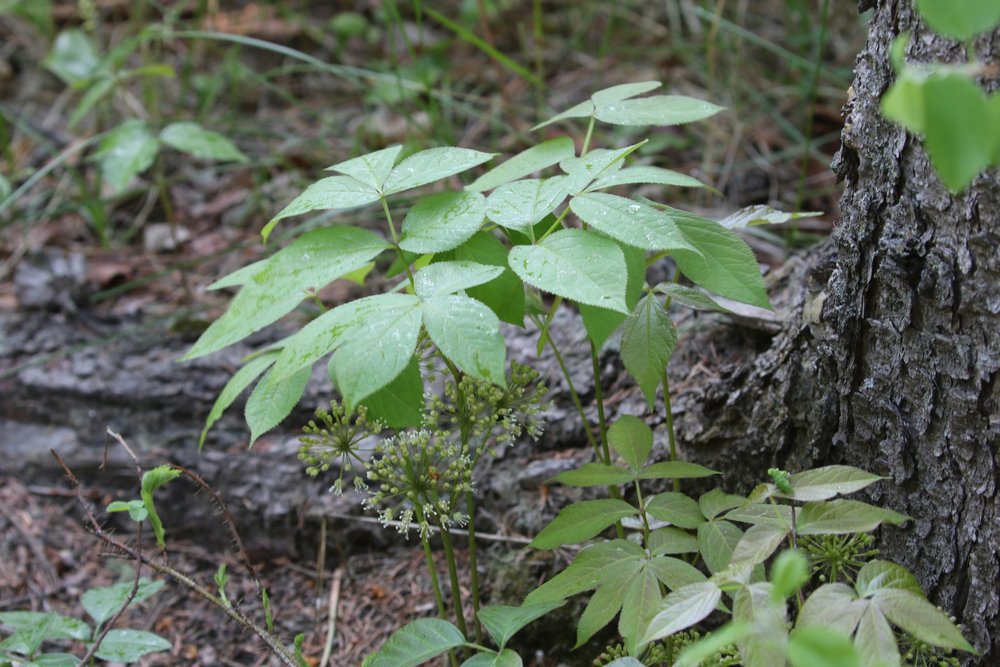
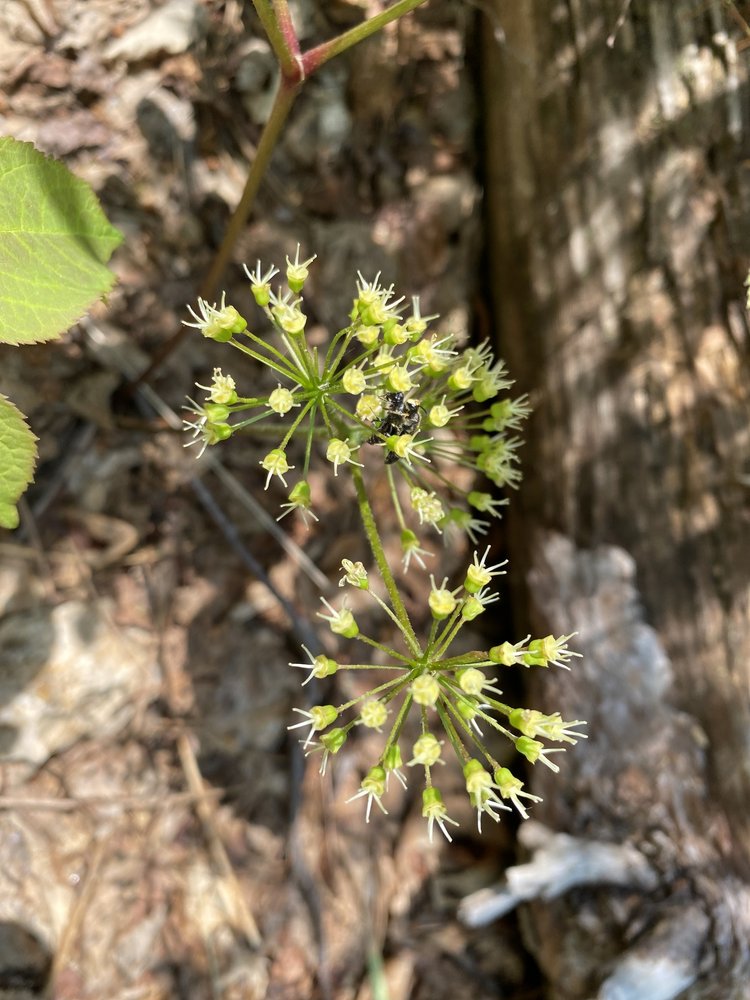
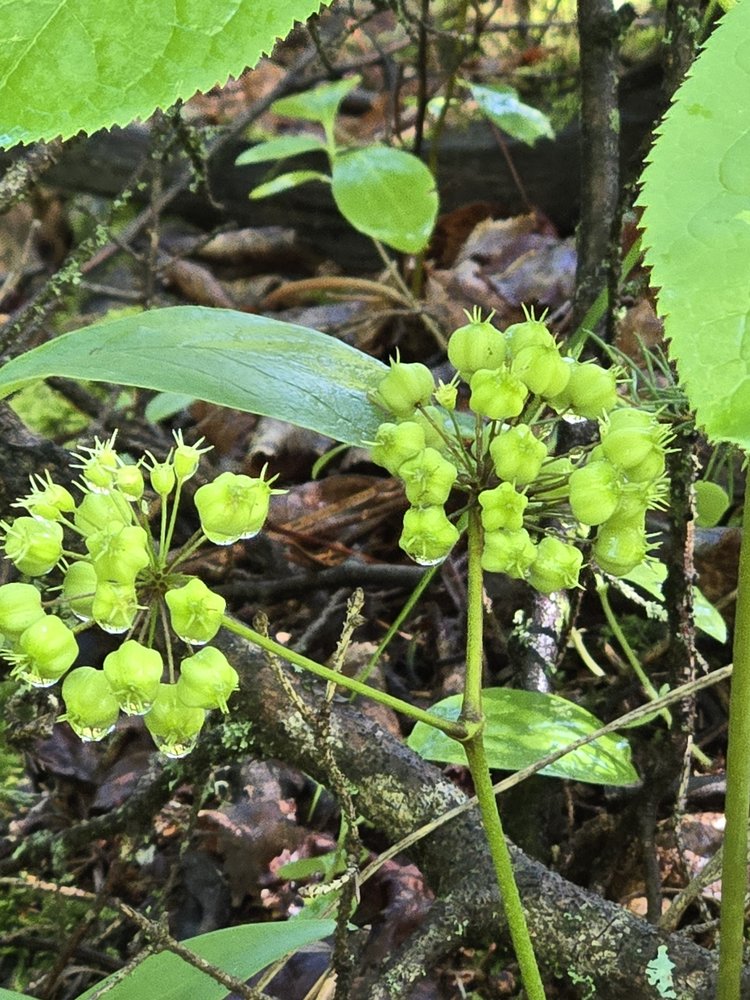
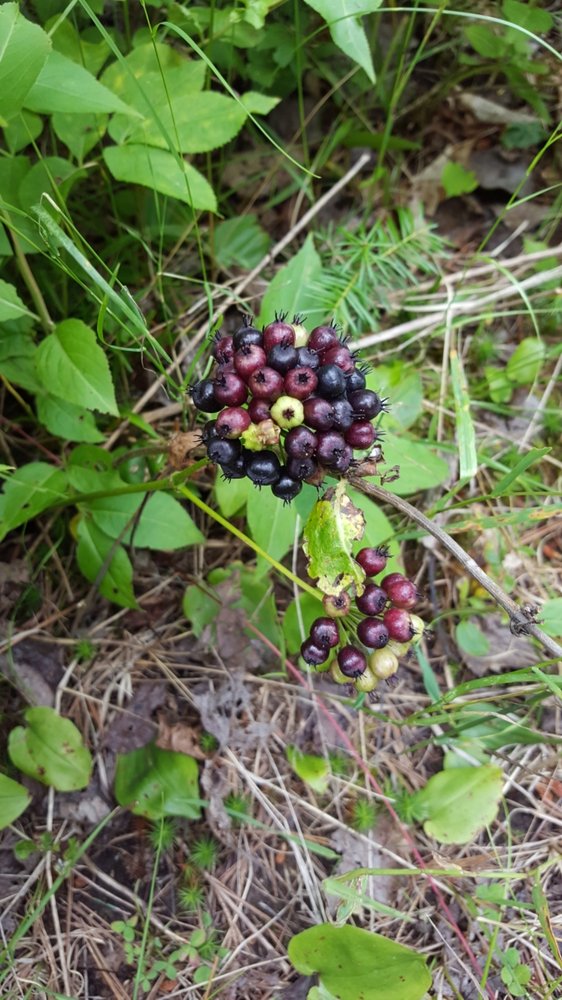
Wild Sarsaparilla (Aralia nudicaulis) is a native perennial of the ginseng family that sends up a single umbrella-like compound leaf, with round balls of small greenish-white flowers hidden underneath on a separate leafless stalk. It blooms in late May and June in shaded aspen, birch, spruce and moist pine woods of the Black Hills, and the flowers turn into purple-black berries by mid to late summer.
Free photos from other sources
| Family | Araliaceae · Ginseng |
|---|---|
| Status | Native perennial |
| Blooms | Late May through June, a few into early July |
| Height | 20–60 cm (8–24 in) |
| Where | Shaded aspen, birch, spruce and moist pine woods and cool stream bottoms |
| Also called | False Sarsaparilla, Shot Bush, Small Spikenard, Rabbit Root |
| Synonym | Aralia nudicaulis var. elongata, Aralia nudicaulis var. prolifera |
| Listed | NatureServe ranks it vulnerable (S3) in Wyoming; South Dakota does not rank it. |
| Traditional use | An ethnobotany database kept by the Botanical Research Institute of Texas records that the Woods Cree put a poultice of chewed root on wounds (Leighton 1985), and that the Chippewa put mashed fresh root on sores and took the root as a remedy for the blood (Densmore 1928). |
Roots, seeds & germination
Root: A long, creeping, aromatic rhizome about 3–12 cm (1–5 in) deep that branches and sends up new shoots up to 1 m (3 ft) from the parent, so one plant becomes a large patch. It survives fire and resprouts, and it was once used to flavor root beer and as a stand-in for true sarsaparilla, which comes from tropical Smilax vines.
Seed: Each berry is a round purple-black drupe 6–10 mm (¼–⅜ in) across, usually holding about five small, flattened seeds, ripe about a month after flowering. Birds such as thrushes, and black bears, eat the berries and spread the seeds.
Germination: Seeds are dormant and need cold, so fall sowing outdoors usually works best. Germination is low even after stratification, about 34 percent in one study, and most new plants in the wild come from the rhizome, which is also the easy way to propagate it.
How do you identify Wild Sarsaparilla?
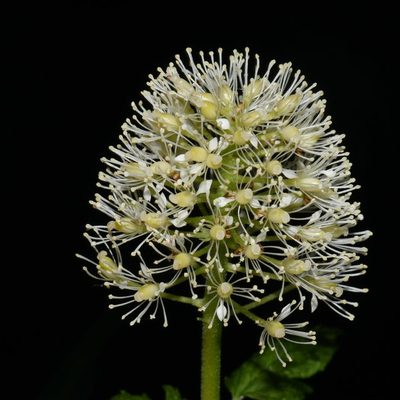
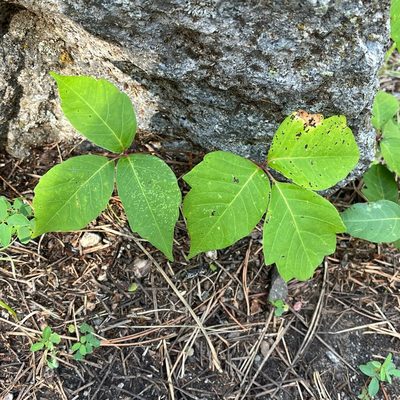
Look in shady woods for a single leaf on a bare stalk 20–60 cm (8–24 in) tall that splits at the top into three branches, each with 3–5 finely toothed, oval, sharp-tipped leaflets, so the leaf spreads flat like an umbrella. Underneath, a separate leafless stalk carries usually three round balls of tiny greenish-white flowers, each ball 2.5–5 cm (1–2 in) across, which ripen to purple-black berries. Western Poison Ivy always has exactly three leaflets per leaf, smooth-edged or coarsely toothed, and Red Baneberry carries its flowers and red or white berries on top of a leafy, branched stem.
When does it bloom?
Late May through June, a few into early July.
Where does it grow?
Shaded, moist to fairly dry forest: aspen and paper birch stands, white spruce and mixed spruce-pine woods, cool stream bottoms and the shadier parts of ponderosa pine forest, usually in rich, leafy soil. The Forest Service's habitat-type study of the Black Hills National Forest (Hoffman and Alexander 1987) describes an aspen and beaked hazelnut type with a Wild Sarsaparilla phase. Herbarium specimens come from Lawrence, Pennington, Custer and Meade counties and Crook County, Wyoming, and the National Park Service lists it at Wind Cave and Mount Rushmore.
Other flowers to compare
Sources: Reese, R.N. Araliaceae: Aralia nudicaulis. SDSU Open PRAIRIE, South Dakota Native Plant Research; Pavek, D.S. 1993. Aralia nudicaulis. USDA Forest Service Fire Effects Information System (FEIS); Li, J.C. 2016. Plant Propagation Protocol for Aralia nudicaulis. University of Washington ESRM 412; Minnesota Wildflowers: Wild Sarsaparilla; Illinois Wildflowers: Wild Sarsaparilla; Manitoba Agriculture: Wild Sarsaparilla; USDA PLANTS Database, Aralia nudicaulis (ARNU2) (read through the PLANTS API); GBIF herbarium specimens of Aralia nudicaulis in the Black Hills (lat 43.3-44.85, lon -104.75 to -103.0); GBIF species page and synonym list, Aralia nudicaulis; NPSpecies checklist, Wind Cave National Park vascular plants; NPSpecies checklist, Mount Rushmore National Memorial vascular plants; NPSpecies checklist, Jewel Cave National Monument vascular plants (Aralia not listed); NPSpecies checklist, Devils Tower National Monument vascular plants (Aralia not listed); A Survey of the Vegetation of Jewel Cave National Monument (Marriott & Hartman 1986) (Aralia not listed); Hoffman, G.R. & R.R. Alexander 1987. Forest Vegetation of the Black Hills National Forest of South Dakota and Wyoming: A Habitat Type Classification (USDA Forest Service Res. Paper RM-276); Shepperd, W.D. & M.A. Battaglia 2002. Ecology, Silviculture, and Management of Black Hills Ponderosa Pine. USDA Forest Service RMRS-GTR-97; USDA Forest Service 2023. Black Hills National Forest Revised Forest Assessment: Ecological Integrity of Forested Ecosystems; USDA Forest Service FEIS: Actaea rubra (red baneberry); Native American Ethnobotany Database (BRIT): Aralia nudicaulis uses; Black Elk, L. & W. Flying By. 1998. Culturally Important Plants of the Lakota, Sitting Bull College (Aralia not included); NatureServe Explorer: Aralia nudicaulis (state ranks); Wikipedia: Aralia nudicaulis (other common names); iNaturalist observations of Aralia nudicaulis within 80 km of the central Black Hills.