Spotted Jewelweed Impatiens capensis
Also called Jewelweed, Orange Jewelweed, Spotted Touch-me-not
Spotted Jewelweed (Impatiens capensis) is a native annual of wet, shady ground that grows 50–150 cm (20–59 in) tall on weak, hollow, watery stems and hangs out orange, red-spotted, cone-shaped flowers with a curled spur from July into September. Its ripe seed pods burst at a touch, which earned it the name touch-me-not. In the Black Hills it has been collected along creeks and ditches in Lawrence County and in Custer State Park, and iNaturalist has recent records from Pennington, Lawrence and Custer counties.
Free photos from other sources
| Family | Balsaminaceae · Touch-me-not |
|---|---|
| Status | Native annual |
| Blooms | July into September; SDSU gives May to October for South Dakota, and Black Hills herbarium specimens were in flower in August and September |
| Height | 50–150 cm (20–59 in) |
| Where | Creek banks, seeps, wet ditches, marsh and pond edges and moist woods, in shade or part sun |
| Also called | Jewelweed, Orange Jewelweed, Spotted Touch-me-not |
| Synonym | Impatiens biflora, Impatiens fulva, Impatiens nortonii |
| Toxicity | Toxic to livestock when eaten in large quantities. |
| Traditional use | Gilmore recorded in 1919 that the Omaha put a poultice of the crushed stems and leaves on rashes and eczema. |
Roots, seeds & germination
Seed: A slender, club-shaped capsule about 2 cm (¾ in) long with five cells. When ripe it splits into five strips that coil back and fling the seeds, and the lightest touch sets it off. The seeds are 4–5 mm long, oblong, slightly flattened and mottled green to dark brown. SDSU gives June to October for collecting seed in South Dakota.
Germination: The seed needs no pretreatment. Sow fresh seed in early fall in rich, moist soil in shade or part sun; seedlings come up in early spring and reach full size by August. The plant reseeds itself and can form dense stands.
How do you identify Spotted Jewelweed?
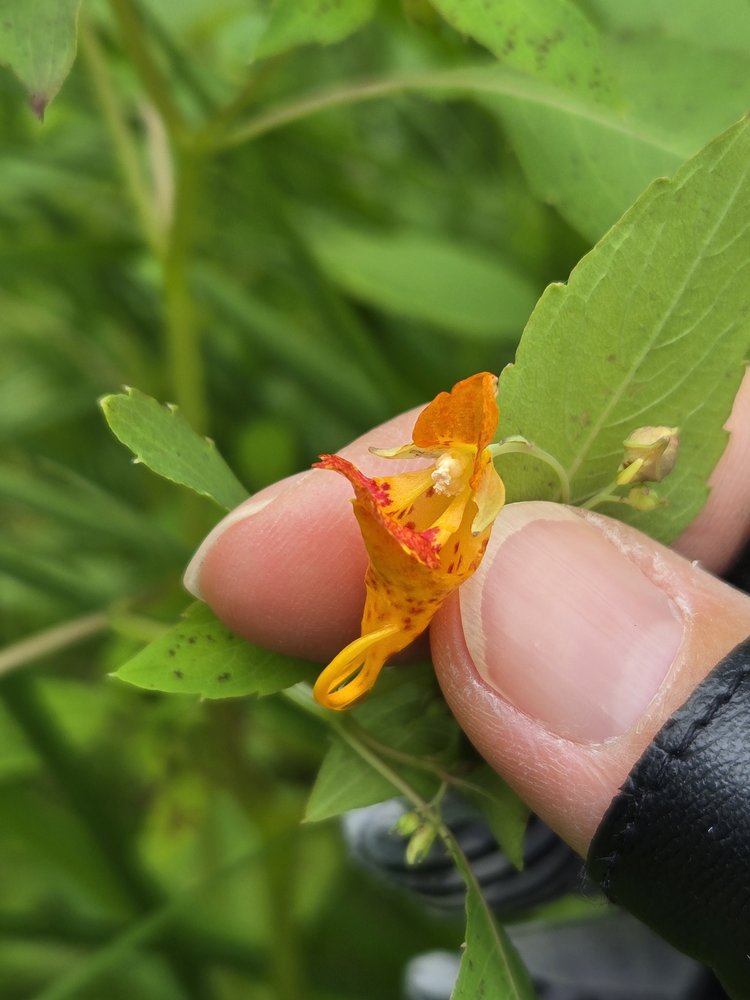
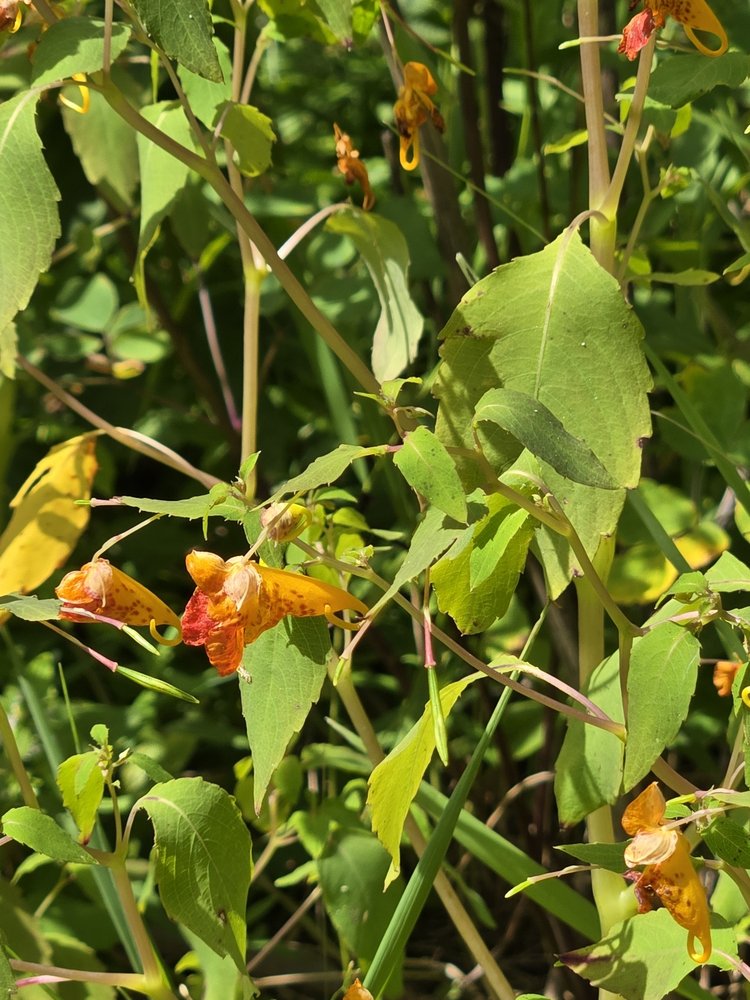
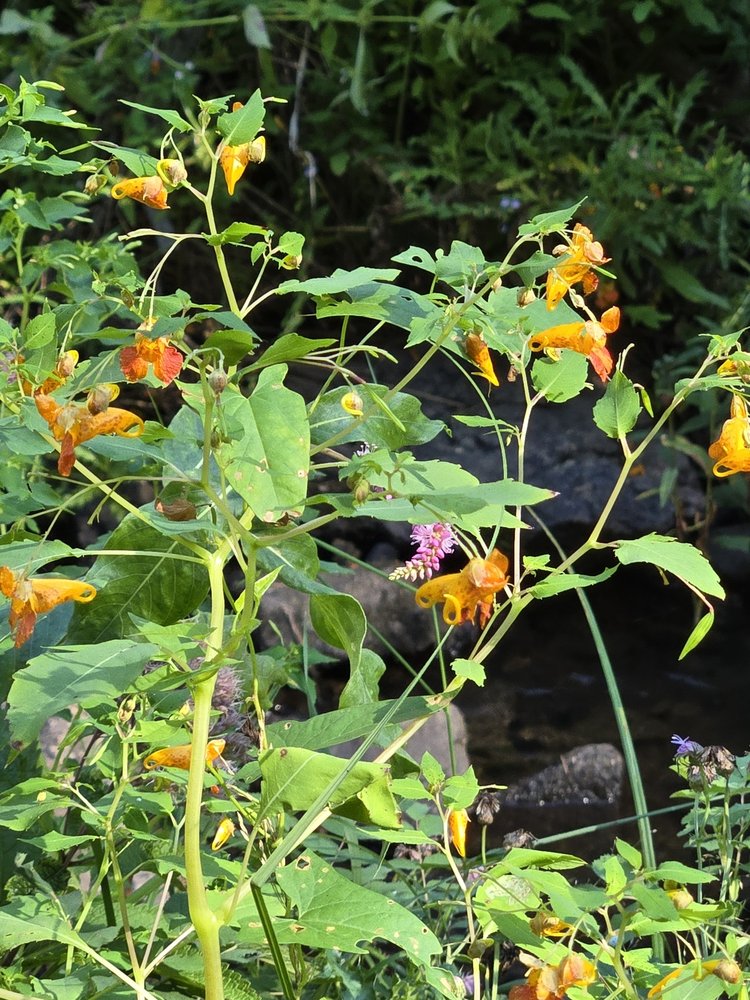
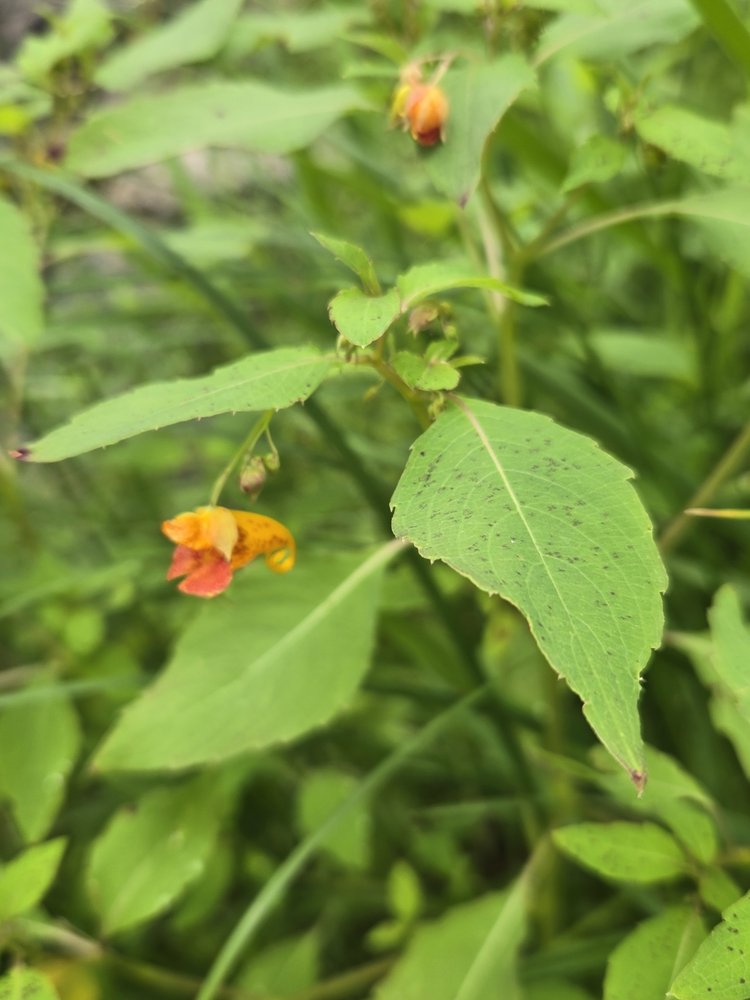
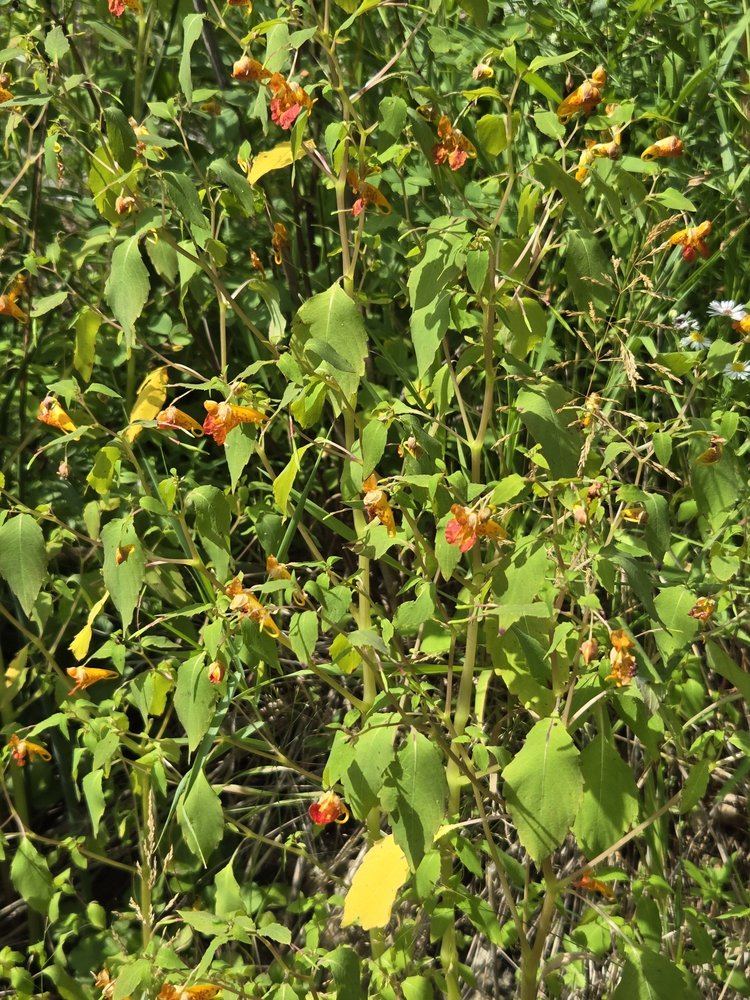
The flowers give it away: orange, sometimes red, speckled with crimson, cone-shaped and 2–3 cm (about 1 in) long, hanging on thin stalks in ones, twos or threes from the leaf axils, each with a spur 6–9 mm long that curls back under the flower. The stems are weak, hollow, smooth and succulent, pale green and almost see-through, with swollen joints. The leaves are alternate, stalked, oval, 3–10 cm (1–4 in) long, thin and hairless, with widely spaced blunt teeth and a pale, waxy underside. Ripe pods are slender, about 2 cm long, and split and coil at a touch, throwing the seeds. Pale Touch-me-not (Impatiens pallida) is a larger plant with larger yellow flowers and a shorter spur; it is on none of the four Black Hills park plant lists.
When does it bloom?
July into September; SDSU gives May to October for South Dakota, and Black Hills herbarium specimens were in flower in August and September.
Where does it grow?
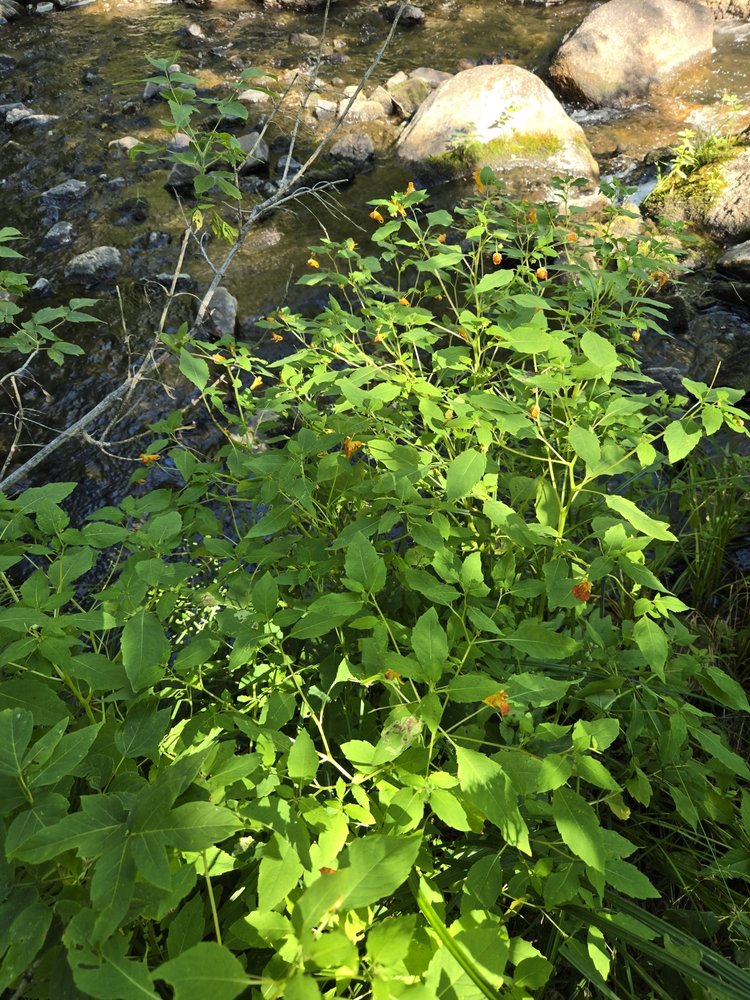
Wet, shaded ground: creek banks, seeps, wet ditches, marsh and pond edges and moist woods, where it often grows in dense stands. In the Black Hills, herbarium specimens from 1925 to 2008 come from Lawrence County and Custer State Park; their labels describe a moist, shaded gulch, a shady creek bed, a streambank in open deciduous woods, wet soil at a creek edge and muck along an irrigation ditch. iNaturalist has 23 research-grade Black Hills records, August and September, in Pennington, Lawrence and Custer counties. It is on none of the plant lists for Wind Cave, Jewel Cave, Mount Rushmore or Devils Tower.
Sources: Balsaminaceae: Impatiens capensis (R. Neil Reese) — SDSU Open PRAIRIE; Impatiens capensis (Spotted Touch-me-not) — Minnesota Wildflowers; Impatiens capensis, Spotted touch-me-not — Kansas Wildflowers and Grasses; Plant of the Week: Jewelweed (Kent Karriker) — USDA Forest Service; Impatiens capensis — Lady Bird Johnson Wildflower Center; Impatiens capensis Meerb., TSN 29182 — ITIS; Occurrence search: Impatiens capensis, South Dakota herbarium specimens — GBIF; NPSpecies checklist, Wind Cave National Park vascular plants (not listed) — National Park Service; NPSpecies checklist, Jewel Cave National Monument vascular plants (not listed) — National Park Service; NPSpecies checklist, Mount Rushmore National Memorial vascular plants (not listed) — National Park Service; NPSpecies checklist, Devils Tower National Monument vascular plants (not listed) — National Park Service; Research-grade Impatiens capensis observations in the Black Hills — iNaturalist; Impatiens capensis — Native American Ethnobotany Database (BRIT).