Rock Jasmine Androsace occidentalis
Also called Western Rock Jasmine, Western Androsace
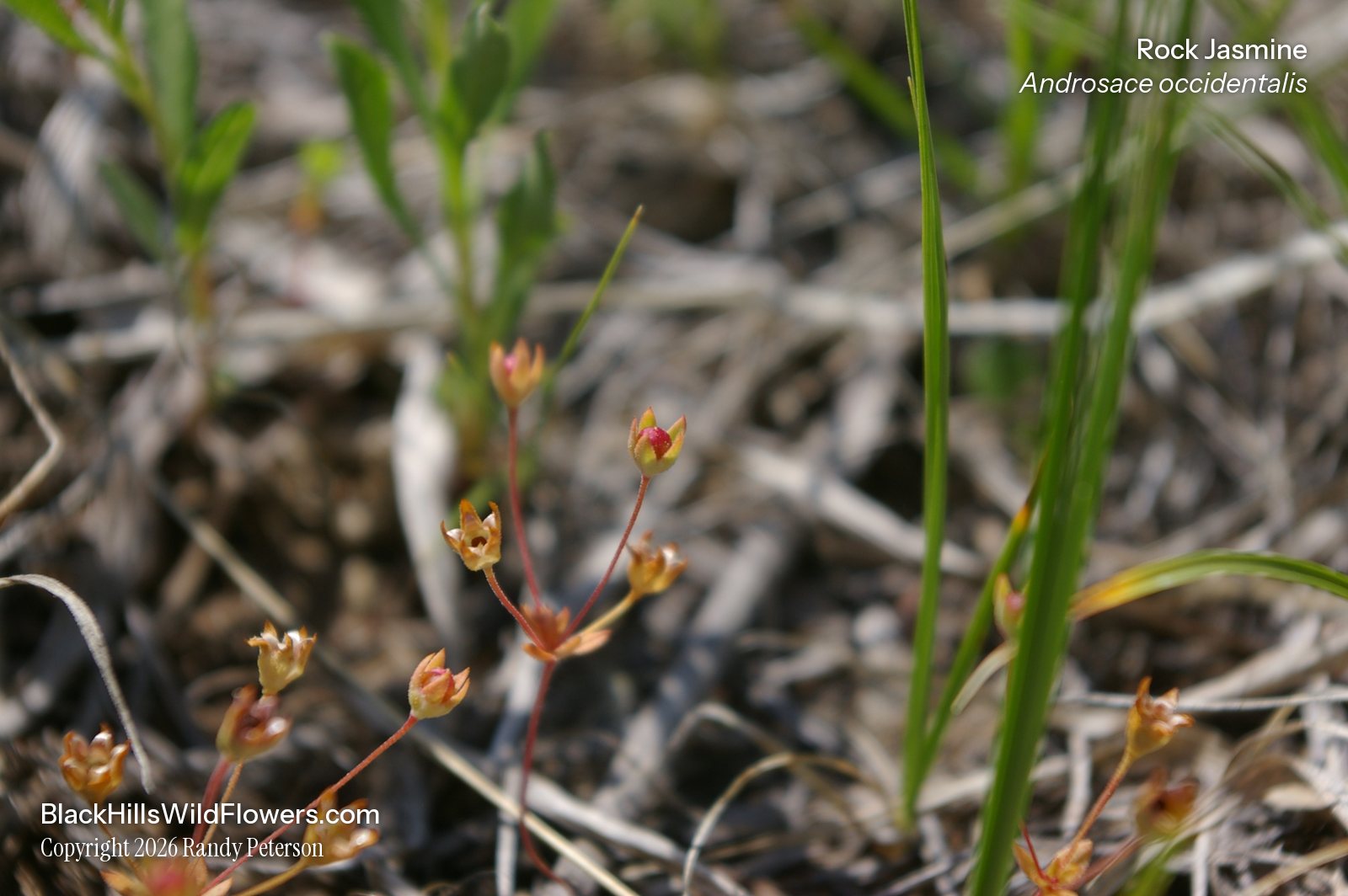
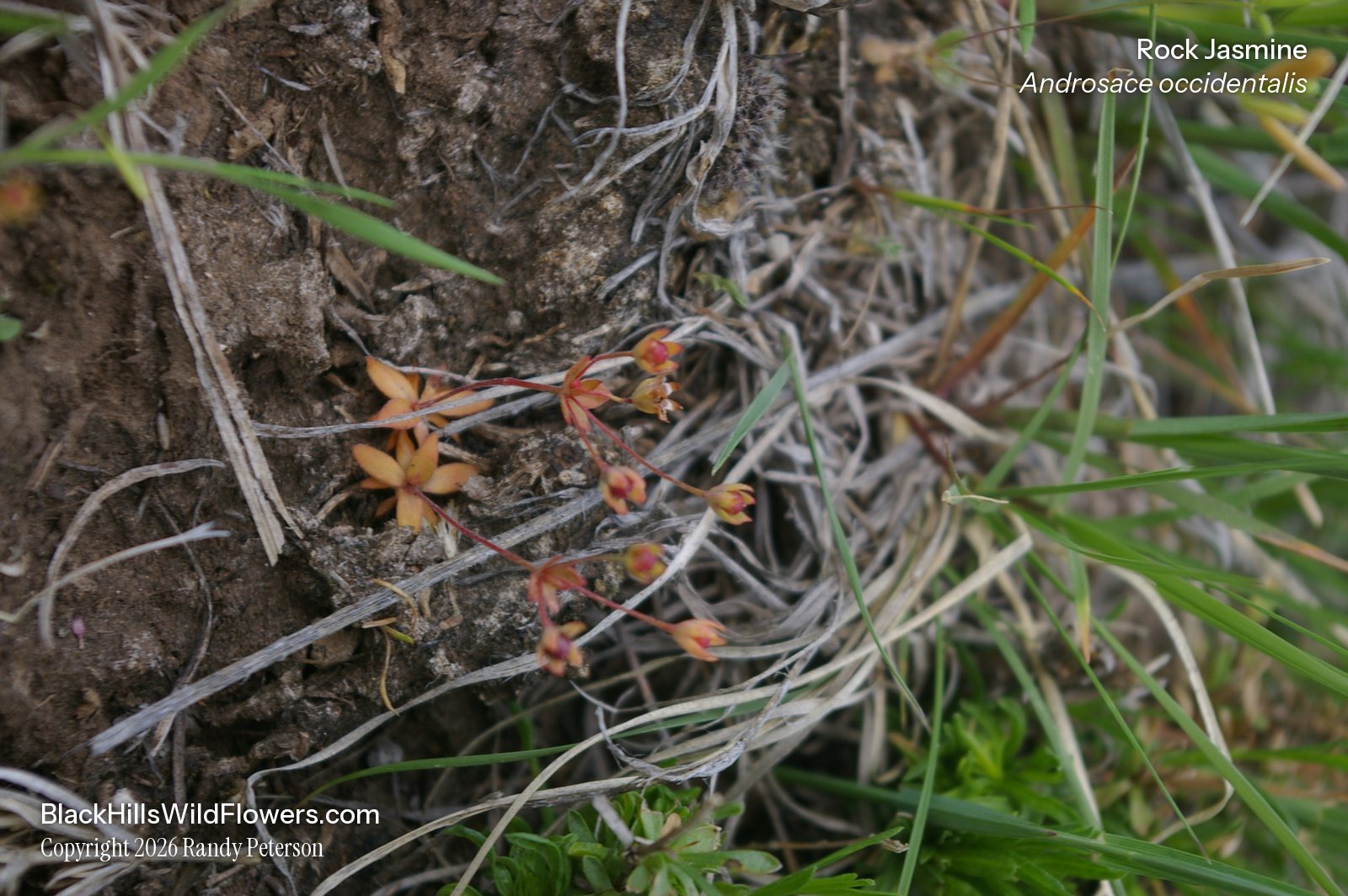
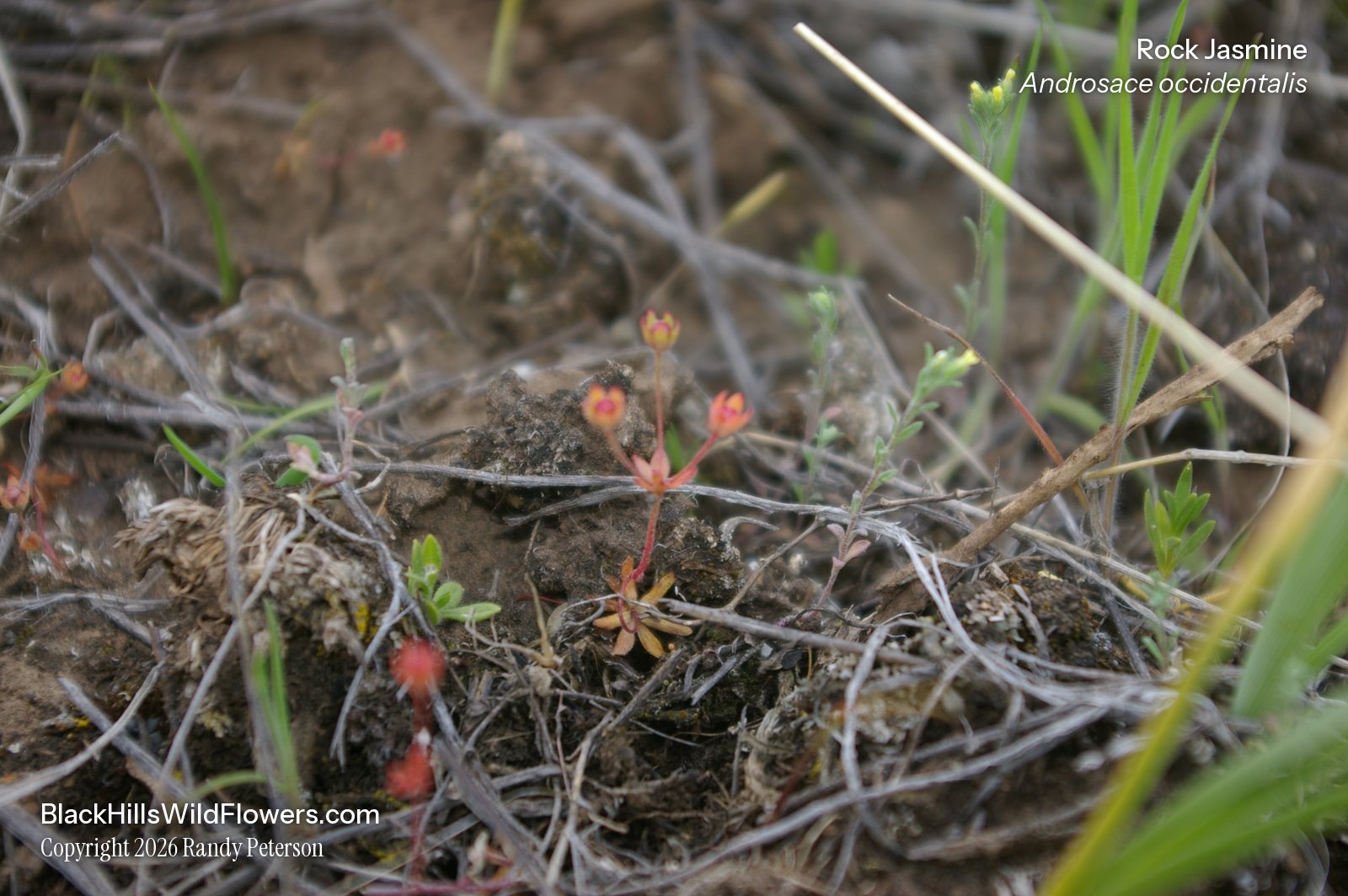
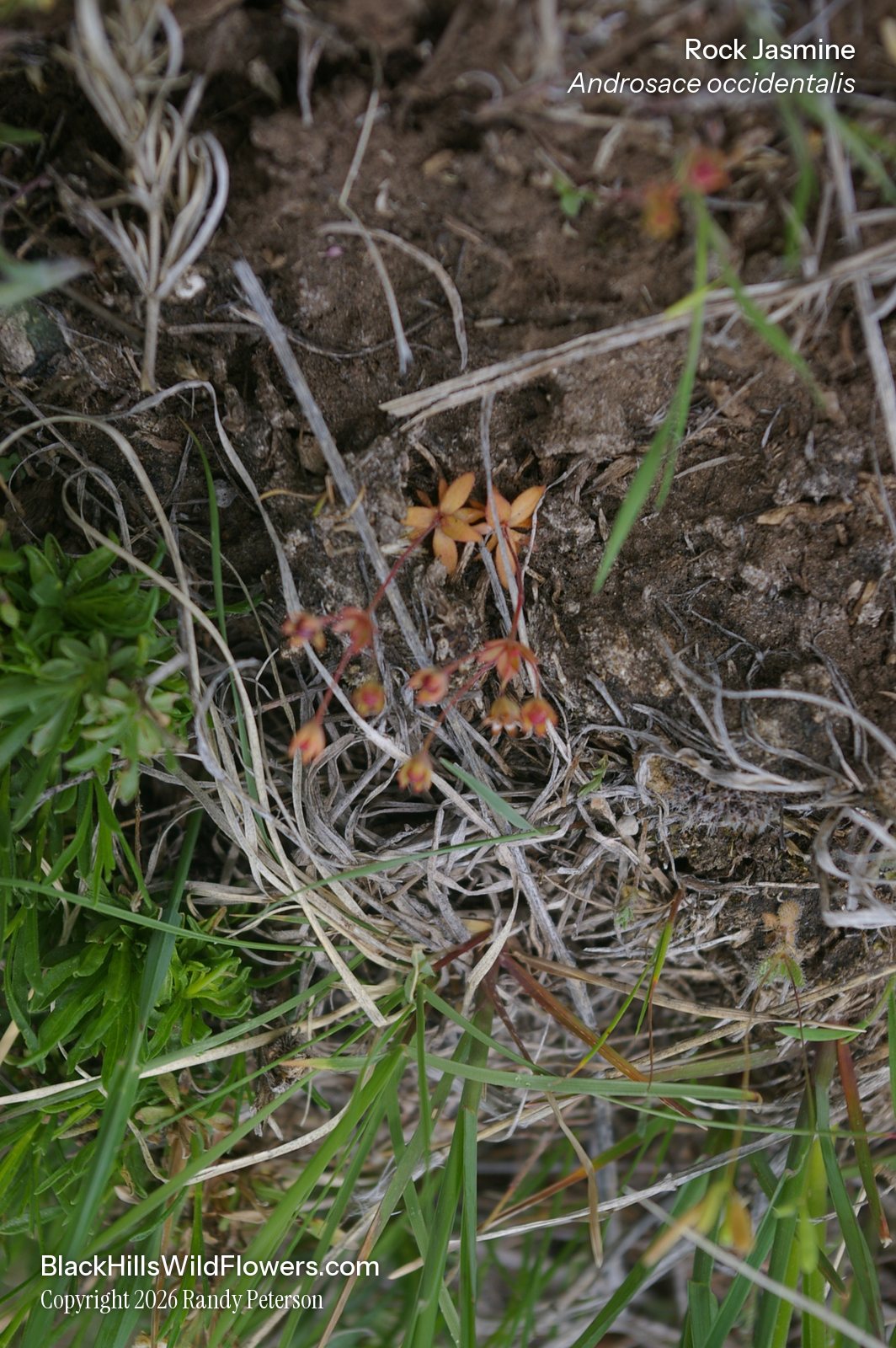
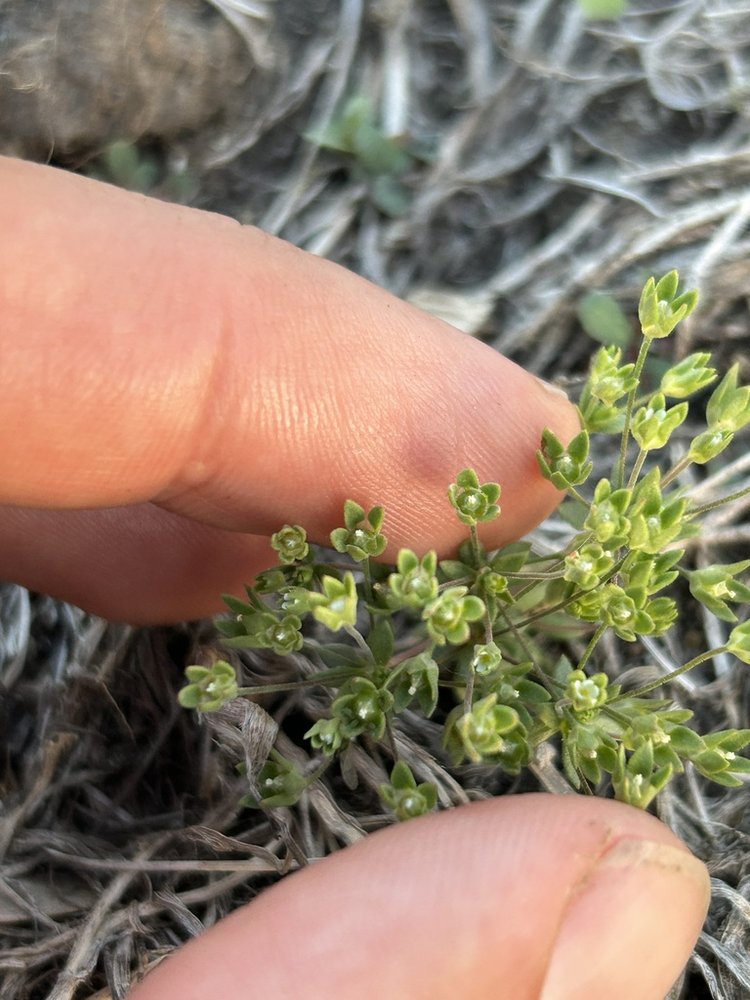
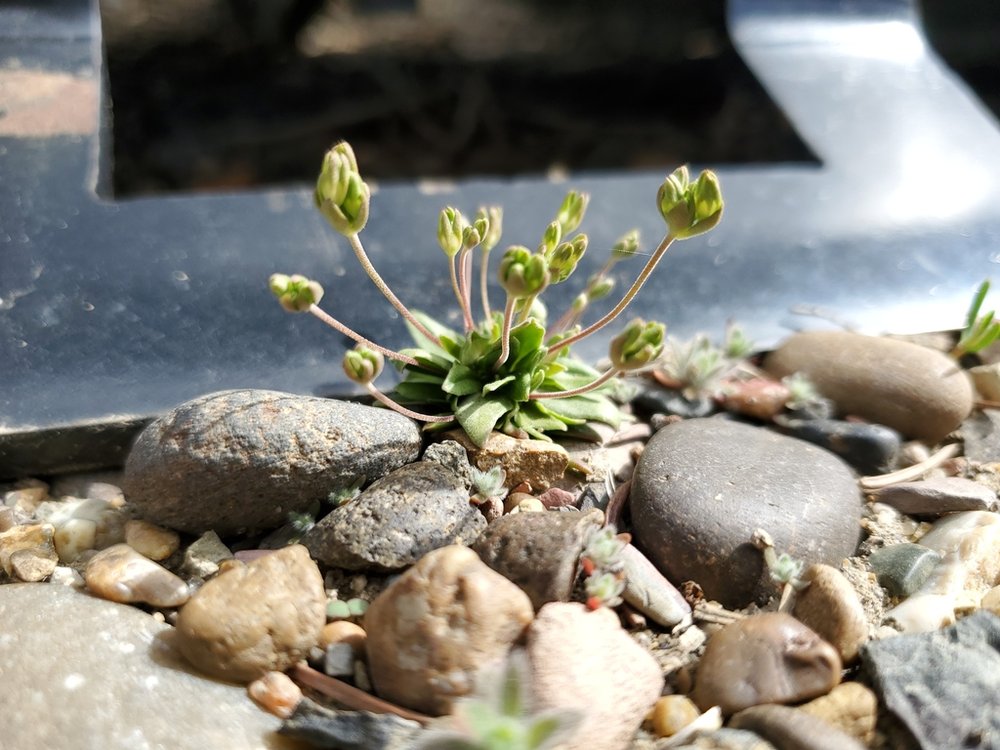
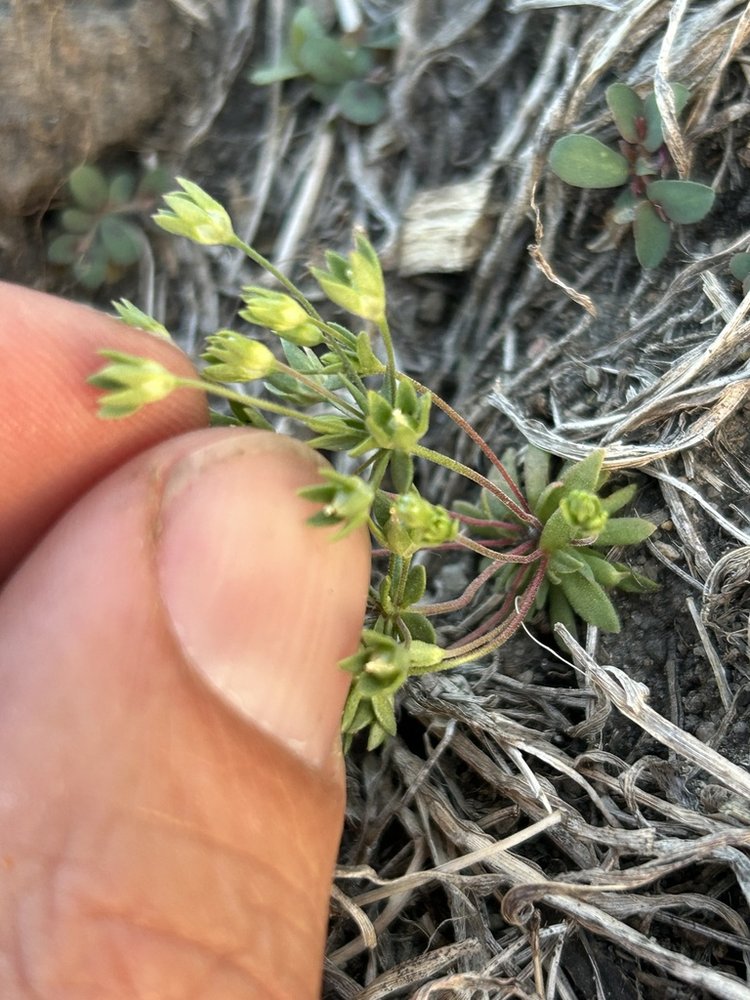
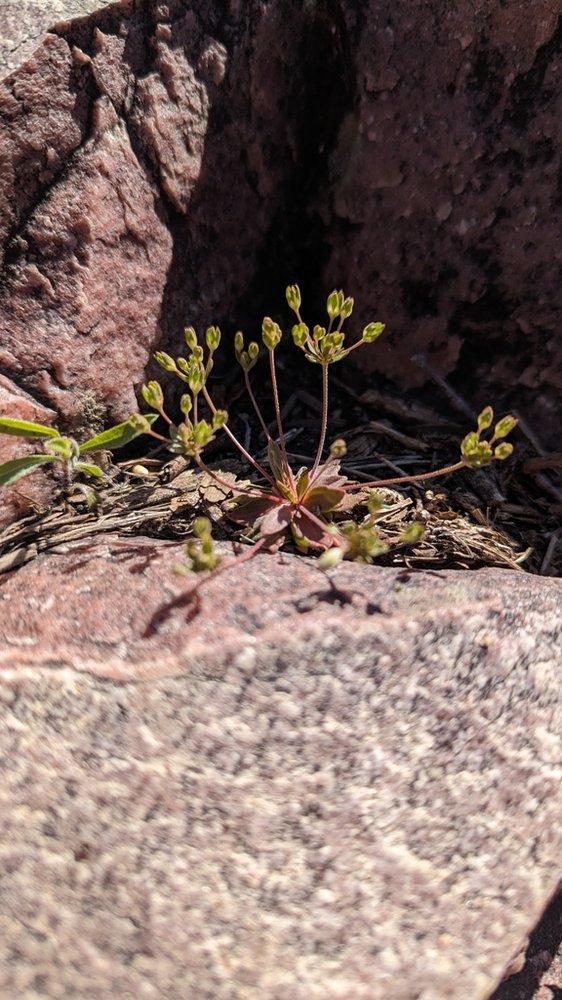
Rock Jasmine (Androsace occidentalis), also called western rock jasmine, is a tiny native annual only 2–10 cm (1–4 in) tall, with a small rosette of narrow leaves and thread-thin stalks that end in umbels of very small white flowers set in pointed green cups. It blooms from April into June on open, sandy or gravelly ground, and herbarium specimens from the Black Hills and its edges come from Lawrence, Pennington, Custer, Meade and Fall River counties in South Dakota and Crook and Weston counties in Wyoming. Photographed in the Black Hills.
Free photos from other sources
| Family | Primulaceae · Primrose |
|---|---|
| Status | Native annual |
| Blooms | April into June |
| Height | 2–10 cm (1–4 in) |
| Where | Open sandy or gravelly ground, prairie, grassy meadows and disturbed spots |
| Also called | Western Rock Jasmine, Western Androsace |
| Synonym | Androsace arizonica, Androsace occidentalis var. arizonica, Androsace occidentalis var. simplex, Androsace platysepala |
Roots, seeds & germination
Seed: The fruit is a smooth, round capsule 3–5 mm long, about as long as the calyx around it.
How do you identify Rock Jasmine?
Look for a single flat rosette of lance-shaped to spoon-shaped leaves 5–30 mm long with short hairs, and from it one to many thin stalks 2–10 cm (1–4 in) tall, each topped by an umbel of 3 to 15 flowers on slender stalks of unequal length, 3–30 mm. The flowers are tiny: a white corolla about 3 mm across sits in a ridged, broadly bell-shaped calyx 3–5 mm long whose 5 broad, pointed lobes stand upright, and the round capsule that follows is about as long as the calyx. Under each umbel is a whorl of fairly broad, leafy bracts. Northern rock jasmine (Androsace septentrionalis), the other rock jasmine in the Black Hills, has narrow, lance-shaped to linear bracts and a calyx that narrows to a V at its base with more prominent ridges, according to Flora of North America, which adds that western rock jasmine generally grows at lower elevations; Minnesota Wildflowers notes that northern rock jasmine is a larger plant.
When does it bloom?
April into June.
Where does it grow?
Open, sandy or gravelly ground, prairie, grassy meadows and disturbed spots. Herbarium labels from the Black Hills and its edges record it on open slopes and plains, sandy prairie, silt ledges of gulch walls, rocky outcrops at the edge of pine forest, limestone grassland, grassland on red shale soil, sagebrush grassland and gravelly waste ground, at about 1,200 to 1,400 m (3,940 to 4,600 ft) where elevation is given. Nearly all specimens marked as flowering were collected from mid-April to mid-June. GBIF lists 42 specimens from 1892 to 2024 from Lawrence, Pennington, Custer, Meade and Fall River counties in South Dakota and Crook and Weston counties in Wyoming, and the National Park Service lists it at Wind Cave, Mount Rushmore and Devils Tower.
Primrose family (Primulaceae): 2 other plants in this guide
Sources: Flora of North America Vol. 8: Androsace occidentalis (S. Kelso), eFloras; Flora of North America Vol. 8: Androsace septentrionalis, eFloras; Flora of North America Vol. 8: genus Androsace, with key to species, eFloras; Minnesota Wildflowers: Androsace occidentalis (Western Rock Jasmine); USDA PLANTS Database: Androsace occidentalis (ANOC2); NPSpecies checklist, Wind Cave National Park vascular plants; NPSpecies checklist, Mount Rushmore National Memorial vascular plants; NPSpecies checklist, Devils Tower National Monument vascular plants; NPSpecies checklist, Jewel Cave National Monument vascular plants (lists A. septentrionalis); Marriott and Hartman 1986, A Survey of the Vegetation of Jewel Cave National Monument (lists A. septentrionalis); GBIF occurrence search: Androsace occidentalis, South Dakota and Wyoming herbarium specimens; GBIF occurrence search: Androsace septentrionalis, South Dakota and Wyoming herbarium specimens; GBIF specimen 2512284296: McIntosh 1924, Meade County, "common on open slopes and plains"; GBIF specimen 5159161519: Tuma, Weedon and Bowlin 1987, Custer County, flowering and fruiting, 19 April; GBIF specimen 3051415727: Bennett 1932, Lawrence County, "silt ledges of gulch walls"; GBIF specimen 3051415725: Kravig 1965, Fall River County, "rocky outcrops bordering foothills, pine forest"; GBIF specimen 3454983377: Marriott 1983, Crook County, Wyoming, "grassland on red shale soil", 1,402 m; GBIF specimen 3067053373: Marriott 1984, Weston County, Wyoming, "big sagebrush-grassland", 1,280 m; GBIF specimen 3091263818: Kravig 1972, Lawrence County, "limestone plateau, grasslands", 1,219 m; GBIF specimen 2512332897: Van Bruggen 1960, Pennington County, "sandy prairie"; GBIF specimen 5102764373: Halse 2023, Lawrence County, gravelly waste area, 1,200 m.