Green Ash Fraxinus pennsylvanica
Also called Red ash, Swamp ash, Water ash, pseȟtíŋ čháŋ (Lakota)
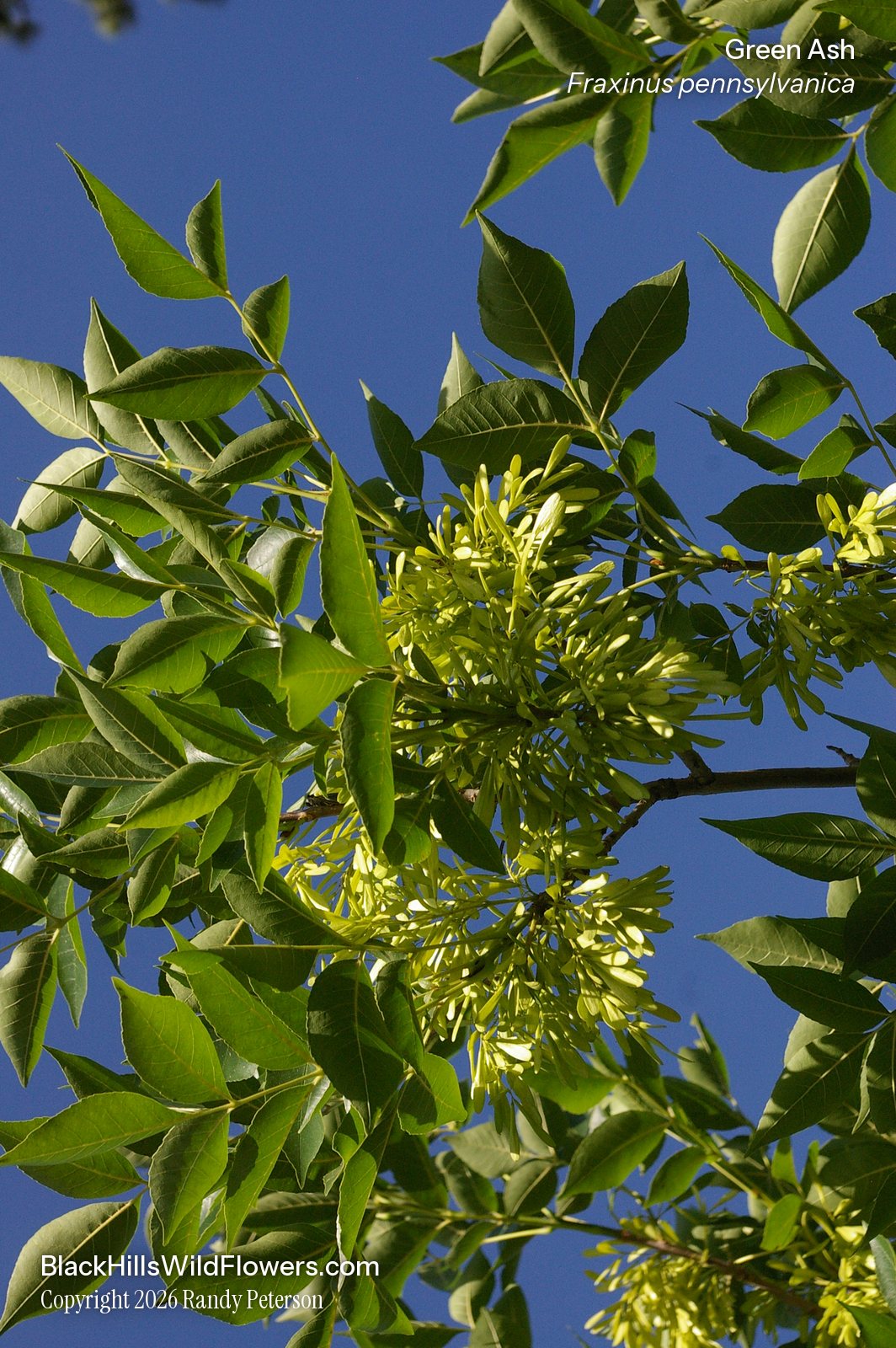
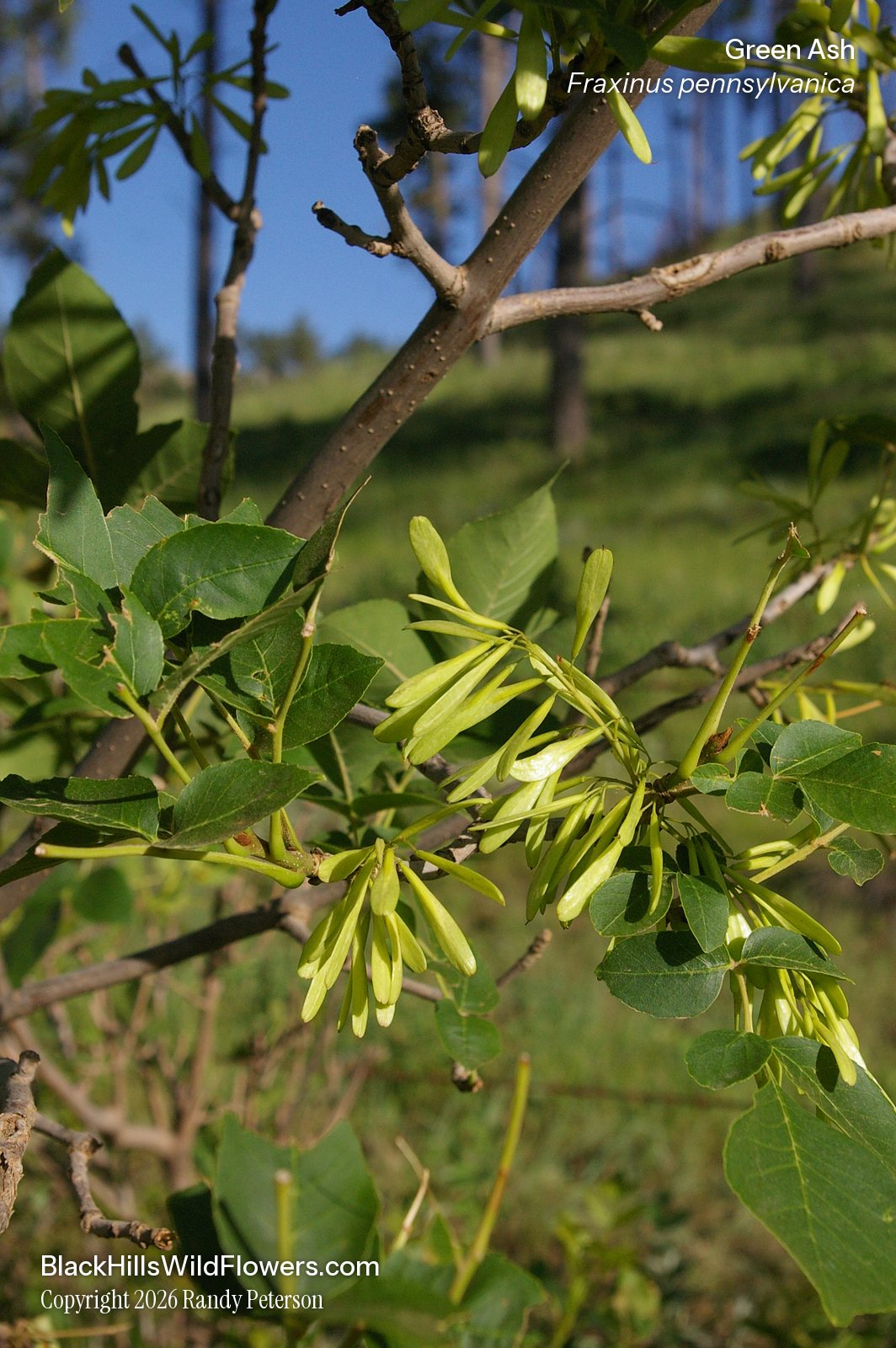
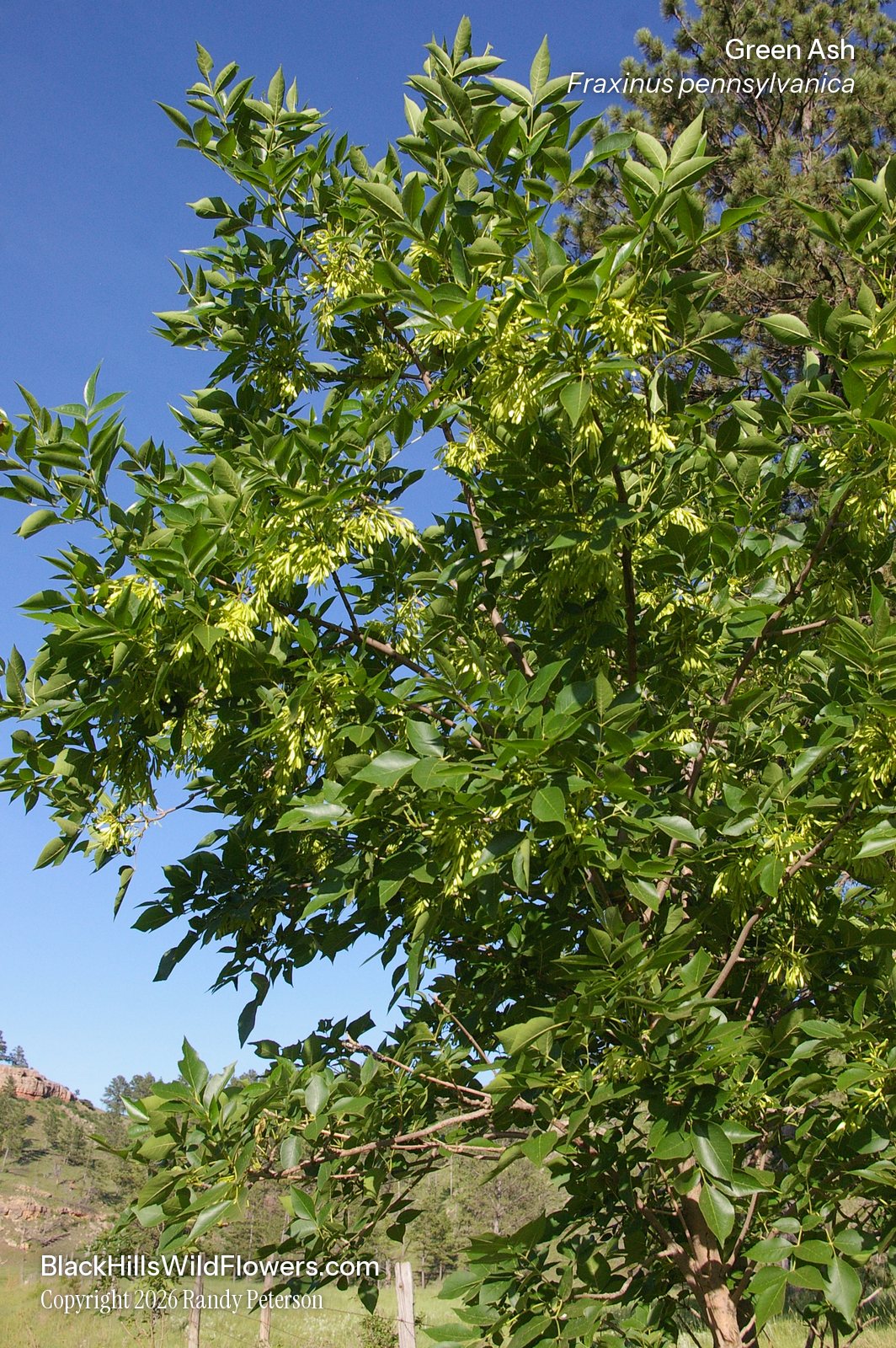
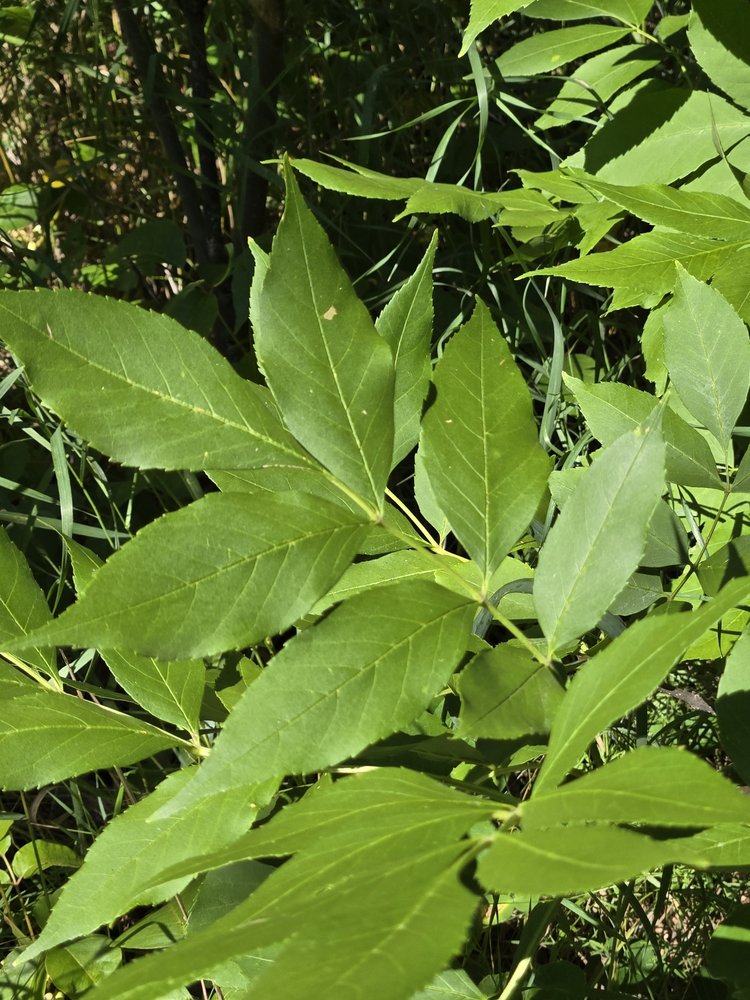
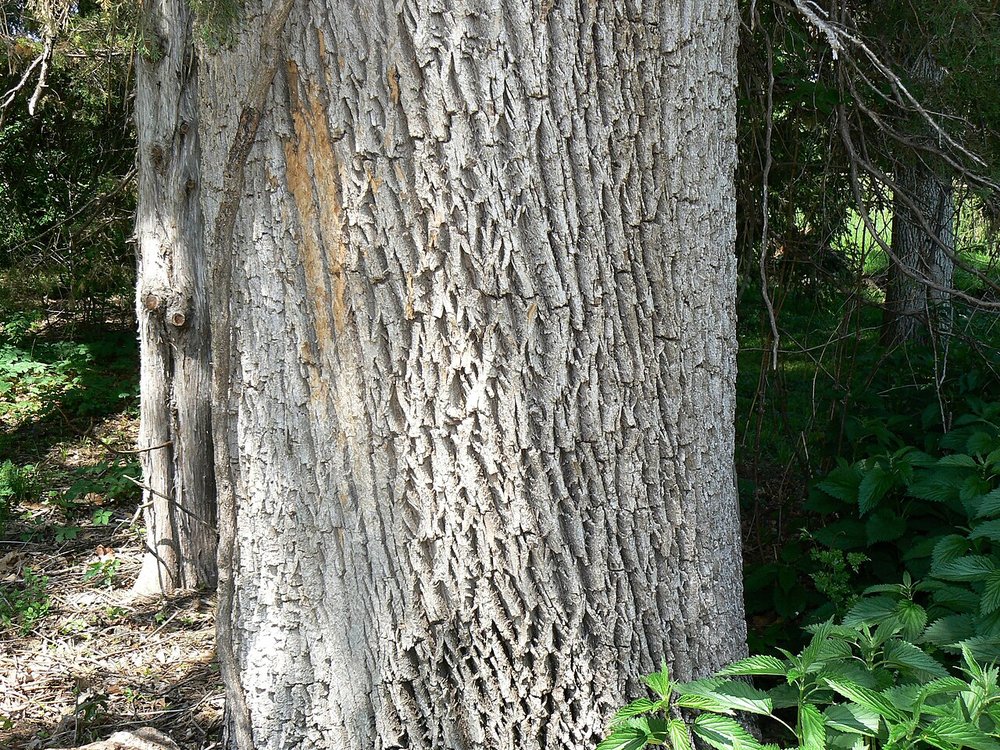
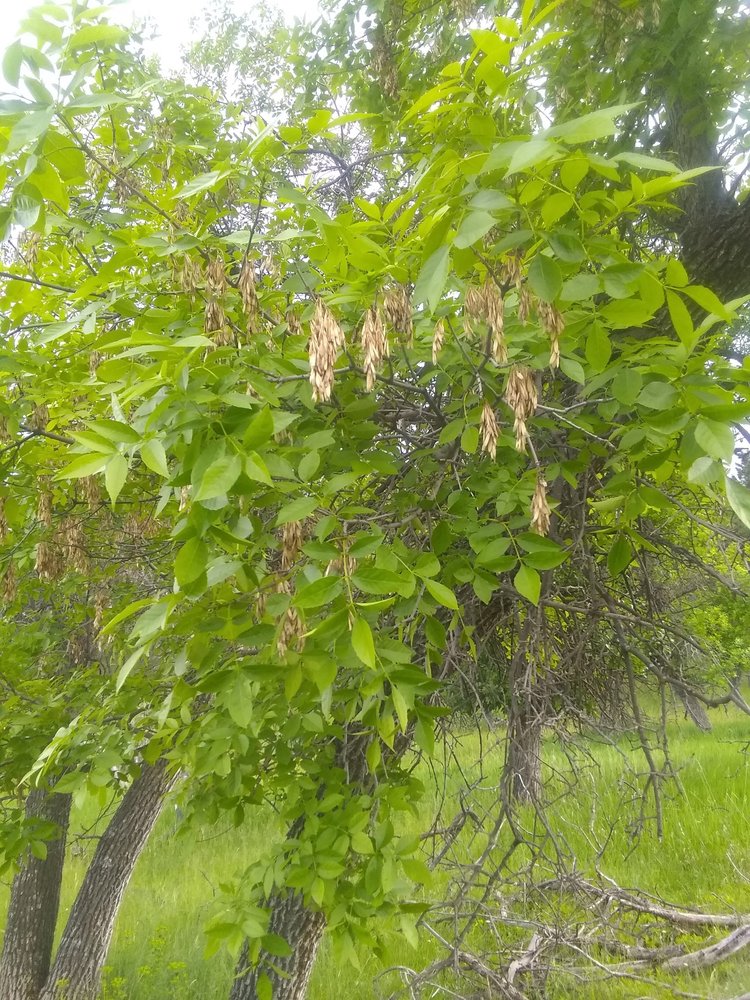
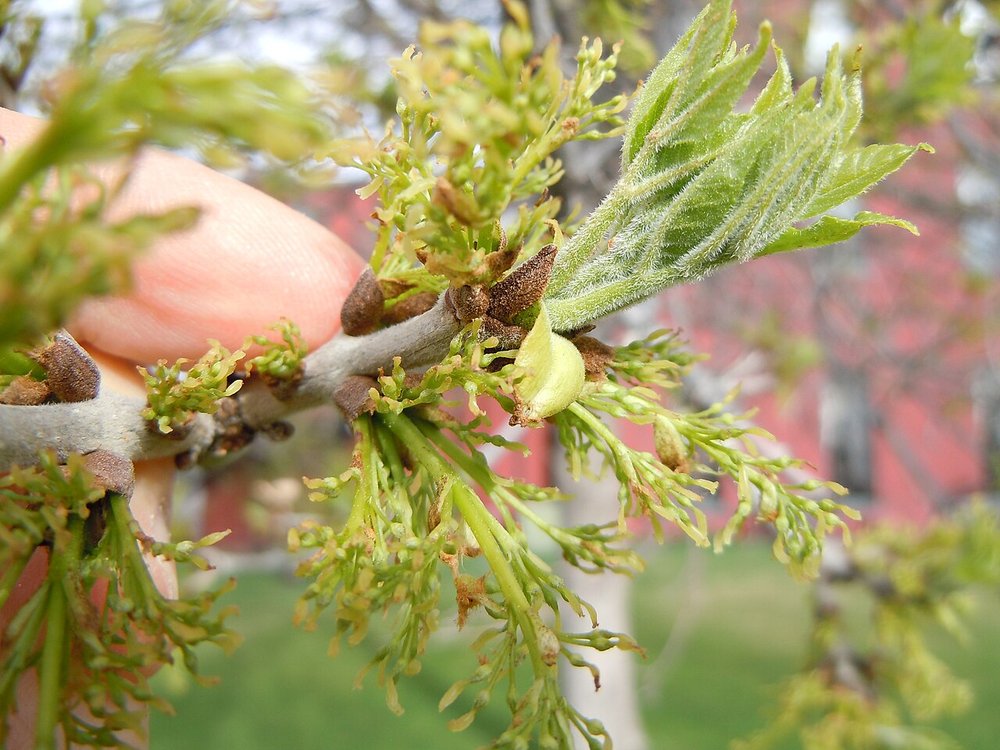
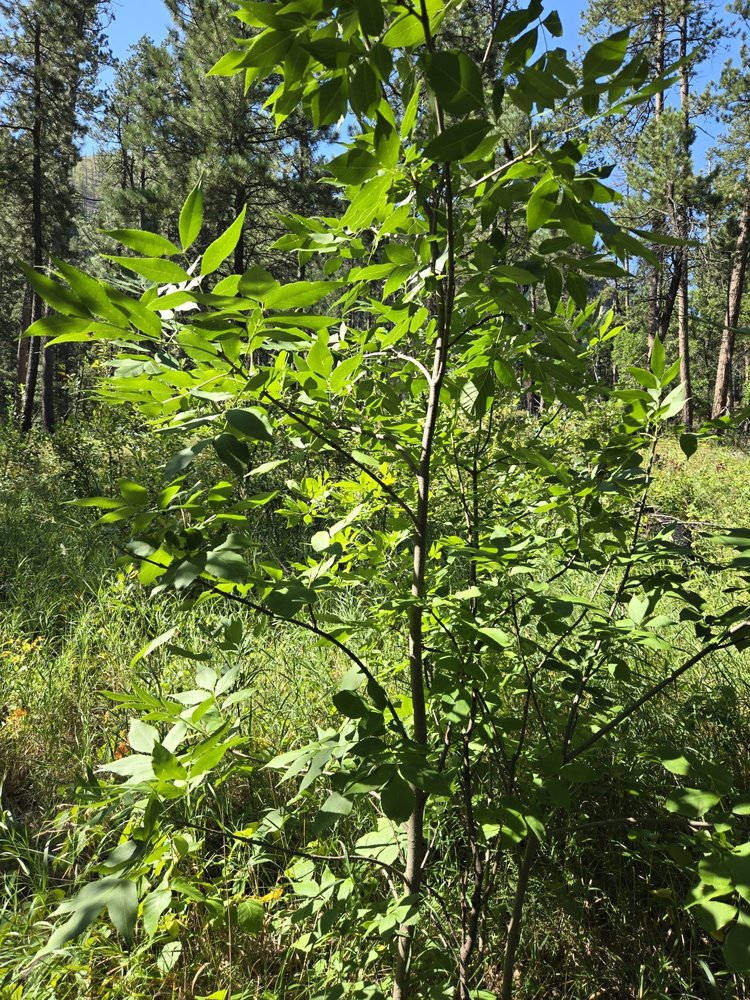
Green Ash (Fraxinus pennsylvanica) is a native tree of the olive family with opposite, compound leaves of 5 to 9 leaflets, gray-brown bark cut into a woven pattern of diamond-shaped ridges, and single-winged seeds that hang in clusters from late summer into winter. Its small, petal-less flowers open before the leaves in April and May, and in the Black Hills it grows along creeks and in draws and floodplains, where the Forest Service counts it as typical of the bur oak woods and the National Park Service lists it at Wind Cave and Devils Tower. Photographed in the Black Hills.
Free photos from other sources
| Family | Oleaceae · Olive |
|---|---|
| Status | Native deciduous tree |
| Blooms | April and May, before the leaves; the winged seeds hang on from late summer into winter |
| Height | Up to 20 m (65 ft); in South Dakota rarely over 15 m (49 ft) |
| Where | Creek bottoms, floodplains, ravines and draws, and lake shores; also planted in towns and shelterbelts |
| Also called | Red ash, Swamp ash, Water ash, pseȟtíŋ čháŋ (Lakota) |
| Synonym | Fraxinus lanceolata, Fraxinus pennsylvanica var. lanceolata, Fraxinus pennsylvanica var. subintegerrima |
| Traditional use | Black Elk and Flying By (1998) record that the Lakota used ash wood for bows, tipi pins and pegs, drums, drying racks and pipestems, and that it makes excellent firewood. Gilmore (1919) recorded that ash wood was used for pipestems and bows and young stems for arrow shafts, and that the Omaha counted the ash among their two sacred trees; Moerman's database lists the pipestem, bow and arrow-shaft uses for the Dakota, Omaha, Pawnee, Ponca and Winnebago, and adds that the Northern Cheyenne used ash for Sun Dance lodge posts, tipi pins and pegs, meat-drying racks and bows (Hart 1981). |
| Note | The emerald ash borer, a beetle whose larvae kill untreated ash trees within about three years, has reached eastern South Dakota; as of June 2025 the state's ash quarantine covered seven eastern counties, none in the Black Hills. People moving firewood are the main cause of its long-distance spread. |
Traditional use: first drafted by Google AI, then checked against the sources on this page.
Roots, seeds & germination
Root: The side roots are long with few branches, and on fine-textured soils the roots are shallow, about 2–3 m (5–10 ft) deep; a 45-year-old Nebraska tree had roots spreading about 13 m (44 ft). High winds can topple trees. A tree killed back to the ground sprouts freely from the root crown, and lesser damage brings sprouts on the trunk and branches.
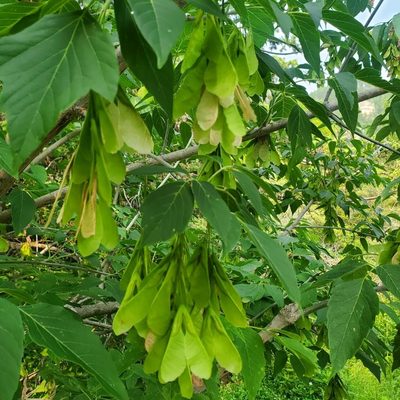
Seed: Each winged seed is a single tan samara 2.5–4.5 cm (1–1¾ in) long, hanging in open clusters that ripen in August and September on the north-central plains and can stay on the tree into winter. Wind spreads most of it, water and seed-caching animals some; seed shed in winter can travel far over frozen ground, and ash seed may travel 100 m (300 ft) or more. Ash seed may stay alive in the soil for up to 3 or 4 years, and dried seed sealed and kept cold held its viability for seven years.
Germination: The seed needs a cold, moist period and usually sprouts the spring after it falls. SDSU recommends 60 days of cold, moist treatment before spring planting, or sowing in fall. The USDA plant guide gives seed from the northern part of the range 16 weeks warm and then 16 weeks cold, says some seed sprouts the next spring while the rest stays dormant for several years, and says old stored seed is more dormant than fresh seed. Daily temperatures swinging between about 20 and 30 °C (70 and 90 °F) help it germinate.
How do you identify Green Ash?
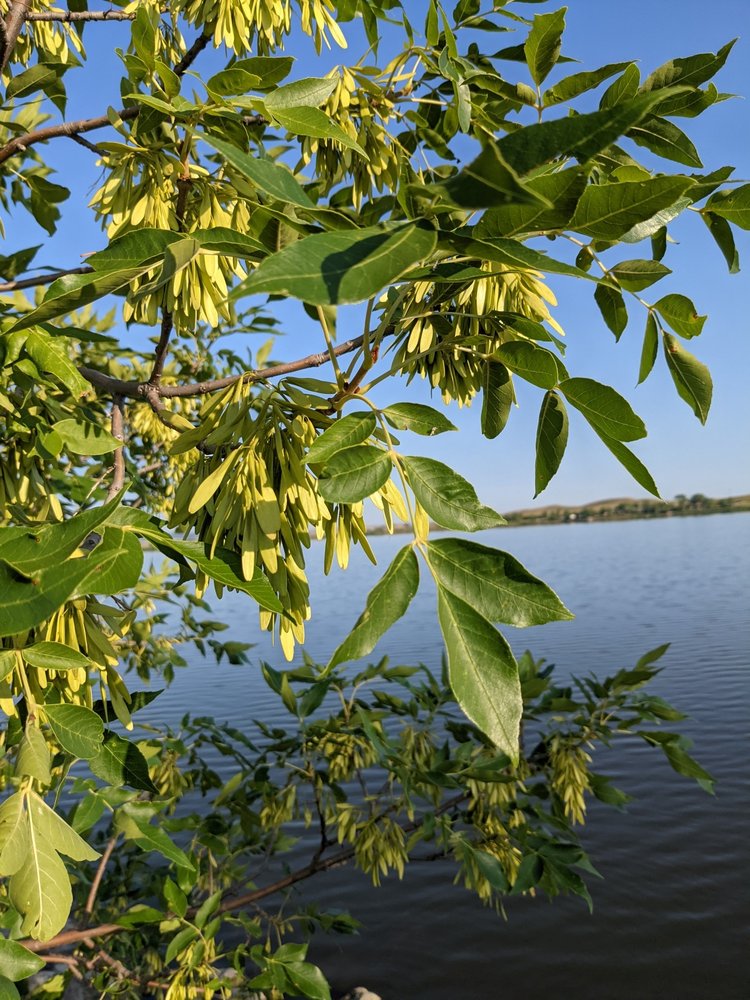
Start with the leaves and twigs: the leaves and branches come in opposite pairs, and each leaf is compound, 11–30 cm (4–12 in) long, with 5 to 9 leaflets, usually 7, each lance-shaped, 6–15 cm (2½–6 in) long, finely toothed, dark green above and paler with short hairs below, on a very short winged stalk; the lowest pair of leaflets is usually the shortest. Young twigs are greenish with white dots, turning gray-brown; winter buds are chocolate brown, with the first two side buds pressed tight against the end bud, over half-moon leaf scars. Mature bark is gray-brown and furrowed, with the ridges woven into a diamond pattern. The flowers come before the leaves in small clusters from last year's twigs, with no petals, male and female on separate trees. The fruit is a single tan, spatula-shaped winged seed 2.5–4.5 cm (1–1¾ in) long, hanging in open clusters that can stay on the tree all winter. The North Dakota ash identification sheet says the only other trees with both opposite branches and compound leaves are Boxelder and Amur corktree, a tree rarely planted there, and it separates Boxelder this way: Boxelder has only 3 to 5 leaflets where ash has 5 to 11, Boxelder's seeds always hang in pairs where ash seeds are single, and Boxelder twigs are often blue or purple with a white, waxy coating. A leaf with 5 leaflets fits both, so check the seeds and twigs.
When does it bloom?
April and May, before the leaves; the winged seeds hang on from late summer into winter.
Where does it grow?
Creek bottoms, floodplains, ravines and draws, and lake shores, at about 1,070–1,340 m (3,500–4,400 ft) on herbarium labels; it is also widely planted in towns, yards and shelterbelts. SDSU records it in floodplains, ravines and along stream and lake shores throughout South Dakota, and the Fire Effects Information System says it is typical in the bur oak cover type in the Black Hills of South Dakota and Wyoming, with ponderosa pine, American elm and plains cottonwood. The Forest Service's 1987 habitat-type classification of the Black Hills National Forest names it with American elm, hackberry, ponderosa pine and boxelder in the lowland riparian forests where bur oak grows as a tree, notes a few seedlings in bur oak stands, and says the riparian forests that once lined the larger streams are mostly gone, with Custer State Park holding the best examples that may renew themselves. The National Park Service lists it at Wind Cave National Park and Devils Tower National Monument. Herbarium specimens come from Lawrence, Pennington, Meade, Custer and Fall River counties in South Dakota and Crook County in Wyoming, from 1891 on, with labels describing rocky creek banks, canyons, a river floodplain, and ravines and draws in the Bear Lodge Mountains; many town specimens are from lawns and streets.
Other plants to compare
Sources: SDSU Open PRAIRIE: Oleaceae: Fraxinus pennsylvanica (Green ash); USDA Forest Service Fire Effects Information System: Fraxinus pennsylvanica (Gucker 2005); Hoffman and Alexander 1987, Forest Vegetation of the Black Hills National Forest: A Habitat Type Classification (USDA Forest Service RM-276); NPSpecies checklist, Wind Cave National Park vascular plants; NPSpecies checklist, Devils Tower National Monument vascular plants; USDA NRCS Plant Guide: Green Ash, Fraxinus pennsylvanica; Minnesota Wildflowers: Fraxinus pennsylvanica (Green Ash); NDSU Extension F1633: Ash Tree Identification (Zeleznik); ITIS: Fraxinus pennsylvanica Marshall, TSN 32929; GBIF occurrence search: Fraxinus pennsylvanica, South Dakota and Wyoming herbarium specimens; GBIF specimen 4064905368: Crook County, Wyoming, river floodplain, 1971; Black Elk and Flying By 1998, Culturally Important Plants of the Lakota (entry 126), filed with the South Dakota PUC; South Dakota DANR: Emerald ash borer quarantine (updated 2025-06-12); South Dakota DANR: Emerald ash borer biology; Gilmore 1919, Uses of Plants by the Indians of the Missouri River Region (Bureau of American Ethnology); Moerman, Native American Ethnobotany database (BRIT): Fraxinus pennsylvanica.