Elegant Sunburst Lichen Xanthoria elegans also listed as Rusavskia elegans
Also called Elegant Orange Wall Lichen
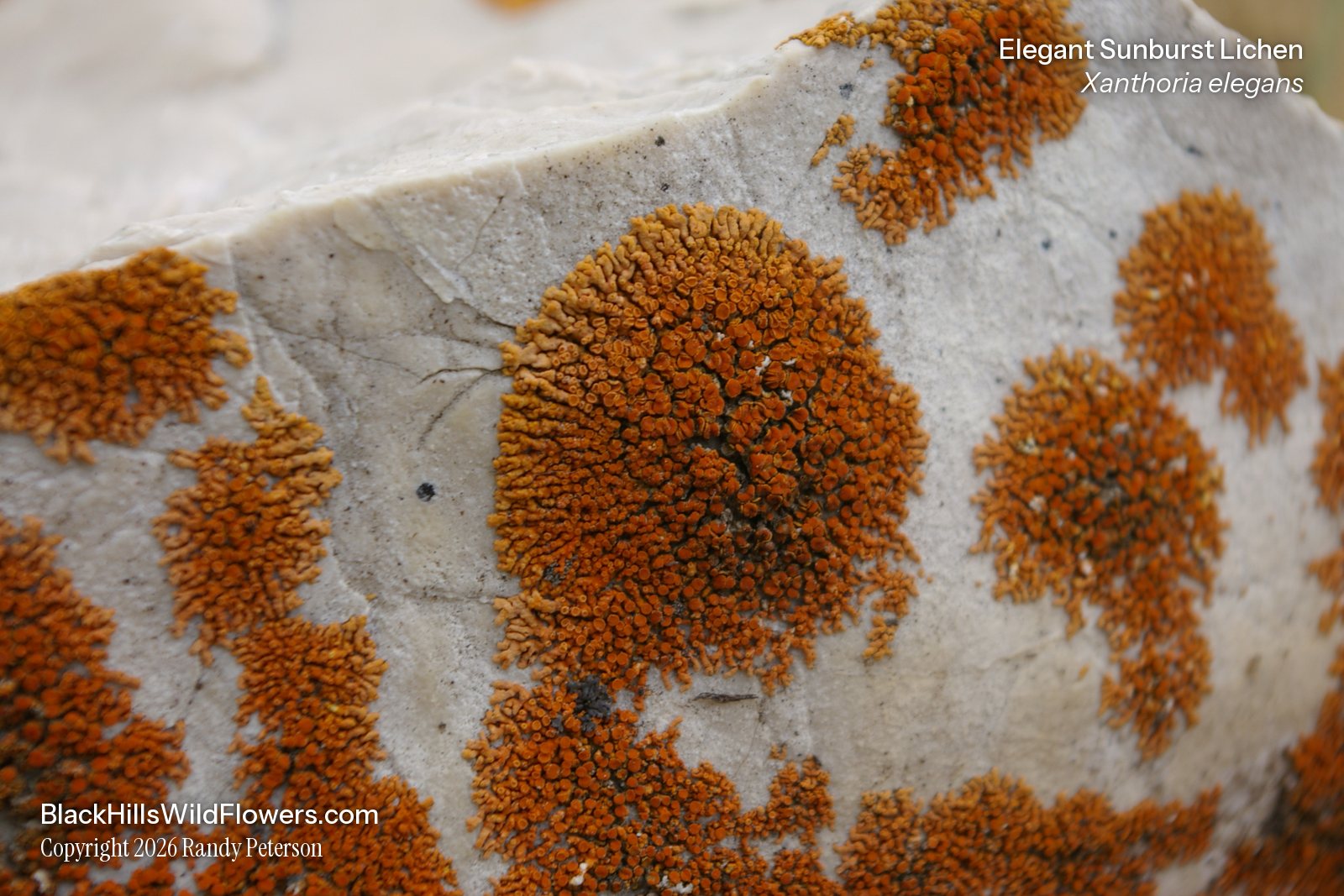
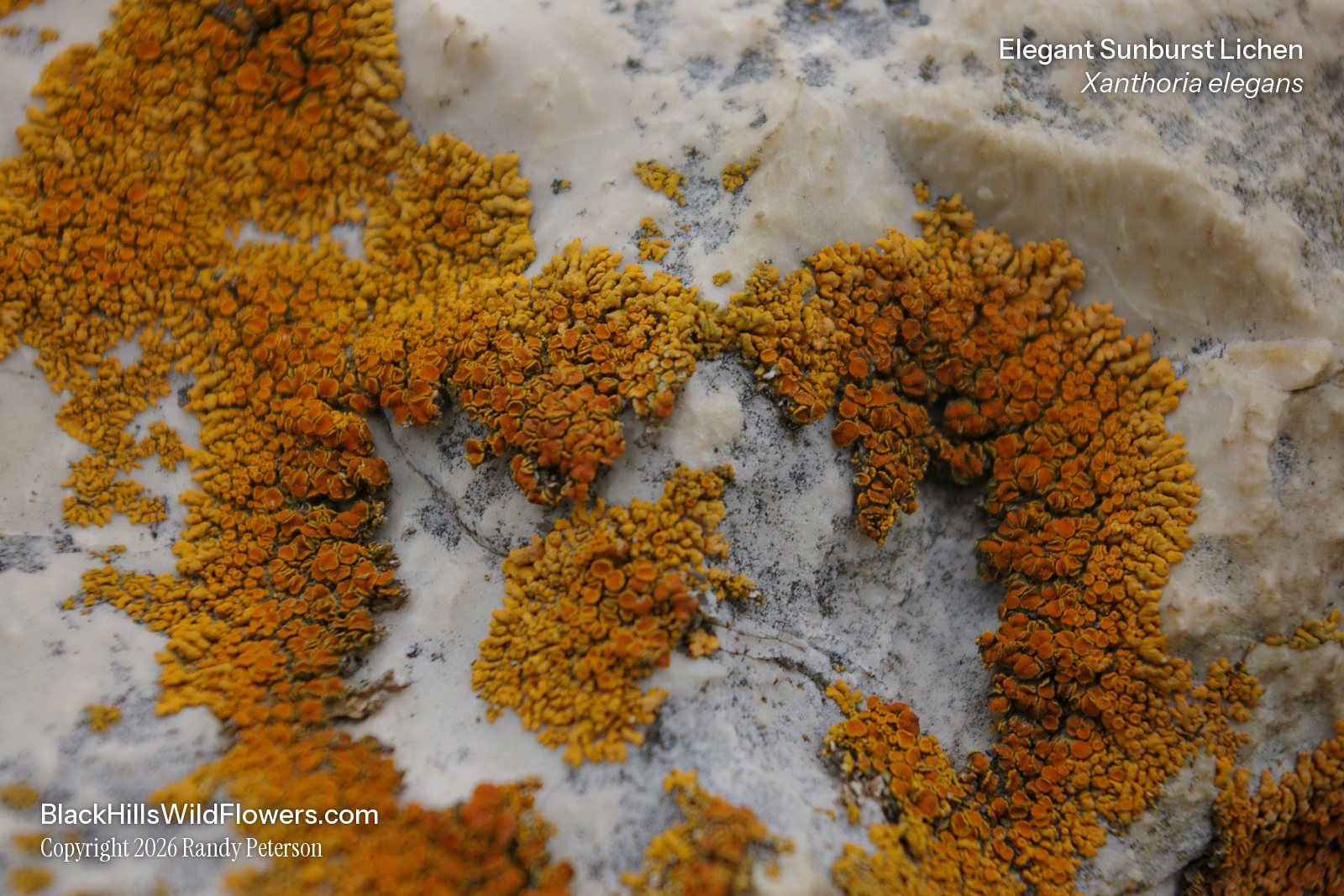
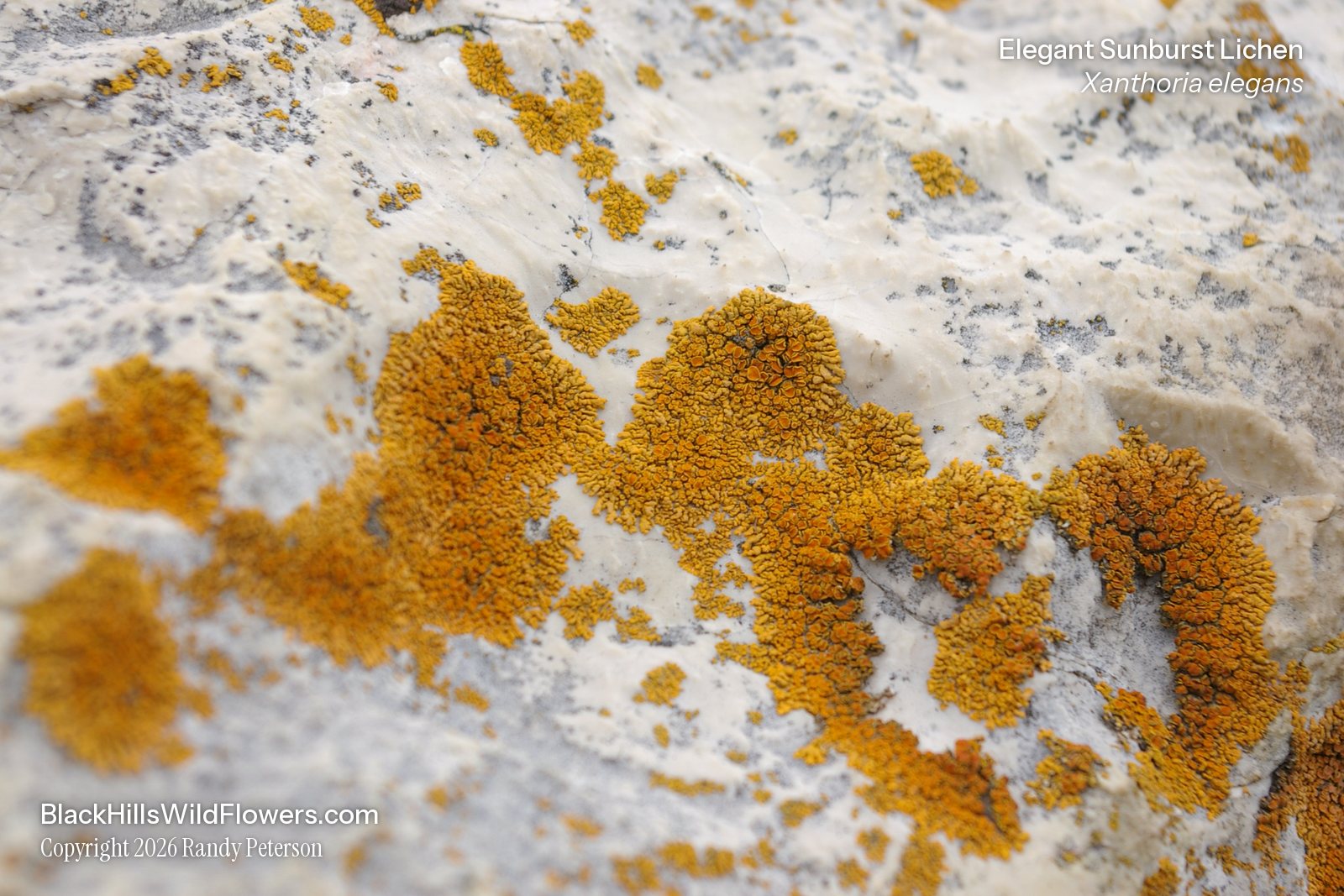
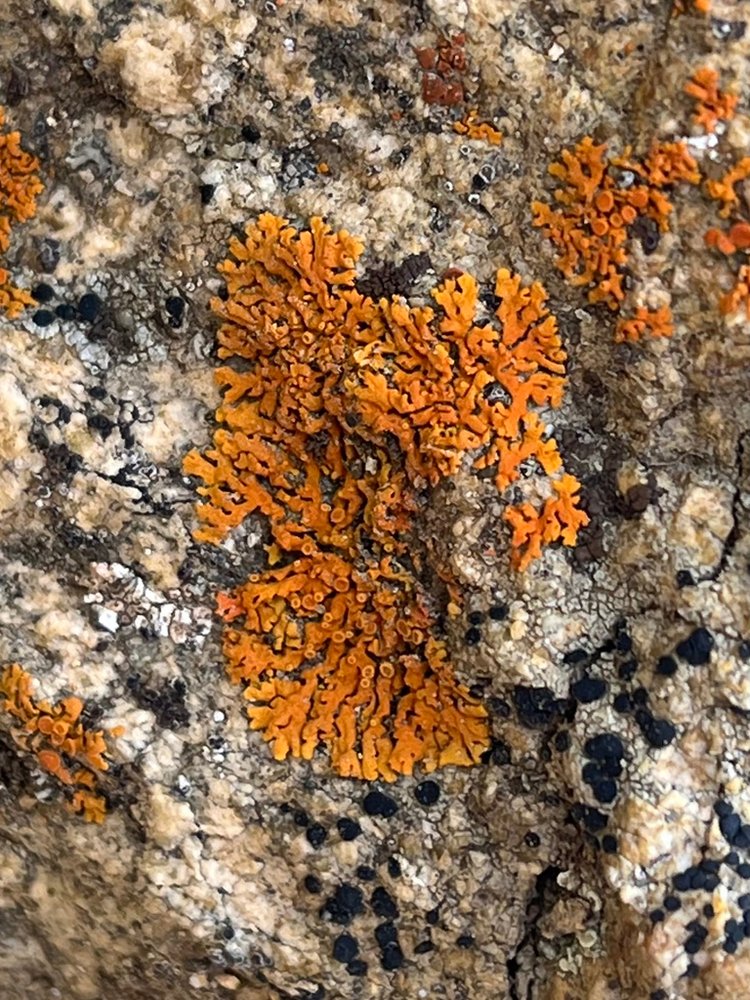
Elegant Sunburst Lichen (Xanthoria elegans, also placed in the genus Rusavskia) is a yellow to orange leafy lichen that grows in small rosettes pressed tight against rock. Herbarium specimens collected from 1891 to 2009 record it across the Black Hills of South Dakota and Wyoming. Photographed in the Black Hills.
Free photos from other sources
| Family | Teloschistaceae · Sunburst lichen |
|---|---|
| Status | Native lichen |
| Blooms | Never flowers; makes spores in orange fruiting discs and never makes soredia |
| Size | Rosettes up to 6 cm (2½ in) across, or larger colonies |
| Where | Rock, in humid to dry sites |
| Also called | Elegant Orange Wall Lichen |
| Synonym | Caloplaca elegans, Lecanora elegans, Lichen elegans, Placodium elegans |
| Traditional use | Moerman's ethnobotany database (BRIT) records two uses under this name, both from Compton 1993: the Haisla and Hanaksiala used it as a pigment for face paint, and the Kitasoo used it as a yellow pigment for paint. |
Roots, seeds & germination
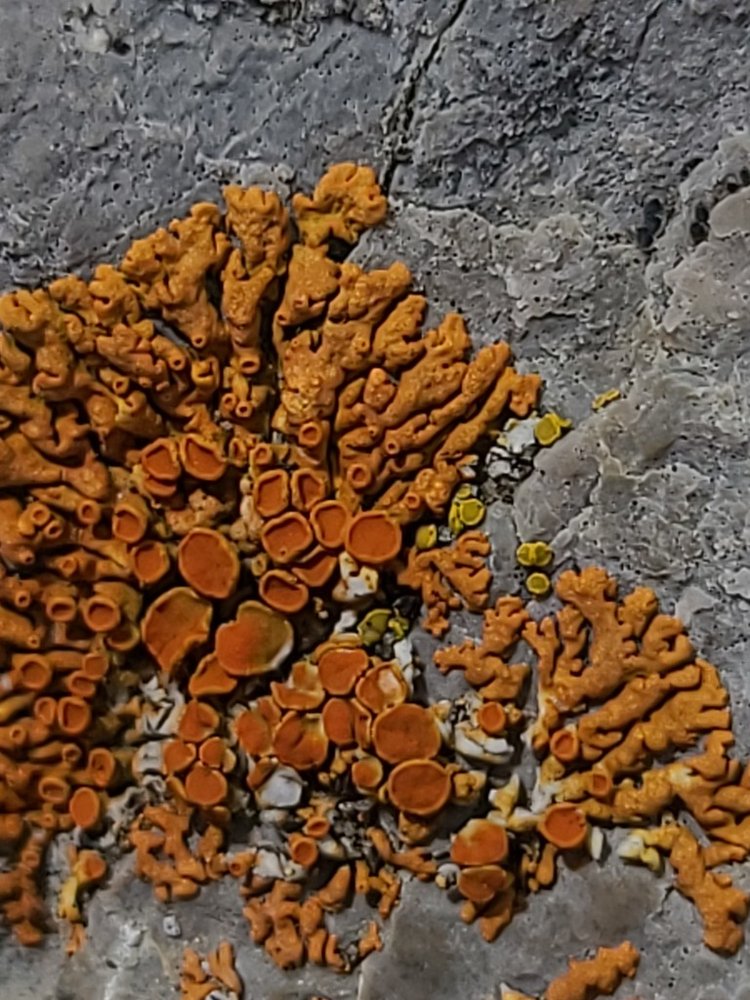
Seed: No seeds. It makes spores in orange, disc-shaped fruiting bodies (apothecia), which are common but sometimes missing, and it never makes soredia (Consortium of Lichen Herbaria).
How do you identify Elegant Sunburst Lichen?
Look for yellow to orange rosettes pressed tight against rock. It is a leafy (foliose) lichen: the Consortium of Lichen Herbaria, quoting the Sonoran Desert lichen flora, gives rosettes up to 6 cm (2½ in) wide or larger colonies, with narrow, convex lobes only 0.4–1.3 mm (1/64–1/20 in) wide and a yellow to orange, sometimes dull red, upper surface that is a little coarse and occasionally lightly frosted. The underside is white and wrinkled, rarely with very short white holdfasts called hapters. Orange disc-shaped fruiting bodies (apothecia) up to 3 mm (1/8 in) across are common but sometimes missing. It never makes soredia, the powdery granules some lichens break off to spread. Two look-alikes have Black Hills specimens (GBIF). Xanthoria sorediata (also placed in Rusavskia) has a thallus most like this one, but it always has soralia, patches of soredia, on its upper surface, and its fruiting discs are very rare (Consortium). Caloplaca saxicola (now Calogaya saxicola) is a crust with a small, smooth orange thallus of short lobes 0.3–1 mm (1/80–1/25 in) wide that sometimes look swollen, with fruiting discs forming near the lobe tips (Consortium). The Consortium says Xanthoria elegans can be told from look-alike Caloplaca species such as C. saxicola because it always has a lower cortex, a protective outer layer on the underside (Nova Scotia guide), which carries the occasional holdfast.
When does it bloom?
Never flowers; makes spores in orange fruiting discs and never makes soredia.
Where does it grow?
It grows on rock, in places from humid to dry, and the Consortium of Lichen Herbaria describes it as circumpolar and reaching farther south in mountain areas. GBIF lists 94 herbarium specimens from the Black Hills, filed under Xanthoria elegans or one of its synonyms, such as Rusavskia elegans, and collected from 1891 to 2009, most of them by Clifford Wetmore in 1960 and 1961. They come from Custer, Pennington, Lawrence, Fall River and Meade counties in South Dakota and Crook and Weston counties in Wyoming, with labels such as Custer State Park, Wind Cave National Park and Devils Tower National Monument. The 20 labels that give an elevation run from about 1,040 to 2,070 m (3,400–6,800 ft). Labels name limestone, igneous cliffs, sandstone boulders, rock outcrops in open pine forest, ponderosa pine with bur oak and paper birch, spruce and aspen forest, and north-facing slopes; one also lists a wooden fence post and another a concrete block. The Black Hills National Forest's 2023 at-risk assessment names five other lichens but not this one, and South Dakota's rare plant list includes no lichens.
Sources: Consortium of Lichen Herbaria: Rusavskia elegans, the page Xanthoria elegans redirects to (description from Lichen Flora of the Greater Sonoran Desert Region, Nash et al. 2004); Consortium of Lichen Herbaria: Xanthoria sorediata, listed as Rusavskia sorediata (description from the same flora); Consortium of Lichen Herbaria: Caloplaca saxicola, now Calogaya saxicola (description from Lichen Flora of the Greater Sonoran Desert Region, Vol. 3, 2007); ITIS: Xanthoria elegans (Link) Th. Fr., TSN 191776, usage accepted; USDA PLANTS: Xanthoria elegans (XAEL60), elegant orange wall lichen, native to North America; GBIF occurrence search: Xanthoria elegans with synonyms (Rusavskia elegans, Placodium elegans), preserved specimens, South Dakota (181); GBIF occurrence search: Xanthoria elegans with synonyms, preserved specimens, Wyoming (192); GBIF occurrence search: Xanthoria sorediata (Rusavskia sorediata) and Caloplaca saxicola (Calogaya saxicola), preserved specimens, South Dakota and Wyoming (Black Hills counties: 39 and 16); GBIF species match: Rusavskia elegans (a synonym of Xanthoria elegans in the GBIF backbone); GBIF vernacular names for Rusavskia elegans (Elegant Sunburst Lichen, from the Checklist of Vermont Fungi); iNaturalist taxon: Rusavskia elegans (Elegant Sunburst Lichen) and family Teloschistaceae (sunburst lichens, firedots, and allies); BRIT Native American Ethnobotany Database: search for Xanthoria; Identifying Lichens of Nova Scotia (Brodo, Cameron, Andrachuk and Craig): glossary (cortex, soredium, pruina); Black Hills National Forest Revised Forest Assessment: At-Risk Species (October 2023); South Dakota Natural Heritage Program: Rare Plants of South Dakota.