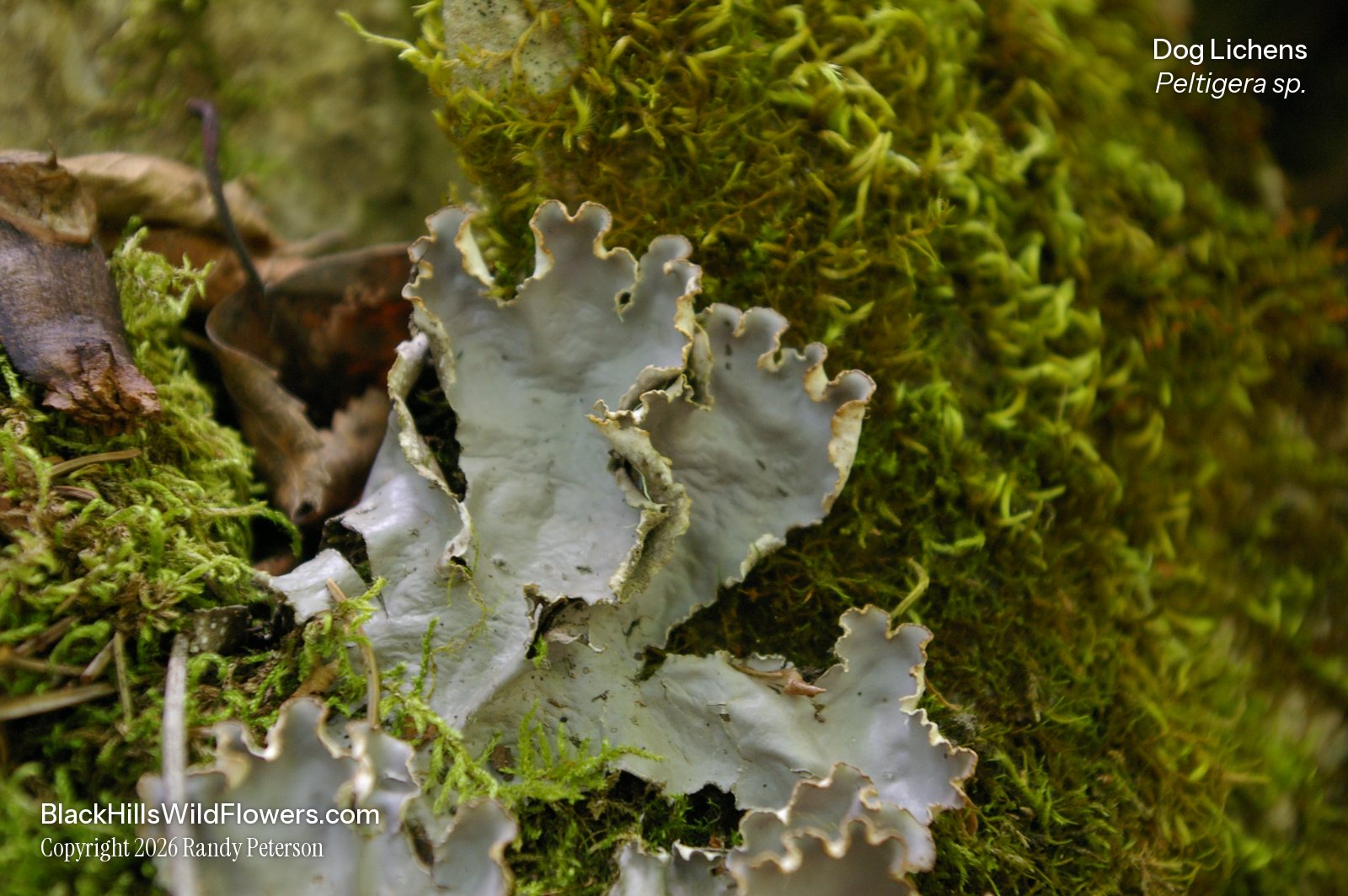
Dog Lichens Peltigera sp.
Also called Veined Lichens, Felt Lichens, Pelt Lichens
Dog lichens (Peltigera) are leafy lichens, most of them large, with broad lobes that lie over moss and soil, gray to brown when dry and blackish green, or in a few species bright green, when wet. Herbarium specimens of at least 17 Peltigera species, collected from 1891 to 2009, record them across the Black Hills of South Dakota and Wyoming. Photographed in the Black Hills.
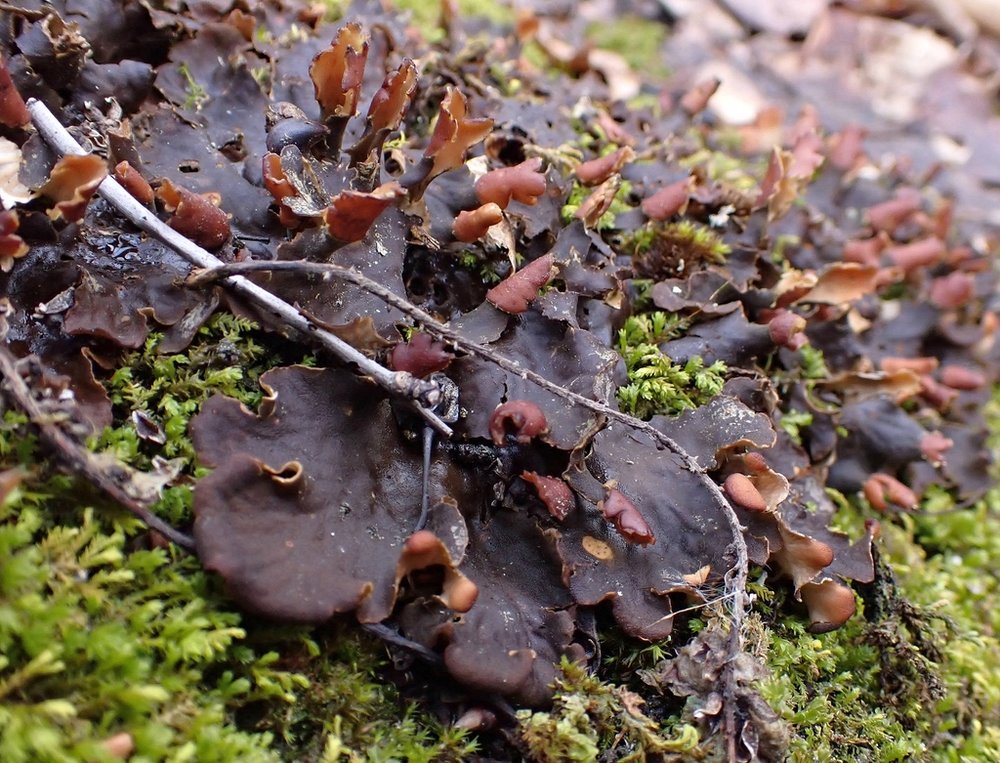
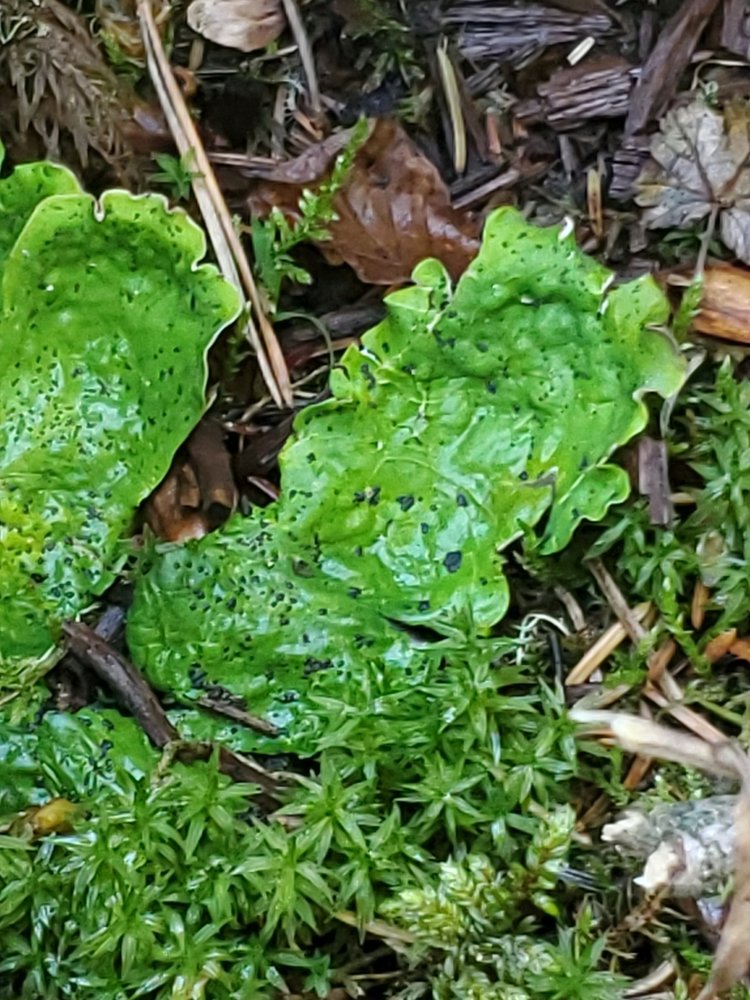
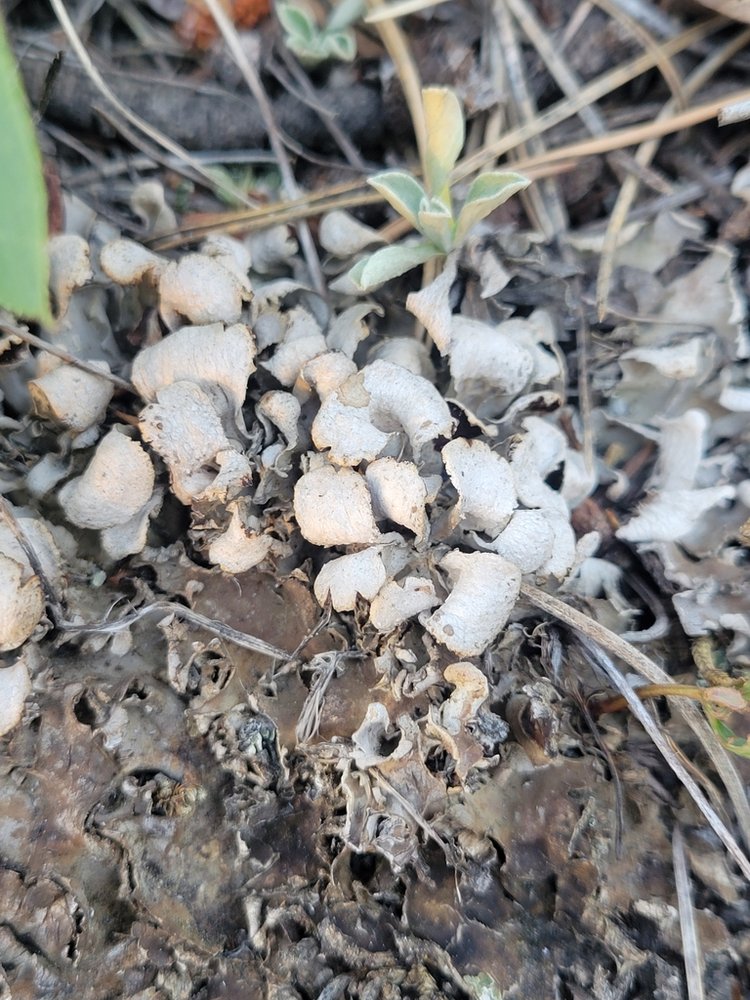
Free photos from other sources
| Family | Peltigeraceae · Peltigera |
|---|---|
| Status | Native lichen |
| Blooms | Never flowers; makes spores in fruiting discs on the lobe tips, and some species spread by soredia or scale-like outgrowths |
| Size | Patches 1–30 cm (0.4–12 in) across, depending on the species |
| Where | Among mosses over soil and rock, and on bare soil |
| Also called | Veined Lichens, Felt Lichens, Pelt Lichens |
| Traditional use | Moerman's ethnobotany database (BRIT) has two records: under Inuktitut, that Peltigera aphthosa was used to stuff caribou skins for rafts (Wilson 1978), and under Oweekeno, that a poultice of pounded Peltigera and spruce pitch was applied to wounds (Compton 1993). |
| Note | This page covers the dog lichens of the Black Hills as a group. Several species look alike from above; the Consortium of Lichen Herbaria's descriptions tell them apart mostly by the veins and rhizines underneath. |
Roots, seeds & germination
Seed: No seeds. Most species make spores in saddle-shaped fruiting discs (apothecia) on the lobe tips, and some also spread by soredia or small scale-like outgrowths (Consortium of Lichen Herbaria).
How do you identify Dog Lichens?
Look for large leafy (foliose) lobes lying on moss or soil, gray to brown when dry and blackish green when wet, often with brown to black, saddle-shaped fruiting discs (apothecia) on upturned lobe tips. Turn a lobe over: most of the species below have a pale underside with veins and tufts of root-like threads called rhizines, which hold the lichen down (Nova Scotia guide), and the Consortium of Lichen Herbaria's descriptions use the veins and rhizines to tell the species apart. The Black Hills have specimens of at least 17; the eight most collected, and one rarer one, are described below from those descriptions. Peltigera rufescens (Field Dog Lichen): thickly felted (tomentose) with white-gray hairs, especially toward the edges, with lobes up to 10 mm (2/5 in) wide whose rounded tips often turn up and back, dark veins below and dense brown rhizines at the lobe bases. Peltigera canina (Dog Lichen): gray to brown and hairy or felt-like above; the Consortium's note on P. membranacea says its veins are flatter and darker than that species' and its bushy rhizines usually form mats. Peltigera polydactylon: smooth and shiny, blue-gray to brown, with ruffled (crisped) lobe margins that often bear small scale-like lobes (phyllidia), a flat network of brownish veins below and dense brown to black rhizine tufts. Peltigera elisabethae: thick, glossy and smooth, with small outgrowths (schizidia) along the margins; the underside is white near the edge, darkens abruptly and has no veins. Peltigera praetextata: felted, gray to bluish gray, with small scale-like lobes along the margins and cracks, and pale to medium brown, smooth, flat veins and slender, scattered rhizines below; the Consortium warns these marks vary and that young plants without the scale-like lobes are hard to name. Peltigera didactyla: small, 1–5 cm (0.4–2 in) across, thinly felted, with strongly upturned lobes; young plants carry soredia (powdery granules) in round whitish patches on top, which disappear once fruiting discs form. Peltigera leucophlebia: bright green when wet, with small raised cephalodia (gall-like growths that hold blue-green bacteria; Nova Scotia guide) on top and pale, smooth veins below. The Consortium notes it is often mistaken for P. aphthosa, which is thick, has no veins underneath and has mostly flat cephalodia. Peltigera membranacea (2 Black Hills specimens) is thin and felted, with narrow, raised, pale veins and slender rhizines.
When does it bloom?
Never flowers; makes spores in fruiting discs on the lobe tips, and some species spread by soredia or scale-like outgrowths.
Where does it grow?
Dog lichens grow among mosses over soil, rock and tree trunks, and on bare soil (Consortium of Lichen Herbaria; P. rufescens at middle to fairly high elevations, P. leucophlebia in moist places). GBIF lists 543 herbarium specimens of Peltigera from the Black Hills, collected from 1891 to 2009: Custer County 160, Pennington 137, Lawrence 133, Meade 27 and Fall River 6 in South Dakota, Crook County 48 and Weston 16 in Wyoming, and 16 with no county on the label. Clifford Wetmore collected 463 of them, 433 in 1960 and 1961. By species: P. rufescens 100, P. elisabethae 96, P. canina 85, P. polydactylon 50, P. leucophlebia 36, P. aphthosa 36, P. didactyla 34, P. praetextata 30, P. venosa 24, P. horizontalis 15, P. lepidophora 9, P. malacea 9, P. collina 7, P. neckeri 3, P. membranacea 2, P. ponojensis 1 and P. scabrosa 1. Labels that give a habitat mention shady stream valleys with cliffs, north-facing slopes, open pine forest with rock outcrops, ponderosa pine with bur oak and paper birch, spruce, pine, birch and aspen forest, mosses on shaded igneous cliffs, and a deep, shaded gulch. Of the 84 labels that give an elevation, 83 fall between about 1,070 and 2,040 m (3,500–6,700 ft). The Black Hills National Forest's 2023 at-risk assessment names five other lichens but no Peltigera, and South Dakota's rare plant list includes no lichens.
Sources: Consortium of Lichen Herbaria: Peltigera rufescens (description from Lichen Flora of the Greater Sonoran Desert Region, Nash et al. 2004); Consortium of Lichen Herbaria: Peltigera canina (Dog Lichen; description from LIAS, Botanische Staatssammlung Muenchen); Consortium of Lichen Herbaria: Peltigera membranacea (same flora; note compares P. canina); Consortium of Lichen Herbaria: Peltigera polydactylon (same flora); Consortium of Lichen Herbaria: Peltigera elisabethae (same flora); Consortium of Lichen Herbaria: Peltigera leucophlebia (same flora; note compares P. aphthosa); Consortium of Lichen Herbaria: Peltigera didactyla (same flora); Consortium of Lichen Herbaria: Peltigera praetextata (same flora); Consortium of Lichen Herbaria: Peltigera aphthosa (description from LIAS); USDA PLANTS: Peltigera Willd. (felt lichen), genus profile PELTI2, native to North America; iNaturalist taxon: genus Peltigera (pelt lichens); GBIF occurrence search: genus Peltigera, preserved specimens, South Dakota (503); GBIF occurrence search: genus Peltigera, preserved specimens, Wyoming (746); GBIF vernacular names for the genus Peltigera (Dog Lichen, pelt lichens, felt lichen; Catalogue of Life, UK Species Inventory, Checklist of Vermont Fungi); GBIF vernacular names for Peltigera rufescens (field dog lichen; Catalogue of Life, Checklist of Vermont Fungi); BRIT Native American Ethnobotany Database: search for Peltigera; Identifying Lichens of Nova Scotia (Brodo, Cameron, Andrachuk and Craig): glossary (rhizine, cephalodium, lobule and phyllidia, tomentum); Black Hills National Forest Revised Forest Assessment: At-Risk Species (October 2023); South Dakota Natural Heritage Program: Rare Plants of South Dakota.