Common Buckthorn Rhamnus cathartica
Also called European Buckthorn, Purging Buckthorn, Hart's Thorn
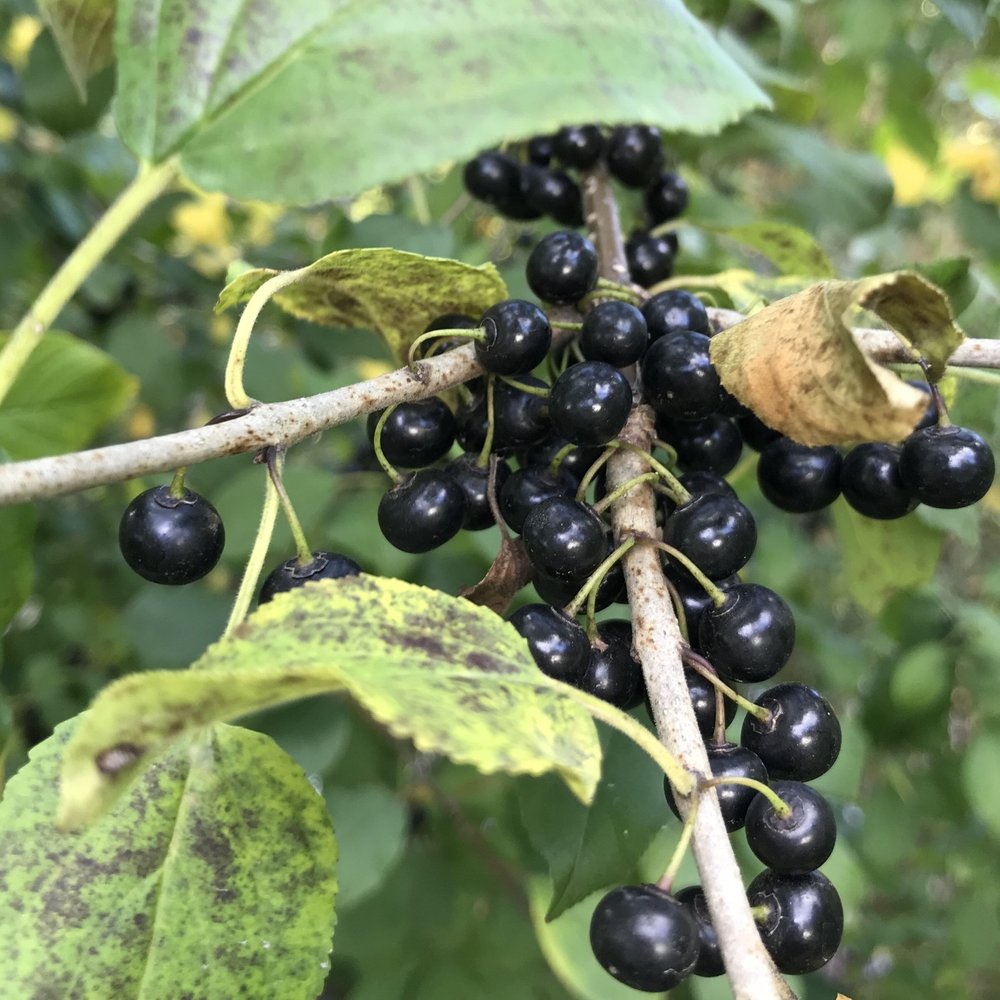
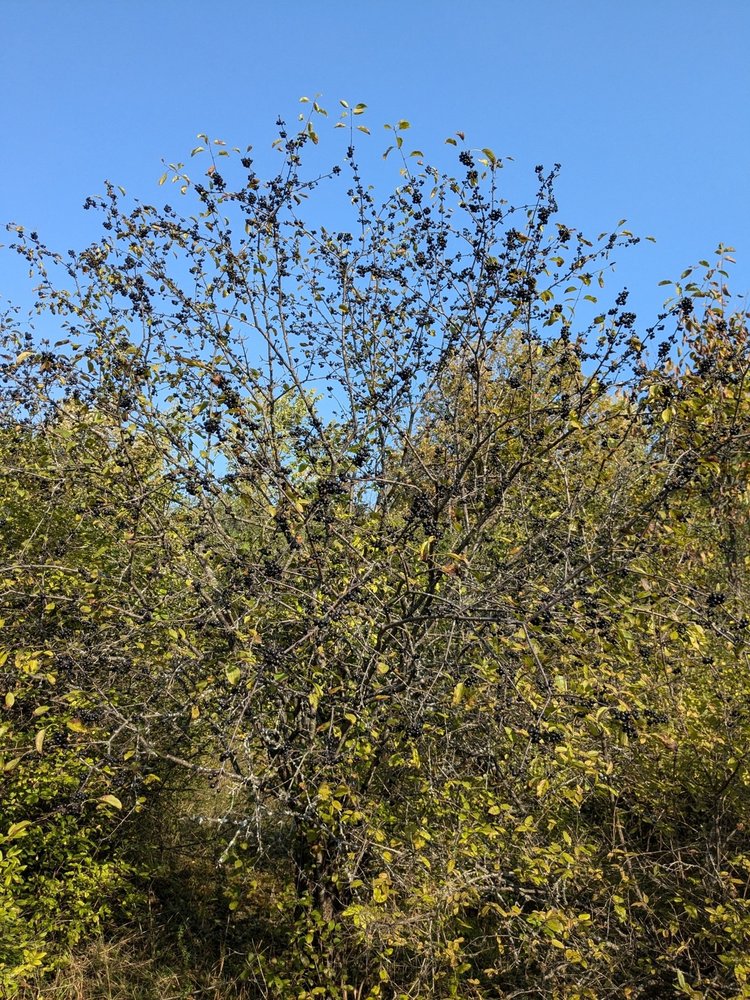
Common Buckthorn (Rhamnus cathartica) is an introduced, invasive shrub or small tree with poisonous, shiny black berries that ripen in August and September, glossy dark green leaves mostly in opposite or nearly opposite pairs, and a thorn at the tip of many twigs. It grows in the Black Hills: Wind Cave National Park lists it, and there are specimens from Fall River and Pennington counties in South Dakota and Crook County in Wyoming.
Free photos from other sources
| Family | Rhamnaceae · Buckthorn |
|---|---|
| Status | Introduced shrub |
| Blooms | May into June |
| Height | 2–6 m (7–20 ft) |
| Where | Woodland edges, fencerows, windbreaks, streambanks and disturbed ground, in sun or shade |
| Also called | European Buckthorn, Purging Buckthorn, Hart's Thorn |
| Toxicity | NC State Extension names the fruit as the poisonous part, glycosides as the poison, and nausea, vomiting and diarrhea as the symptoms. The Forest Service's Fire Effects Information System says the bark, leaves and fruit are all strongly purgative (they empty the bowels) when eaten, with nausea, stomach cramps, gastroenteritis (inflamed stomach and intestines), diarrhea and irritation of the stomach and intestine lining to the point of bleeding. SDSU Extension says the fruit is not edible for people and has a laxative effect. Montana State University Extension says the berries act as a laxative, that the fruit would have the same effect on people, with nausea, vomiting and colic (belly pain), and that the laxative effect in animals is severe. The University of Toronto Scarborough says the berries were once used as medicine for people, but that use ended because their purging effect was too powerful and caused excess dehydration. |
| Note | It is in this guide for its poisonous berries. SDSU Extension says many people have mistaken them for chokecherries and even made jam or jelly from them. |
Roots, seeds & germination
Root: Shallow and very fibrous; roots pulled from the ground are black throughout (Minnesota Wildflowers). Minnesota DNR calls the root system extensive and fibrous.
Seed: Birds eat the berries and spread the seeds in their droppings (SDSU Extension; Minnesota Wildflowers).
Germination: Seeds sprout from spring through late summer, though many can lie dormant in the soil for a year or more (SDSU Extension). Minnesota DNR says most viable seeds sprout within two years.
How do you identify Common Buckthorn?
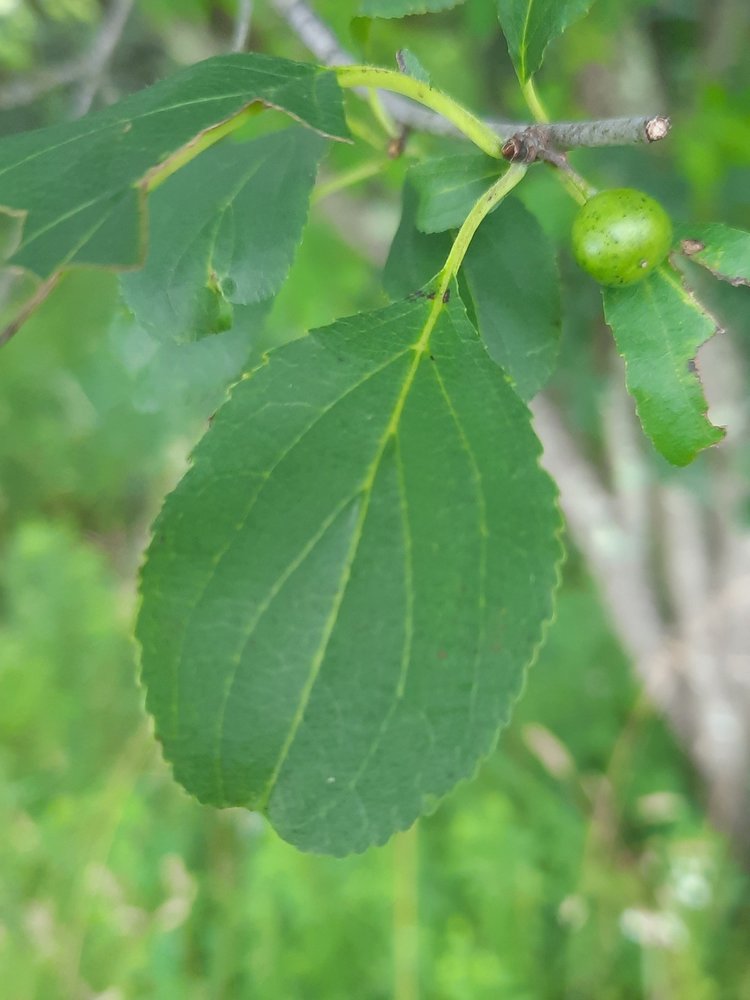
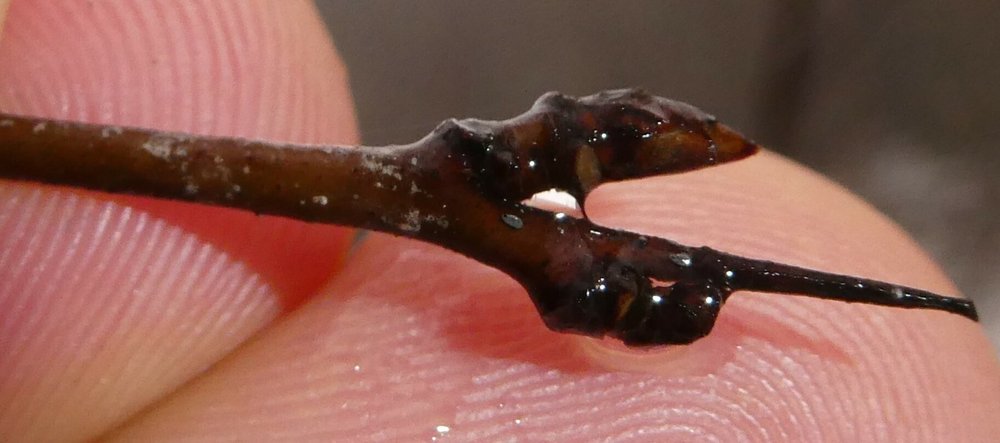
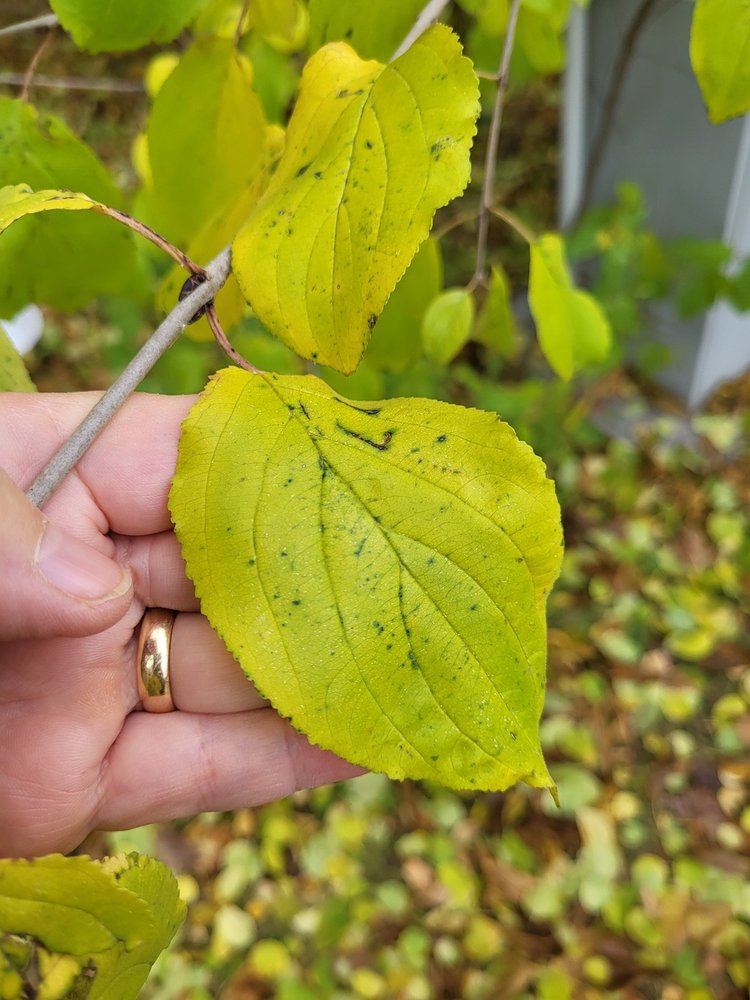
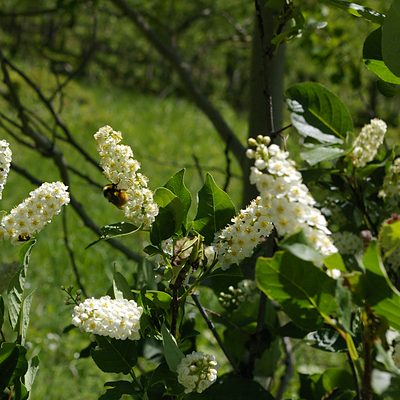
Look for a shrub or small tree 2–6 m (7–20 ft) tall (SDSU Open PRAIRIE). The bark is gray, brown or nearly black, smooth and often shiny on the branches, and turns scaly with age (SDSU Extension; SDSU Open PRAIRIE; Minnesota Wildflowers); scraping it shows a bright yellow-orange layer just underneath (Minnesota Wildflowers; Montana State University Extension). The leaves are egg-shaped to elliptical, 3–7 cm (1¼–2¾ in) long, glossy dark green above and paler beneath, with small rounded teeth along the edge (SDSU Open PRAIRIE; SDSU Extension). They grow in opposite or nearly opposite pairs, with some alternate (SDSU Open PRAIRIE; Minnesota Wildflowers; NC State Extension); Minnesota DNR describes them as alternate, sometimes opposite. Each side of the midrib has 3 or 4 side veins that curve strongly toward the tip (Minnesota Wildflowers). The leaves stay green late into fall, after most native woody plants have dropped theirs (Minnesota Wildflowers; Montana State University Extension). Twig tips often end in a short, straight thorn between two brown, scaly buds (Minnesota Wildflowers), and SDSU Extension adds that spines about 2.5 cm (1 in) long often grow at wide spacing along the stems. The flowers are small, yellowish green and clustered where the leaves join the twig, opening in May and June (SDSU Open PRAIRIE). Male and female flowers grow on separate plants (Montana State University Extension; NC State Extension), and the berries form on the female plants (Minnesota DNR). The fruit is a round berry 6–9 mm (¼–⅓ in) across, green at first and glossy black when ripe, with 2 to 4 seeds, ripening in August and September (SDSU Open PRAIRIE; Minnesota DNR). To tell the berries from chokecherries, SDSU Extension says each buckthorn berry is attached directly to the twig, while chokecherries are borne in clusters that are attached to the twig. Buckthorn berries do grow bunched together (Minnesota DNR), but each sits on its own short stalk (Minnesota Wildflowers). Chokecherry's flowers come in drooping, cylindrical clusters 5–10 cm (2–4 in) long, each of its fruits holds a single hard seed, and its leaves are alternate (Minnesota Wildflowers). Alder-leaved Buckthorn (Rhamnus alnifolia), a native buckthorn, is 1 m (3 ft) or less tall at maturity, with alternate leaves that have 5 to 8 veins per side, a pair of narrow leafy appendages (stipules) at the base of each leaf stalk, thornless side branches and 5-parted flowers in clusters of 1 to 3. Common Buckthorn grows much taller and bushier, with 3 or 4 veins per side, 4-parted flowers, many more flowers per cluster and far more fruit (Minnesota Wildflowers).
When does it bloom?
May into June.
Where does it grow?
Fencerows, hedges, windbreaks, woodlots, woods and neglected urban ground, in full sun to shade (SDSU Extension); Minnesota Wildflowers adds woodland edges and waste areas, and the Forest Service's Fire Effects Information System says it grows along streambanks and in disturbed areas in Wyoming. SDSU Open PRAIRIE says it was introduced to South Dakota in windbreaks and is now found throughout the state, and SDSU Extension calls it the most significant threat to tree plantings and native woodlands in eastern South Dakota. The plant list of Wind Cave National Park records it as present. GBIF holds five preserved specimens from Black Hills counties: one each from Fall River County (2018) and Pennington County (2012) in South Dakota, and three from Crook County, Wyoming (2002, 2011 and 2018). Their labels give a streambank with poplars (Populus) and elms (Ulmus), mixed riparian (streamside) forest near a creek, a spot beside a house with other ornamental plants, and, for one Crook County specimen in the Black Hills National Forest, “common along trail.” iNaturalist has 53 records from the Black Hills and its foothills, 24 of them research grade. It isn't on South Dakota's state noxious weed list or its locally noxious (county) list, or on Wyoming's state designated weed list, the 2025 declared-weed lists for Crook and Weston counties, or Wyoming's weed-seed lists. Minnesota Wildflowers says Minnesota listed it as a restricted noxious weed in 1999.
Other plants to compare
Sources: Minnesota Wildflowers: Common Buckthorn (Rhamnus cathartica); Minnesota Wildflowers: Alder-leaved Buckthorn (Rhamnus alnifolia); Minnesota Wildflowers: Chokecherry (Prunus virginiana); SDSU Extension: Woody weeds, common buckthorn; SDSU Open PRAIRIE, South Dakota Native Plant Research: Rhamnus cathartica (common buckthorn); NC State Extension Gardener Plant Toolbox: Rhamnus cathartica (European buckthorn); Montana State University Extension, Monthly Weed Post (February 2015): Common buckthorn; University of Toronto Scarborough, Department of Biological Sciences: Common buckthorn; USDA Forest Service, Fire Effects Information System: Rhamnus cathartica and R. davurica (common and Dahurian buckthorn); Minnesota Department of Natural Resources: Common buckthorn; USDA PLANTS Database: Rhamnus cathartica (RHCA3), introduced in the lower 48 states; GBIF occurrence search: Rhamnus cathartica, South Dakota (228 records, 26 preserved specimens); GBIF occurrence search: Rhamnus cathartica, Wyoming (13 records, 5 preserved specimens); NPSpecies checklist, Wind Cave National Park (vascular plants); iNaturalist: Rhamnus cathartica observations in the Black Hills; South Dakota DANR: State Noxious Weed and Pest List; South Dakota DANR: Locally Noxious Weed and Pest List (county designations, PDF; file named "Updated 2024"); Wyoming Weed and Pest Council: Identify Weeds (state designated weeds); Wyoming rule 010-63 Wyo. Code R. 63-3: Prohibited Noxious Weeds (weed-seed list); Wyoming rule 010-63 Wyo. Code R. 63-4: Restricted Noxious Weeds (weed-seed list); Wyoming Weed & Pest Council, report to the Legislature's agriculture committee (2025), with the Weed and Pest Declared List (By County) 2025 (Crook and Weston counties); invasivespeciesinfo.gov (USDA National Invasive Species Information Center): Common buckthorn.