White Pine Blister Rust
Cronartium ribicola
White Pine Blister Rust (Cronartium ribicola) is an introduced rust fungus that kills five-needle pines, making swollen, resinous cankers that release orange-yellow spores from white blisters in spring. Its other hosts are currants and gooseberries, where it spots the leaves. In the Black Hills it attacks the rare limber pine: it was first reported there in 1992, and state forest health reports say it is weakening the couple of hundred limber pines left in the central Hills.
Free photos from other sources
| Family | Cronartiaceae · Blister rust |
|---|---|
| Type | Rust |
| Status | Introduced |
| Season | All year; white blisters of orange-yellow spores on pine cankers April to June, rust on currant leaves summer into fall |
| Size | Cankers on twigs, branches and trunks; a branch canker grows about 8 cm (3 in) a year toward the trunk |
| Grows on | Bark of limber pine; leaves of currants and gooseberries |
| Synonym | Peridermium strobi |
| Eating | This guide doesn't say which mushrooms are safe to eat. |
How it lives
An introduced rust fungus: an Asian species that reached North America from Europe in the early 1900s. It needs two hosts and cannot spread from pine to pine. In late summer and fall, spores from currant and gooseberry leaves infect pine needles, usually within a few hundred feet of the shrubs; the fungus grows down the needle into the bark and forms a canker that keeps spreading. A few years later the canker begins making spores each spring, which the wind can carry for hundreds of miles to currant and gooseberry leaves; there new spores reinfect the shrubs all summer, and in late summer and fall they make the spores that go back to pine. Cankers girdle and kill branches, treetops and whole trees, and small trees die quickly. In the Black Hills, this rust and crowding by other trees are the two main stresses on the relict limber pine.
How do you identify White Pine Blister Rust?
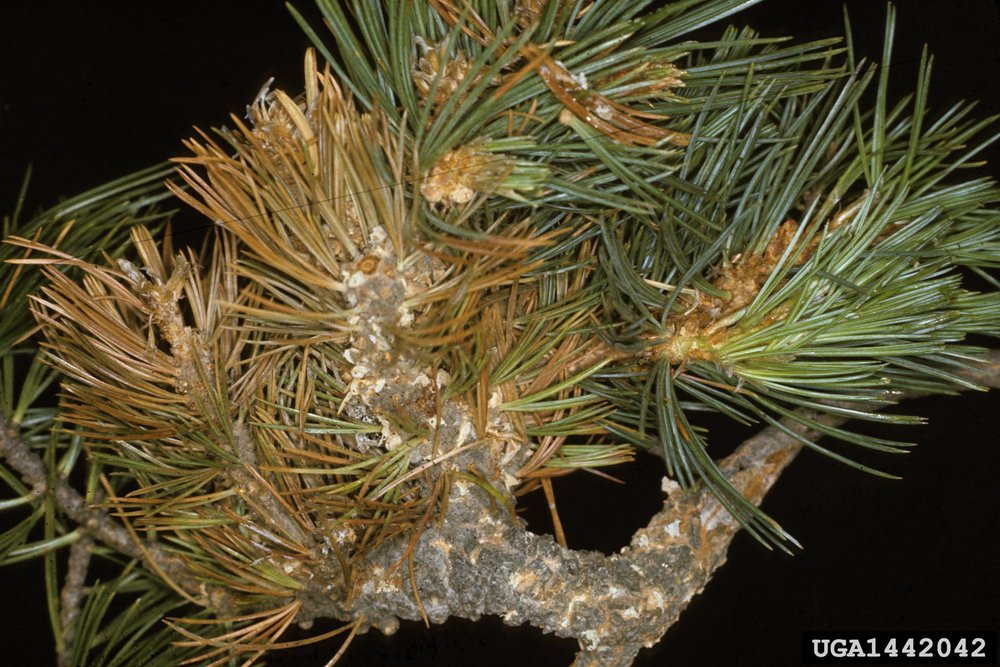
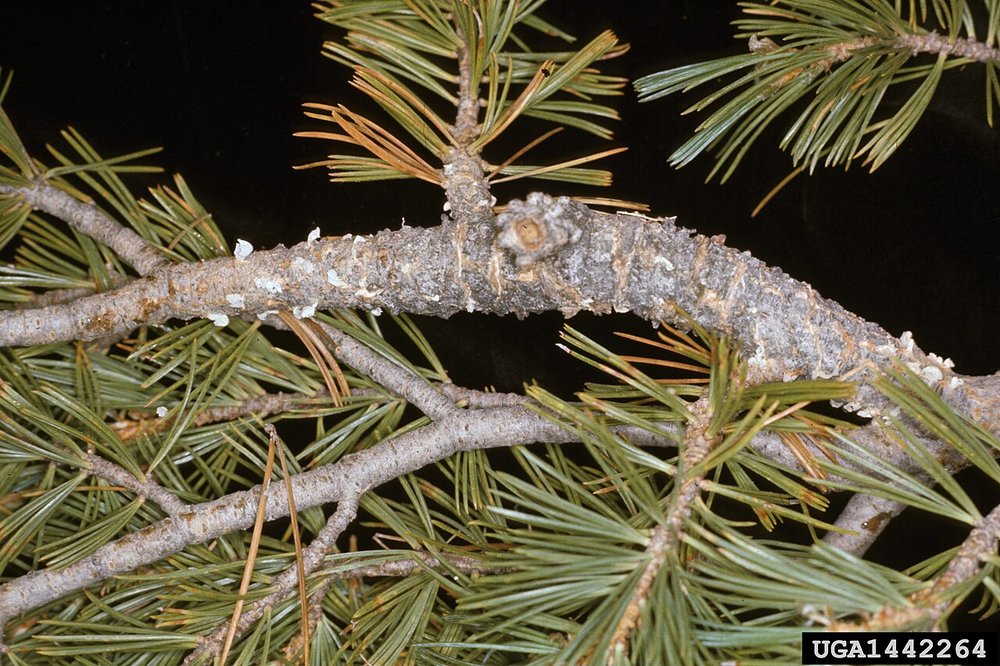
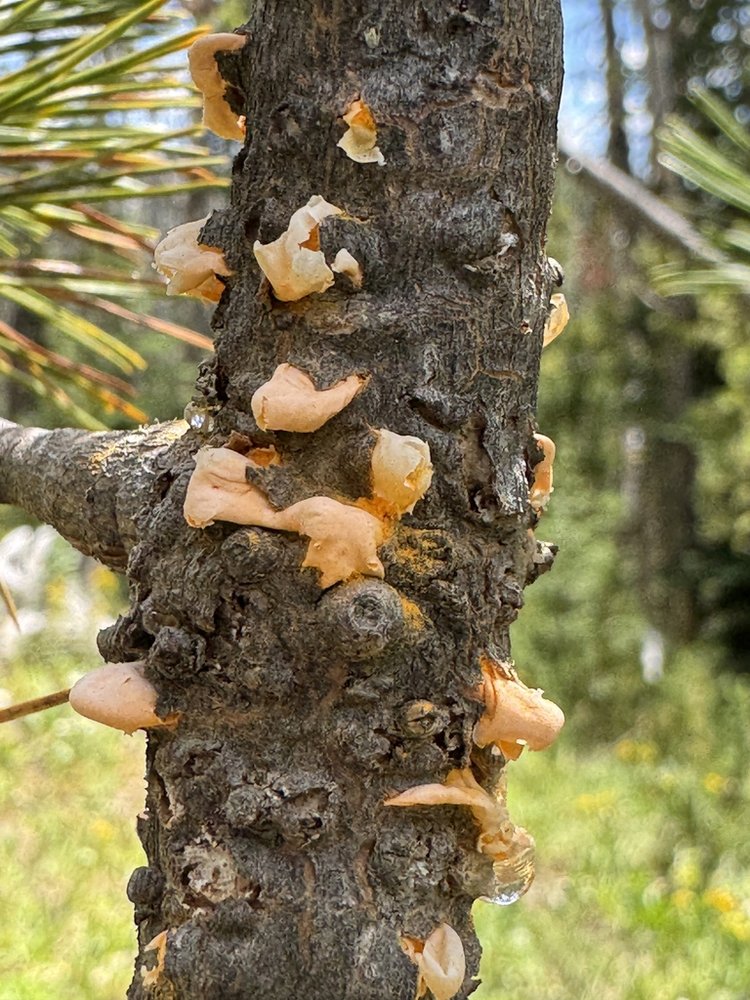
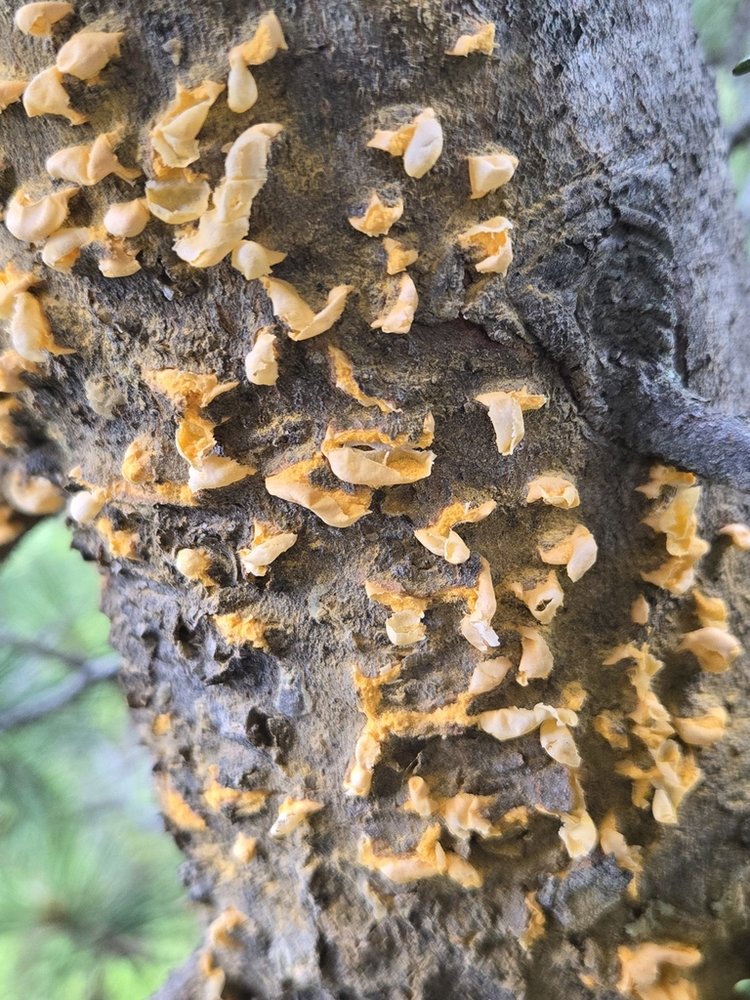
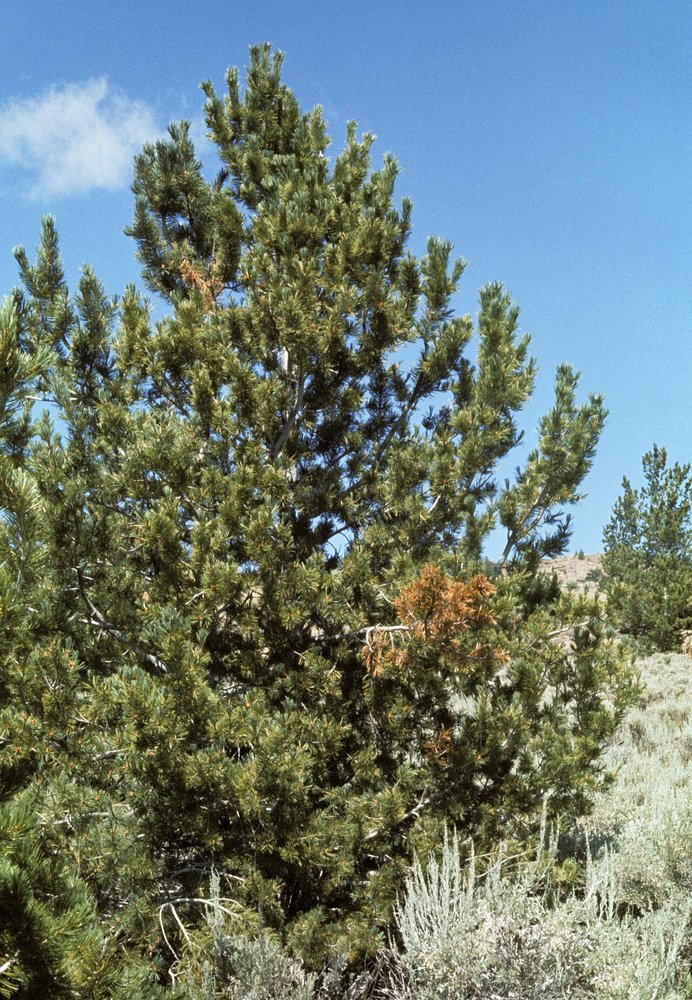
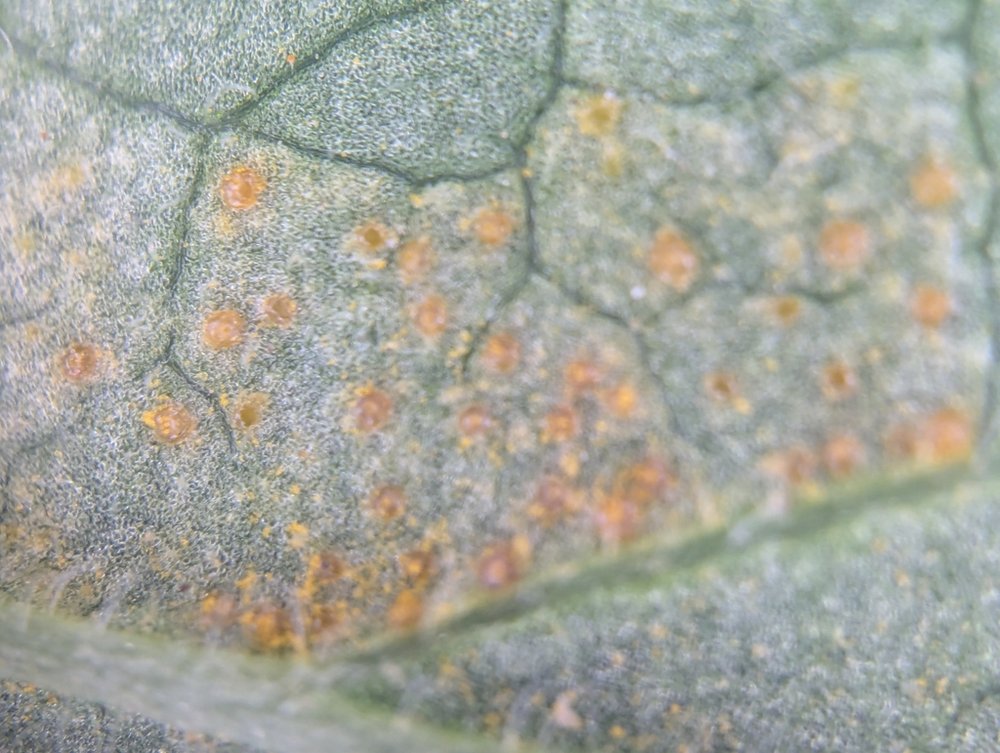
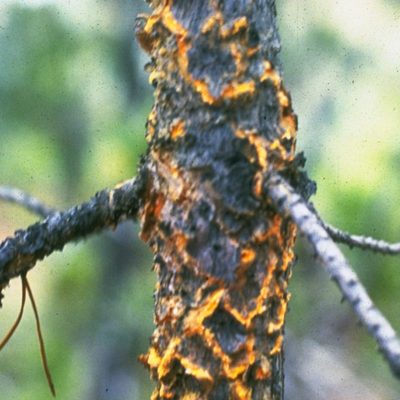
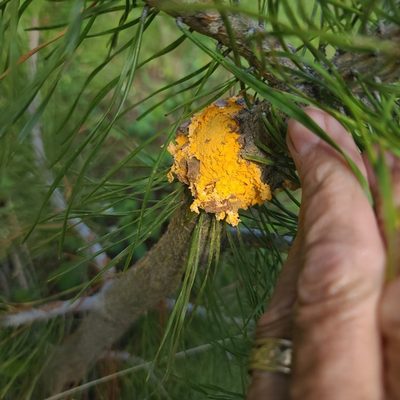
In the Black Hills, look on limber pine. From a distance the plainest sign is a flagged branch, a whole branch of recently killed, bright red needles. Up close, the canker is a swollen, spindle- or diamond-shaped patch of bark, often resinous, edged with a narrow band of yellowish or orange bark. From about April to June, white blisters push through the canker's bark and break open to release powdery orange-yellow spores. Afterward the bark turns rough and dark, rodents often gnaw it away around the canker and leave patches of bare white wood, and large trunk cankers run with streaks of white pitch. On currant and gooseberry leaves it makes yellow spots on top and raised orange pustules underneath, then brownish, hair-like columns in late summer and fall. Canada's forest service notes that it is the only stem rust of white pines, so its host sets it apart from other Cronartium rusts; the stem rusts recorded on Black Hills ponderosa pine are western gall rust, comandra blister rust and limb rust. Red flagging can also come from other causes, such as twig beetles, and resinous cankers at the base of a trunk can look like Armillaria root disease, which shows white fans of fungus under the bark.
When can you find it?
All year; white blisters of orange-yellow spores on pine cankers April to June, rust on currant leaves summer into fall.
Where does it grow?
Limber pine, a five-needle pine that grows in the Black Hills only in a few small, isolated relict stands in the central Hills. A 1992 disease note by Forest Service pathologists gave the first South Dakota record, on limber pine and wax currant in a Black Hills stand about 160 km (100 mi) from the nearest other limber pine stand and 240 km (150 mi) from the nearest known population of the rust; spores were found on about 10 percent of the pines and of the currants. South Dakota forest health reports from 2002 to 2014 say it is causing decline in the Black Hills limber pine, by 2009 only a couple of hundred trees, with stem cankers and some deaths by 2010 and only a few new infections found in 2014. iNaturalist has no Black Hills records.
Other mushrooms to compare


Sources: Lundquist, Geils & Johnson 1992, White Pine Blister Rust on Limber Pine in South Dakota, Plant Disease 76: 538 (disease note) — American Phytopathological Society; South Dakota Forest Health Highlights 2002 — USDA Forest Service and South Dakota; South Dakota Forest Health Highlights 2009 — USDA Forest Service and South Dakota; South Dakota Forest Health Highlights 2010 — USDA Forest Service and South Dakota; South Dakota Forest Health Highlights 2014 — USDA Forest Service and South Dakota; Boldt & Van Deusen 1974, Silviculture of Ponderosa Pine in the Black Hills, Research Paper RM-124 — USDA Forest Service; Lundquist 1991, Tree Disease Survey of Conifers in the Black Hills - 1990, Technical Report R2-51 — USDA Forest Service; Field Guide to Diseases & Insects of the Rocky Mountain Region, RMRS-GTR-241 (2010): White Pine Blister Rust — USDA Forest Service; White Pine Blister Rust, Picture Sheet No. 22 (1948) — USDA Bureau of Entomology and Plant Quarantine; White pine blister rust, Forest invasive alien species — Natural Resources Canada; White pine blister rust — University of Minnesota Extension; Cronartium ribicola, record 452103 — Species Fungorum; Cronartium ribicola specimens, South Dakota (none from the Black Hills) — GBIF; Black Hills observations of Cronartium ribicola (research) — iNaturalist.