Red-belt Conk
Fomitopsis schrenkii
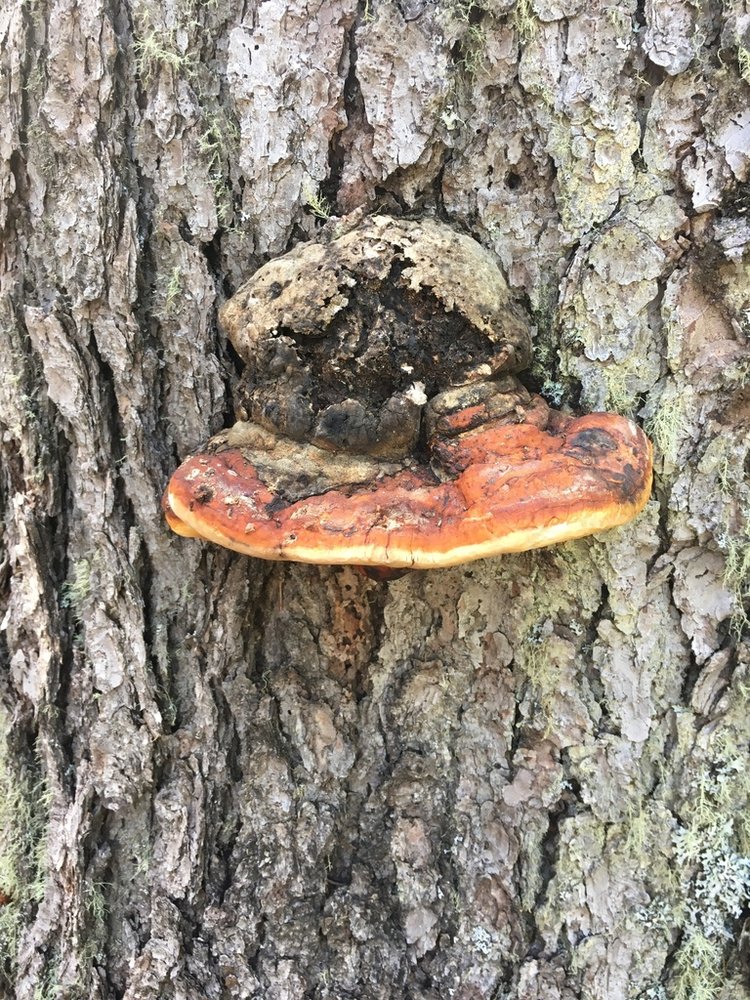
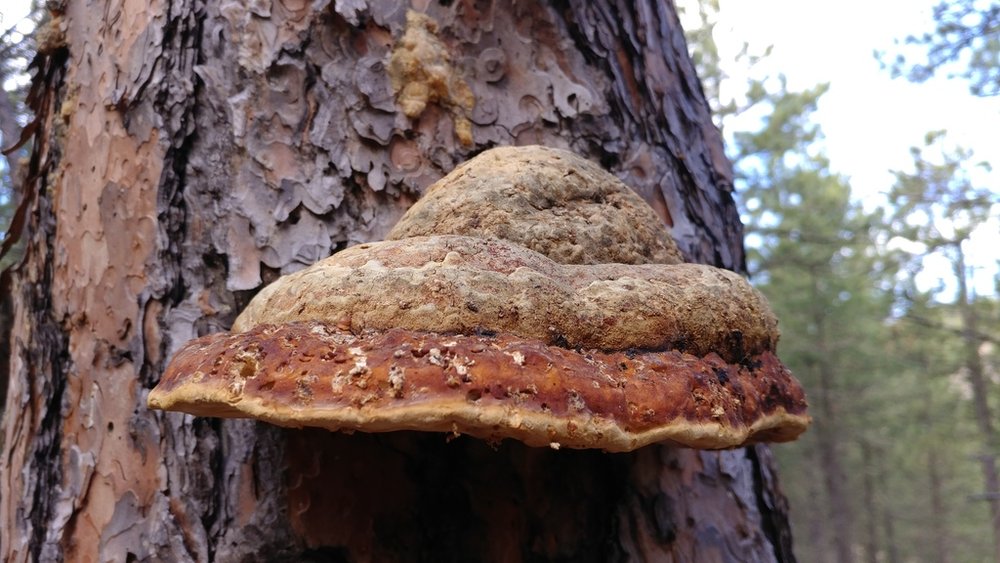
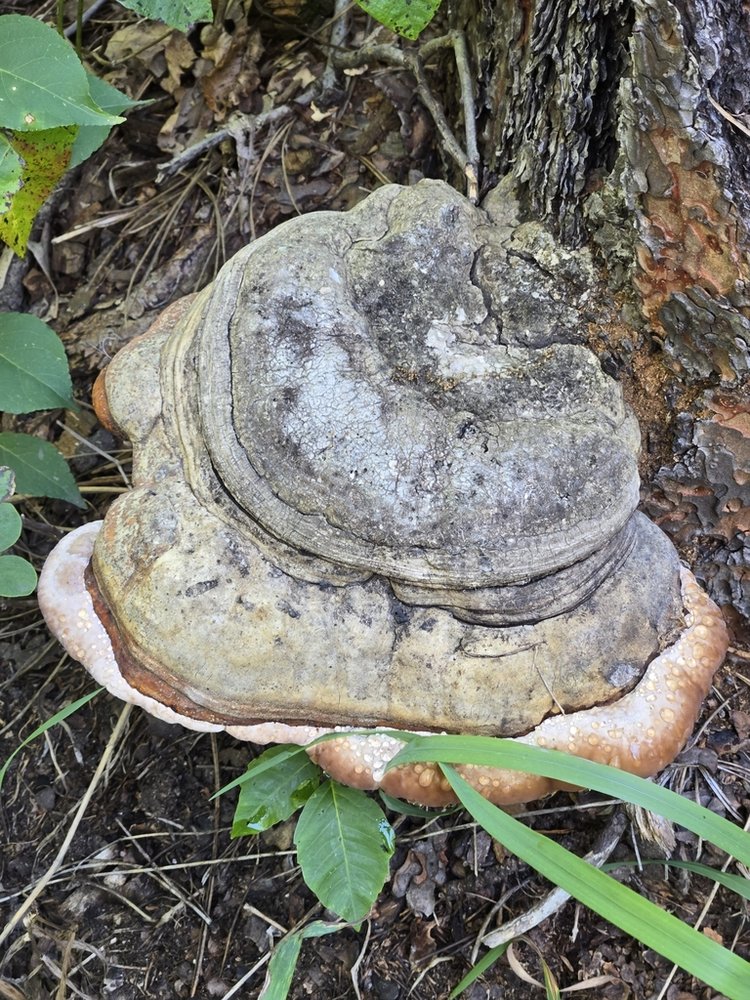
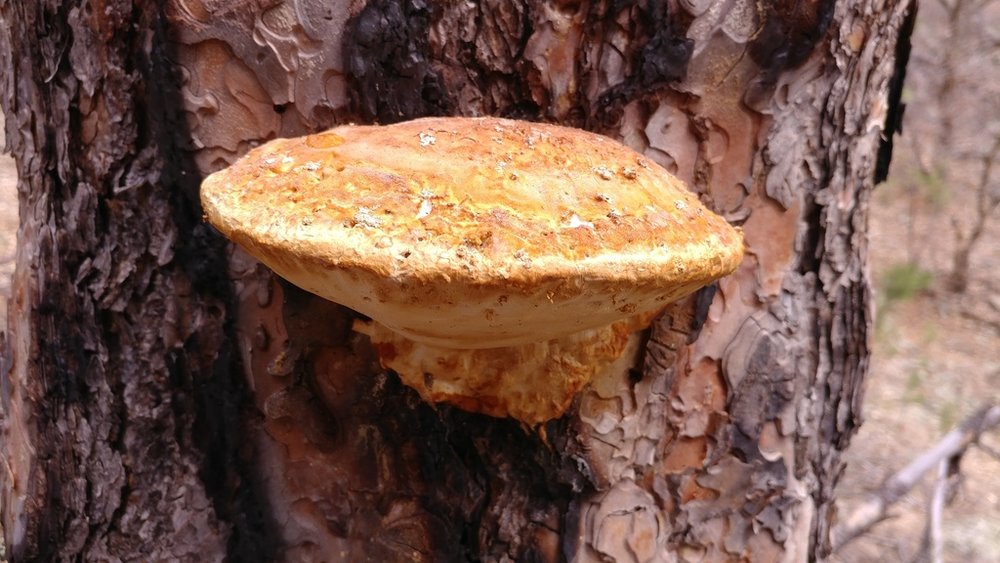
Red-belt Conk (Fomitopsis schrenkii) is a hard, woody shelf fungus with a cream rim, a red-orange band just inside it and a darker, often black top. It grows all year on dead ponderosa pine snags, stumps and logs, and a 1978 Forest Service survey called it the most common decay fungus of dead ponderosa pine in the Black Hills.
Free photos from other sources
| Family | Fomitopsidaceae · Fomitopsis |
|---|---|
| Type | Shelf fungus |
| Season | All year; the conks live for years and add a pore layer each year |
| Size | Shelf 4–18 cm (1½–7 in) wide, rarely to 27 cm (11 in), and 2–7 cm (¾–2¾ in) thick |
| Grows on | Dead ponderosa pine and other conifers: snags, stumps and logs |
| Also called | Schrenk's Red-belt Conk, Red-belted Polypore, Red-belted Conk, Redbelt Fungus |
| Synonym | Polyporus ponderosus |
| Eating | This guide doesn't say which mushrooms are safe to eat. |
| Note | Named in 2019 from a Black Hills specimen; older guides call it Fomitopsis pinicola. |
How it lives
A brown-rot fungus: it breaks down the cellulose in wood and leaves the lignin behind, so the wood turns yellowish, then brown and crumbly, and cracks into cubes with white sheets of fungus in the cracks. It is almost entirely a decayer of dead trees, stumps and slash, and it rots sapwood and heartwood alike. Ponderosa pines killed by fire or bark beetles are often invaded and decay fast. The lignin-rich brown residue it leaves becomes a lasting part of the forest soil, where it holds water and stores carbon, and the rotted snags and logs are homes for many birds, mammals and amphibians.
How do you identify Red-belt Conk?
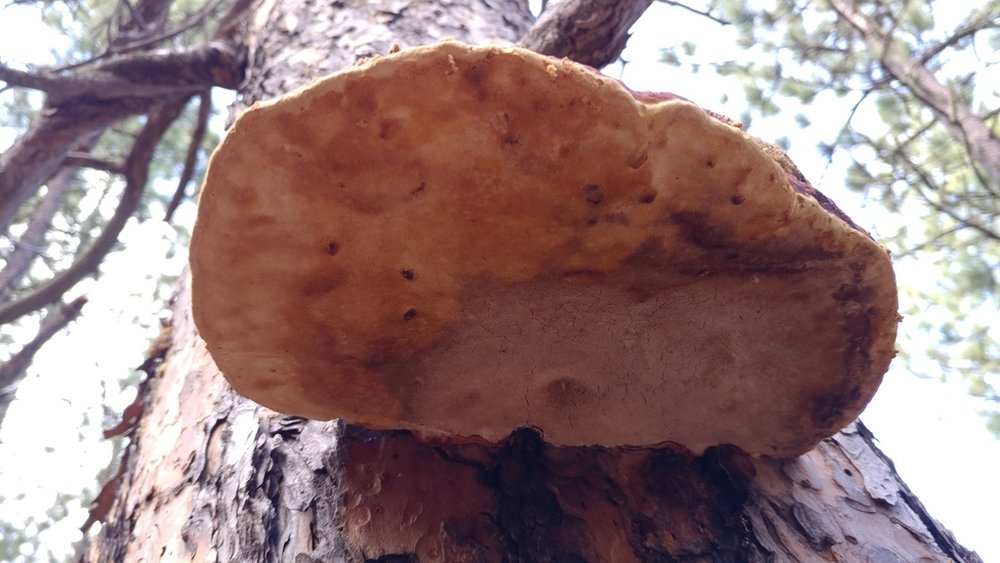
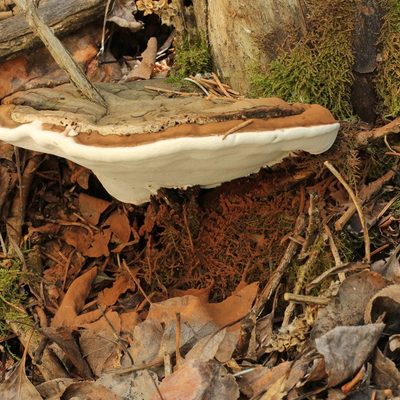
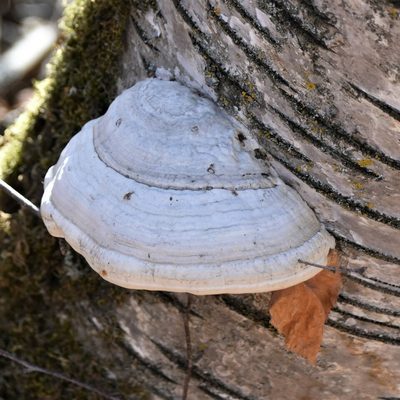
A woody conk with no stem, attached by its side, shelf- to hoof-shaped and 4–18 cm (1½–7 in) wide. The top is smooth at first, then knobby, often with a shiny, black, resinous crust. It is black or dark brown near the tree, then a red-orange to reddish-brown band, then a white to cream rim while the conk is growing. The band can be missing, and young conks start as white or cream lumps. Underneath is a cream to pale yellow pore surface with 3–4 tiny round pores per mm, and the flesh is pale yellow to buff and woody. Artist's Conk has a dull brown or gray top with no band and no resin, brown flesh, and a white underside that turns dark brown at once where scratched; in the Rocky Mountains it grows mostly at the base of living aspen. Tinder Conk is a gray, zoned hoof on birch with a brownish pore surface. Rosy Conk (Rhodofomes cajanderi), also on dead conifers, has a pink pore surface and pinkish flesh.
When can you find it?
All year; the conks live for years and add a pore layer each year.
Where does it grow?
Dead conifers, mostly ponderosa pine: standing snags, stumps, logs and slash. It also rots dead parts of living trees, rarely gets into a living conifer through a big wound or broken top, and rarely grows on hardwoods. Jewel Cave lists it all year on the sides of pines, Mount Rushmore's species list includes it (as Fomitopsis pinicola), and iNaturalist has 78 research-grade Black Hills records, 25 of them in Custer State Park and 3 in Wind Cave National Park. Dated herbarium specimens from the Hills go back to 1914, many of them on ponderosa pine, and a 1991 Forest Service review lists Black Hills reports from 1936 to 1978 on several ranger districts. Until 2019, North American guides called this fungus Fomitopsis pinicola. DNA studies led by Forest Service mycologists then showed that true F. pinicola lives only in Europe and Asia, that the red-belt of Canada, the northern states and the Appalachians is F. mounceae, and that the one of the West and Southwest, including the Black Hills, is F. schrenkii. The new species was described from a specimen collected on ponderosa pine in Custer County in 2014. Hermann von Schrenk had described the same fungus as Polyporus ponderosus from Black Hills pine in 1903, but another fungus already had that name; the 2019 name honors him.
Other mushrooms to compare
Sources: Haight et al. 2019, Fomitopsis mounceae and F. schrenkii, two new species from North America in the F. pinicola complex (Mycologia 111: 339–357) — USDA Forest Service copy; Lundquist 1991, Fungi Associated with Pines in the Black Hills (Technical Report R2-50) — USDA Forest Service; Field Guide to Diseases & Insects of the Rocky Mountain Region (RMRS-GTR-241, 2010) — USDA Forest Service; Mushrooms and Other Fungi, Jewel Cave National Monument — National Park Service; NPSpecies checklist: Fungi, Mount Rushmore National Memorial — National Park Service; Fomitopsis mounceae (M. Kuo) — MushroomExpert.com; Rhodofomes cajanderi (M. Kuo) — MushroomExpert.com; Ganoderma applanatum (M. Kuo) — MushroomExpert.com; Fomes fomentarius (M. Kuo) — MushroomExpert.com; Fomitopsis schrenkii, synonymy — Species Fungorum (Index Fungorum); Fomitopsis schrenkii: research-grade records in the six Black Hills places — iNaturalist; Specimens filed as Fomes pinicola, South Dakota — GBIF.