Deadly Galerina
Galerina marginata
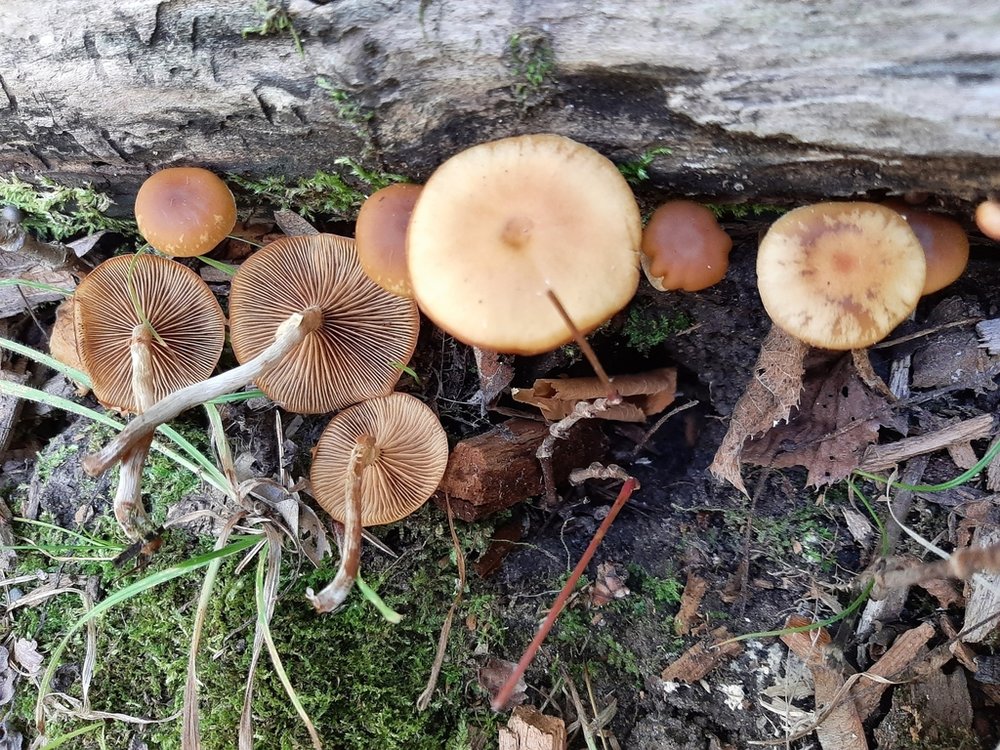
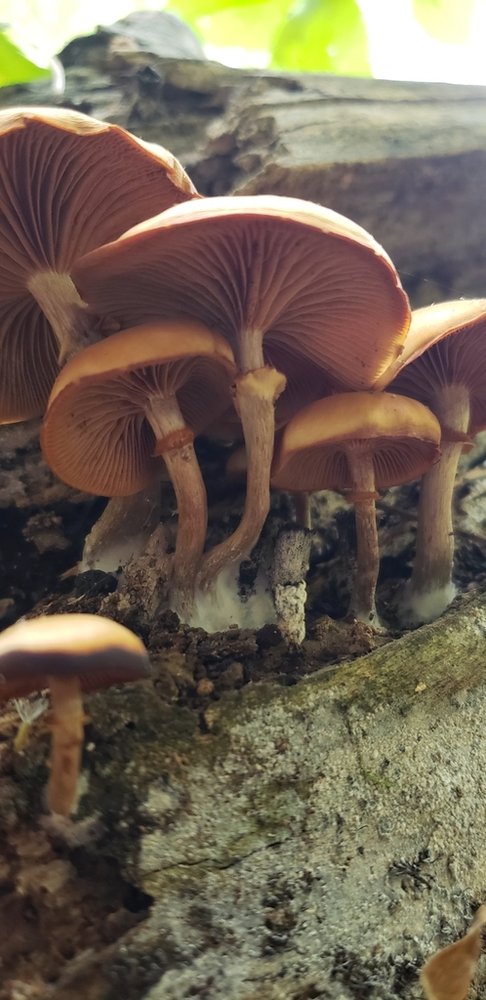
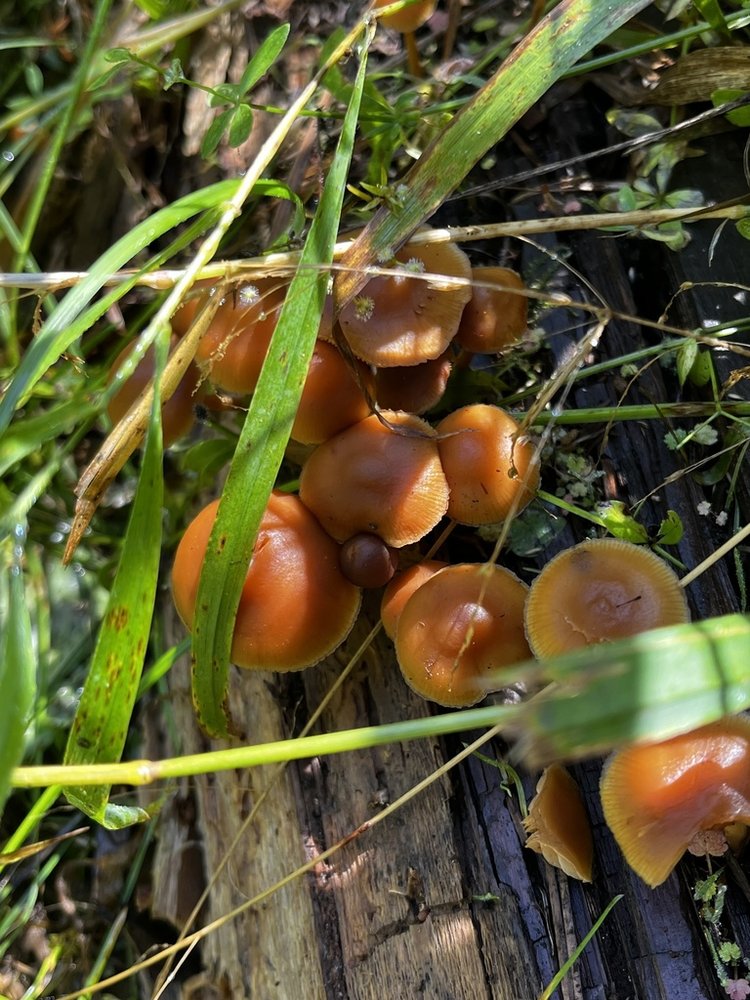
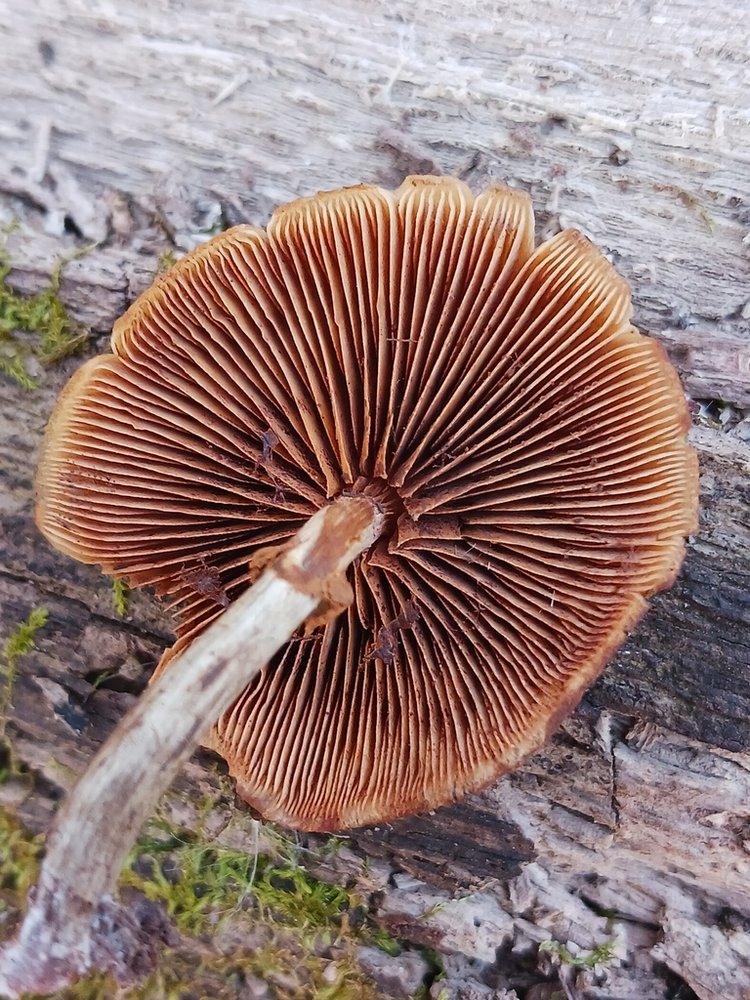
Deadly Galerina (Galerina marginata) is a small brown mushroom with a sticky, honey-yellow to cinnamon cap, gills that turn rusty brown and a thin ring or ring zone on the stem, growing in clusters on rotting wood. It is reported in the Black Hills only from two iNaturalist records in Lawrence County, both from June and neither confirmed.
Free photos from other sources
| Family | Hymenogastraceae · Galerina |
|---|---|
| Type | Gilled mushroom |
| Season | June to September: the two Black Hills reports on iNaturalist, neither confirmed, are from June, and herbarium specimens from Wyoming's mountains were collected from late July to mid-September |
| Size | Cap 1.5–5 cm (½–2 in) wide, stem 2–7.5 cm (¾–3 in) tall |
| Grows on | Rotting logs, stumps and buried wood of conifers and hardwoods |
| Spore print | Rusty brown |
| Also called | Funeral Bell, Autumn Skullcap |
| Synonym | Galerina autumnalis, Pholiota autumnalis, Pholiota marginata, Galerina unicolor |
| Toxicity | Deadly poisonous: it contains amatoxins, the same poison as the destroying angels, which destroy the liver and kidneys. The North American Mycological Association's case registry lists nine people, eight adults and a child, poisoned by it under its older names Galerina autumnalis and G. venenata, with stomach upset, drowsiness, liver damage, kidney failure and one death, and a dog with altered liver and kidney function. |
| Eating | This guide doesn't say which mushrooms are safe to eat. |
How it lives
A saprobe: it lives on dead wood of conifers and hardwoods and breaks it down, leaving a stringy white rot. It tends to come up on wood that is already well rotted.
How do you identify Deadly Galerina?
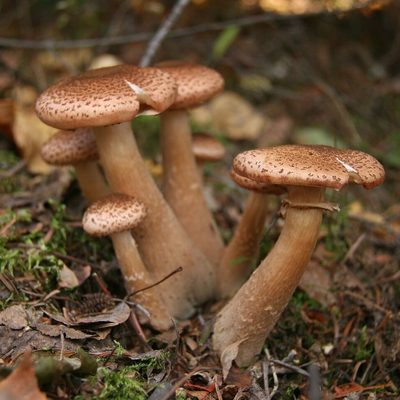
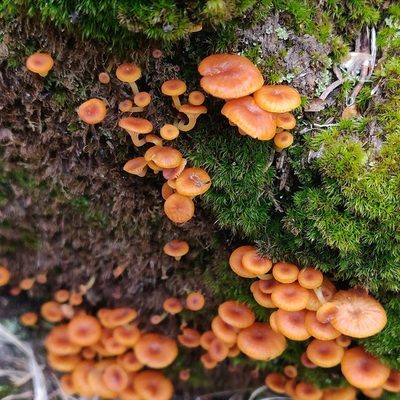
Look for small brown mushrooms on rotting wood, usually in clusters but sometimes scattered or alone. The cap is 1.5–5 cm (½–2 in) wide, sticky when fresh or wet, bald, honey-yellow with an orange tint at first, then cinnamon to brownish orange, and it often fades a lot as it dries, so it looks two-toned; the edge becomes finely lined. The gills attach broadly to the stem and are yellowish at first, then rusty brown. The thin stem is whitish to brownish and darkens from the base up. It usually has a thin, whitish to rusty-brown ring that collapses into a band, but sometimes only a ring zone or no ring at all, and there is white fuzz at the base. The spore print (the dust the gills drop) is rusty brown. Honey Mushroom (Armillaria solidipes) also grows in clusters on wood and has a ring, but its spore print is white, and a large Galerina cluster can pass for honey mushrooms if the spore print and gill color aren't checked. Pholiota species drop a dark brown spore print rather than a rusty brown one, and their caps are often scaly. One of them, Scaly Pholiota (Pholiota squarrosa), has research-grade Black Hills records on iNaturalist; its dry, yellow-brown cap is covered with brownish scales, and its stem is scaly like the cap. Pinewood Gingertail (Xeromphalina campanella) also clusters on rotting conifer wood; its orange to rusty caps are no more than 2.5 cm (1 in) wide, its gills run down the stem and are joined by cross-veins, its wiry stem has a tuft of orange fuzz at the base, and its spore print is white to buff.
When can you find it?
June to September: the two Black Hills reports on iNaturalist, neither confirmed, are from June, and herbarium specimens from Wyoming's mountains were collected from late July to mid-September.
Where does it grow?
Rotting logs, stumps and buried wood of both conifers and hardwoods; growing from buried wood, it can look as if it comes up from soil. Reported in the Black Hills: iNaturalist has one record named Galerina marginata (Lawrence County, June 2019) and one filed to the Galerina marginata group (Lawrence County, June 2025), both in the national forest and both still awaiting confirmation. GBIF holds no South Dakota specimen, and Wyoming's 25 specimens all come from mountains outside the Black Hills. No published Black Hills source opened for this guide names it.
Other mushrooms to compare
Sources: Kuo, Galerina marginata (2016) — MushroomExpert.com; Emberger, Galerina marginata (Deadly Galerina) — Fungi Growing on Wood, archived at MushroomExpert.com; Volk, Galerina autumnalis, the deadly Galerina: Fungus of the Month, May 2003 — University of Wisconsin-La Crosse; Deadly Galerina — Missouri Department of Conservation Field Guide; Mushroom Poisoning Syndromes — North American Mycological Association; Beug, Shaw & Cochran, Thirty-Plus Years of Mushroom Poisoning: Summary of the Approximately 2,000 Reports in the NAMA Case Registry (McIlvainea 16, 2006) — North American Mycological Association; Beug, Summary of the Poisoning Reports in the NAMA Case Registry for 2006 through 2017 — North American Mycological Association; Species Fungorum: Galerina marginata, species synonyms — Royal Botanic Gardens, Kew; iNaturalist: Galerina marginata taxon page data (English names Funeral Bell, Deadly Galerina, autumn skullcap); iNaturalist: Galerina marginata in the Black Hills places (Black Hills ecoregions, Black Hills National Forest, Wind Cave NP, Custer SP); iNaturalist: Galerina (all records, needs ID) in the Black Hills places (Black Hills ecoregions, Black Hills National Forest, Wind Cave NP, Custer SP); GBIF: Galerina marginata specimens from Wyoming (25, none from the Black Hills); GBIF: Galerina marginata specimens from South Dakota (none); Kuo, Armillaria solidipes (2023) — MushroomExpert.com; Kuo, Xeromphalina campanella (2014) — MushroomExpert.com; Emberger, Xeromphalina campanella — Fungi Growing on Wood, archived at MushroomExpert.com; iNaturalist: Pholiota squarrosa in the Black Hills places (Black Hills ecoregions, Black Hills National Forest, Wind Cave NP, Custer SP); Emberger, Pholiota squarrosa (Scaly Pholiota) — Fungi Growing on Wood, archived at MushroomExpert.com.