Pinewood Gingertail
Xeromphalina campanella
Pinewood Gingertail (Xeromphalina campanella) is a tiny orange mushroom, with caps no more than 2.5 cm (1 in) across, that grows in dense clusters on rotting pine logs and stumps. Jewel Cave National Monument lists it from May through September after soaking rains, and iNaturalist's research-grade Black Hills records are from late May and June.
Free photos from other sources
| Family | Xeromphalinaceae · Gingertail |
|---|---|
| Type | Gilled mushroom |
| Season | May through September after soaking rains; most Black Hills iNaturalist records are from late May and June |
| Size | Cap 0.5–2.5 cm (¼–1 in) wide, stem 1–5 cm (½–2 in) tall |
| Grows on | Rotting pine logs and stumps |
| Spore print | White to buff |
| Also called | Fuzzy Foot, Golden Trumpet, Tiny Trumpet, Bell Omphalina |
| Synonym | Omphalina campanella, Omphalopsis campanella |
| Eating | This guide doesn't say which mushrooms are safe to eat. |
How it lives
A saprobe: it lives on dead conifer wood and helps break it down, fruiting in clusters on logs and stumps.
How do you identify Pinewood Gingertail?
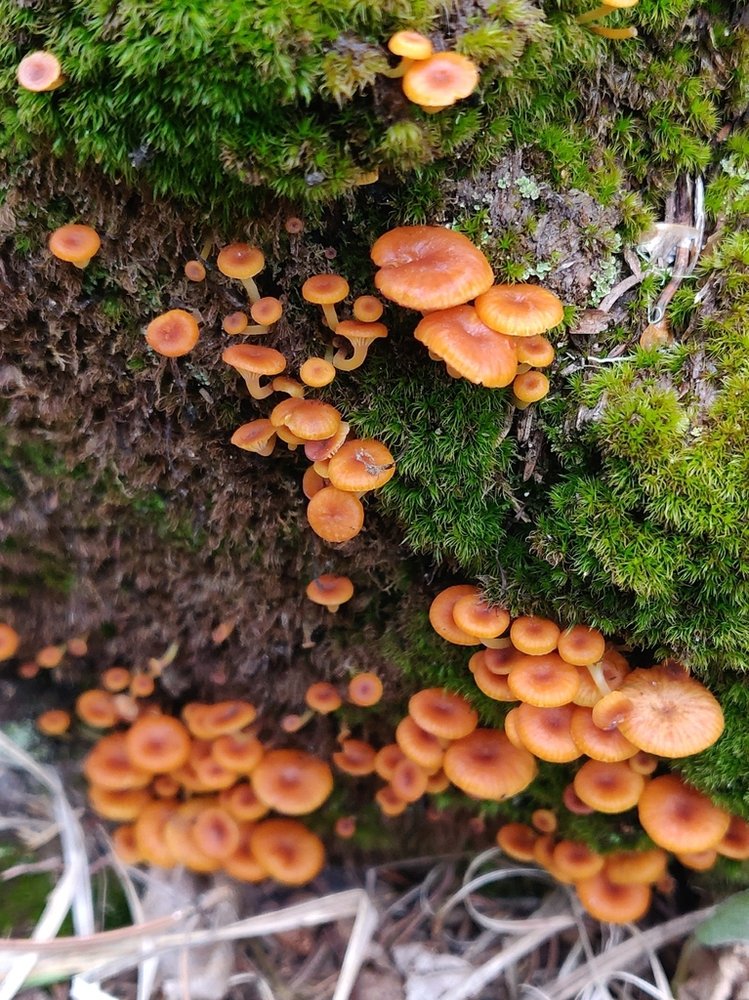
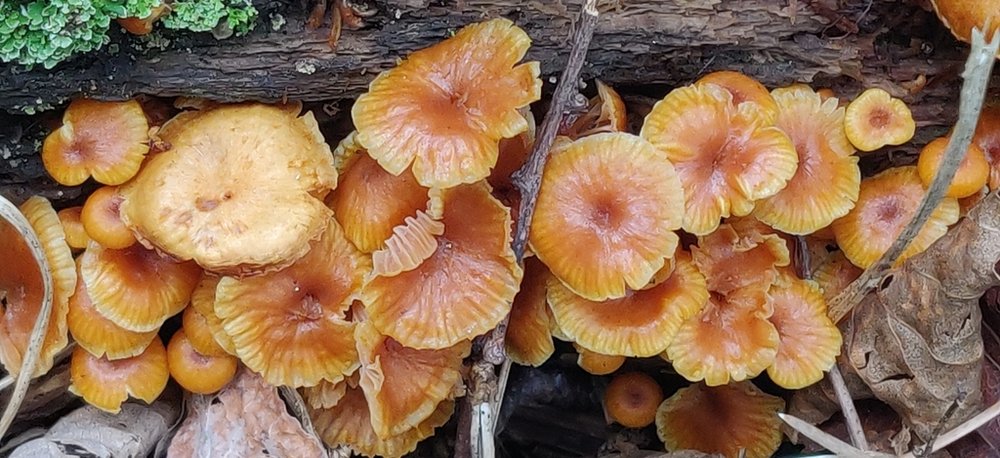
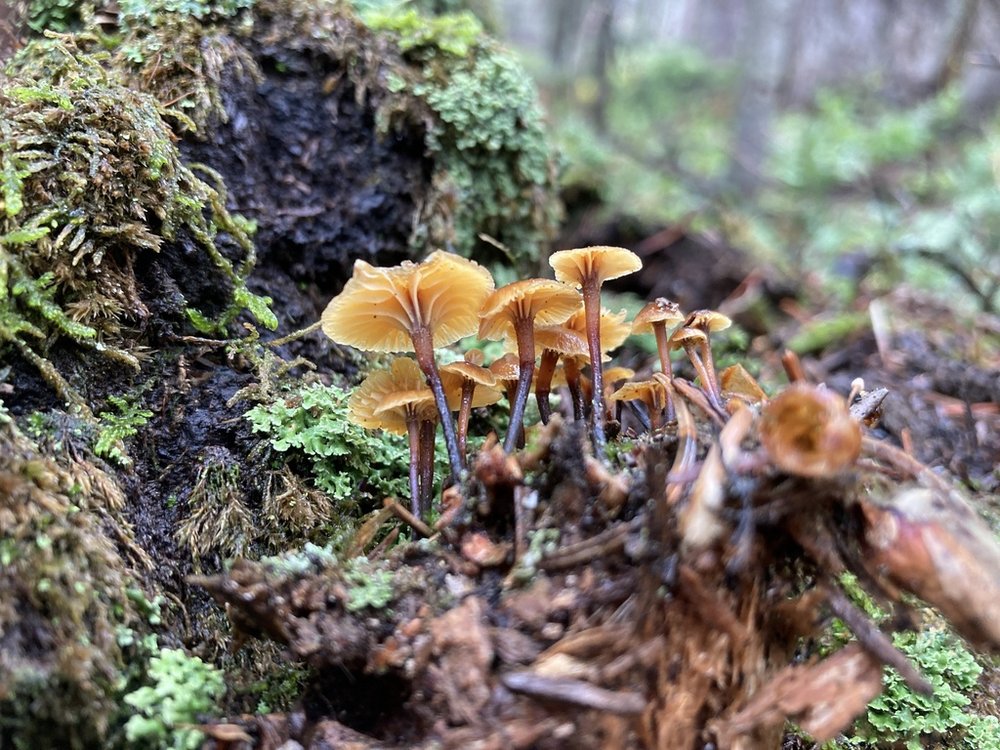
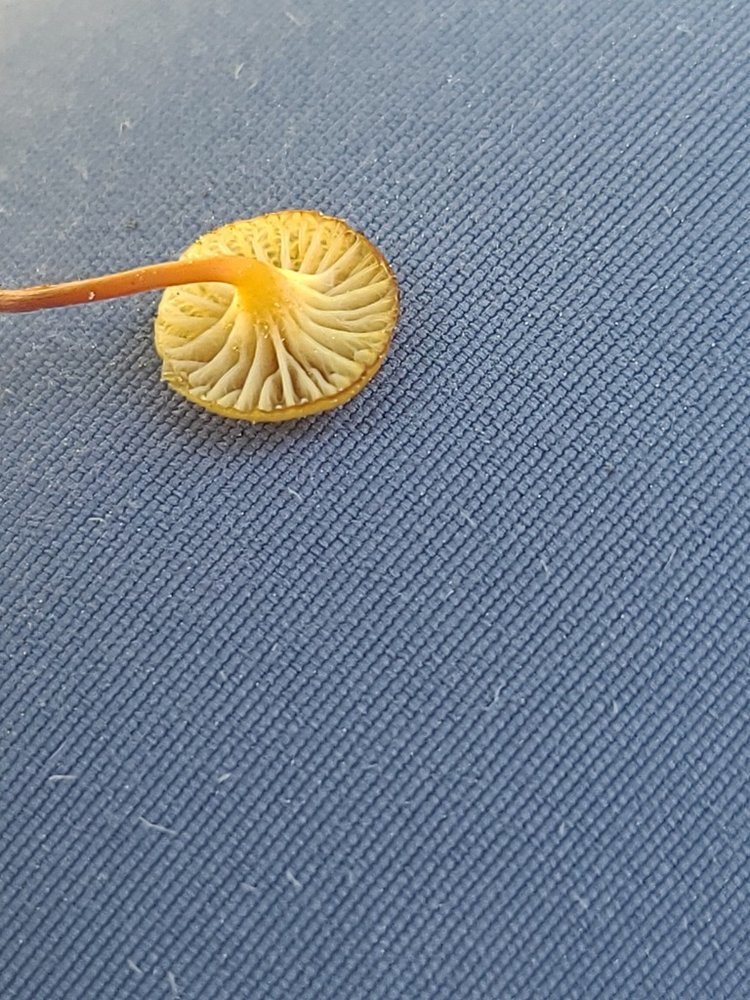
Look for dense clusters of small caps on a rotting conifer log or stump, often among moss. Caps are 0.5–2.5 cm (¼–1 in) wide, yellow-orange to rusty orange, darker and sunken in the middle, with a lined edge, and they turn up as they age. The pale yellow to orange gills run down the stem and are joined by cross-veins. The stem is thin, wiry and tough, yellowish at the top and reddish brown below, with a tuft of orange fuzz at the base. The spore print is white to buff. The Pinelitter Gingertail (Xeromphalina cauticinalis), which also has research-grade Black Hills records on iNaturalist, grows in troops on needle duff on the ground rather than in clusters on logs, and its gills attach broadly or only begin to run down the stem. Deadly Galerina (Galerina marginata), reported on iNaturalist from Lawrence County, also clusters on rotting wood, but it has a sticky, honey to cinnamon-brown cap, usually a ring or ring zone on the stem, and a rusty-brown spore print. It contains amatoxins, which destroy the liver and kidneys.
When can you find it?
May through September after soaking rains; most Black Hills iNaturalist records are from late May and June.
Where does it grow?
Rotting pine logs and stumps, often mossy. Jewel Cave National Monument lists it among the mushrooms seen at the monument. iNaturalist has 5 research-grade Black Hills records, from late May and June in Custer State Park and Lawrence County, and 11 more awaiting confirmation, from April to September, in Custer, Lawrence, Meade and Pennington counties, one of them in Wind Cave National Park.
Sources: Mushrooms and Other Fungi — Jewel Cave National Monument, National Park Service; Kuo, Xeromphalina campanella (2014) — MushroomExpert.com; Emberger, Xeromphalina campanella — Fungi Growing on Wood, archived at MushroomExpert.com; Kuo, Xeromphalina cauticinalis (2014) — MushroomExpert.com; Kuo, Galerina marginata (2016) — MushroomExpert.com; Mushroom Poisoning Syndromes — North American Mycological Association; Species Fungorum: Xeromphalina campanella — Royal Botanic Gardens, Kew; iNaturalist: Xeromphalina campanella in the Black Hills places (Black Hills ecoregions, Black Hills National Forest, Wind Cave NP, Custer SP); iNaturalist: Xeromphalina (all species) in the Black Hills places (Black Hills ecoregions, Black Hills National Forest, Wind Cave NP, Custer SP); iNaturalist: Galerina (all records, needs ID) in the Black Hills places (Black Hills ecoregions, Black Hills National Forest, Wind Cave NP, Custer SP); Catalogue of Life (ChecklistBank): Omphalina campanella, a synonym of Xeromphalina campanella; Species Fungorum: Omphalopsis campanella (synonym) — Royal Botanic Gardens, Kew.