Honey Mushroom
Armillaria solidipes
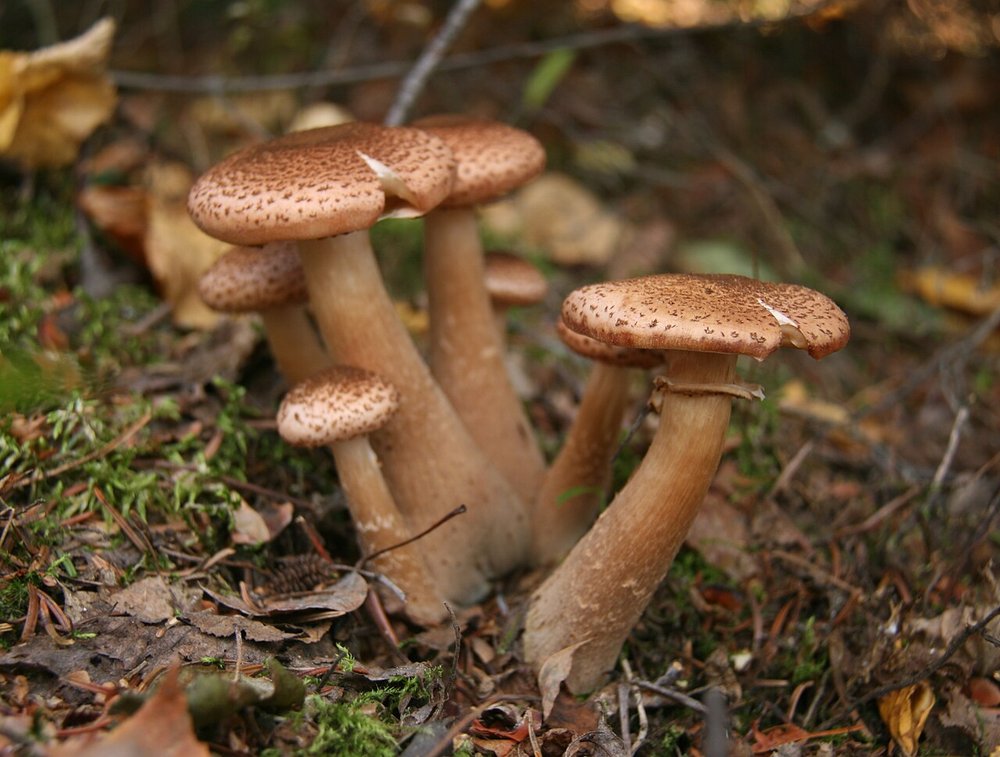
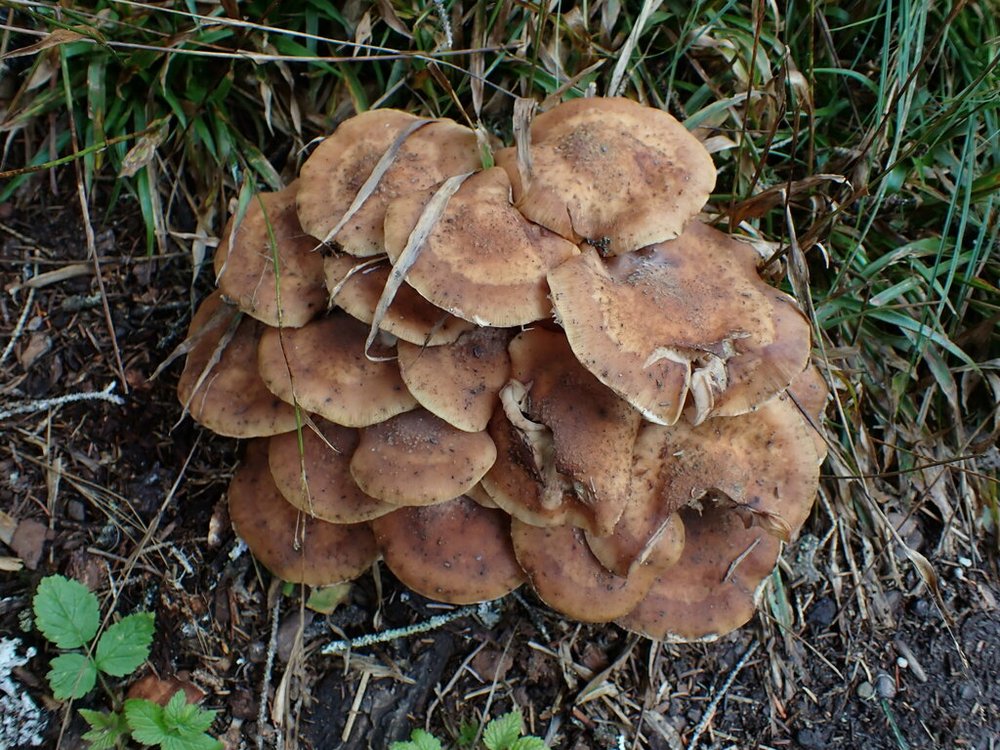
Honey Mushroom (Armillaria solidipes) grows in tight clusters of honey-brown mushrooms with small dark scales on the cap and a whitish ring on the stem, on stumps, buried roots and the base of trees. It causes Armillaria root disease, which Forest Service surveys have found across most of the Black Hills, where crews have seen its mushrooms in September.
Free photos from other sources



| Family | Physalacriaceae · Honey mushroom |
|---|---|
| Type | Gilled mushroom |
| Season | Late summer into October; Forest Service crews found it fruiting here in September; in dry country it fruits only now and then |
| Size | Cap 3–13 cm (1–5 in) wide, stem 5–10 cm (2–4 in) tall |
| Grows on | Stumps, roots and the base of ponderosa pine, white spruce and aspen |
| Spore print | White |
| Also called | Armillaria Root Disease, Shoestring Root Rot |
| Toxicity | It has made people sick: cases in the North American Mycological Association's poisoning registry list nausea, vomiting, diarrhea, cramps and dizziness starting hours later, and dogs have been poisoned by honey mushrooms. |
| Eating | This guide doesn't say which mushrooms are safe to eat. |
| Note | Older guides and Forest Service reports call it Armillaria ostoyae, a name now kept for the European species. |
How it lives
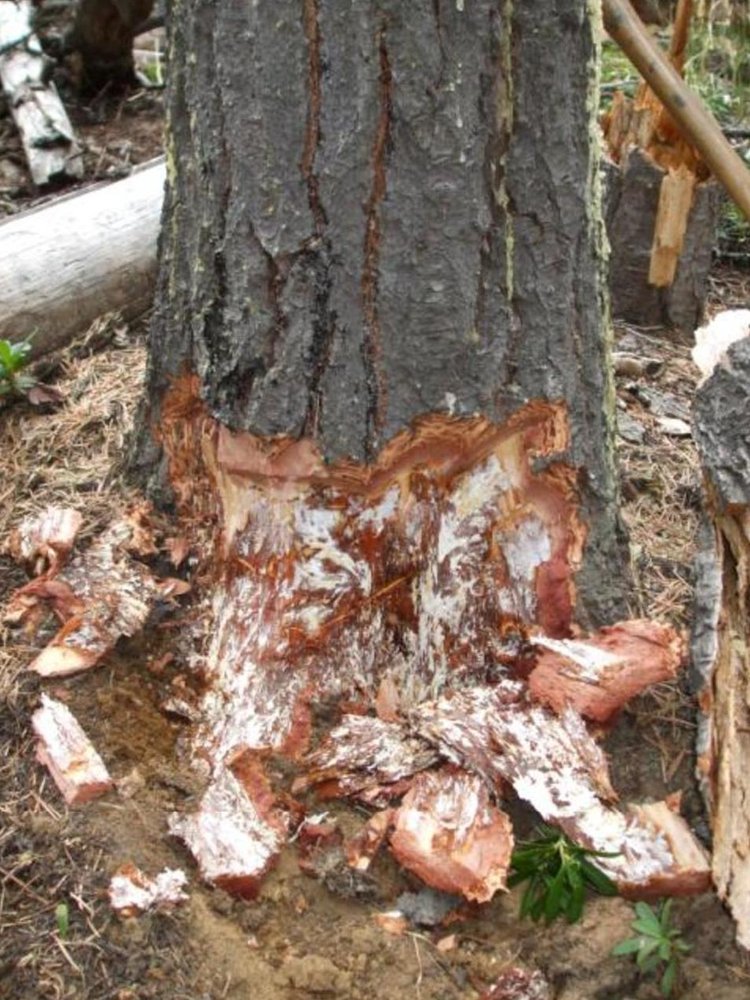
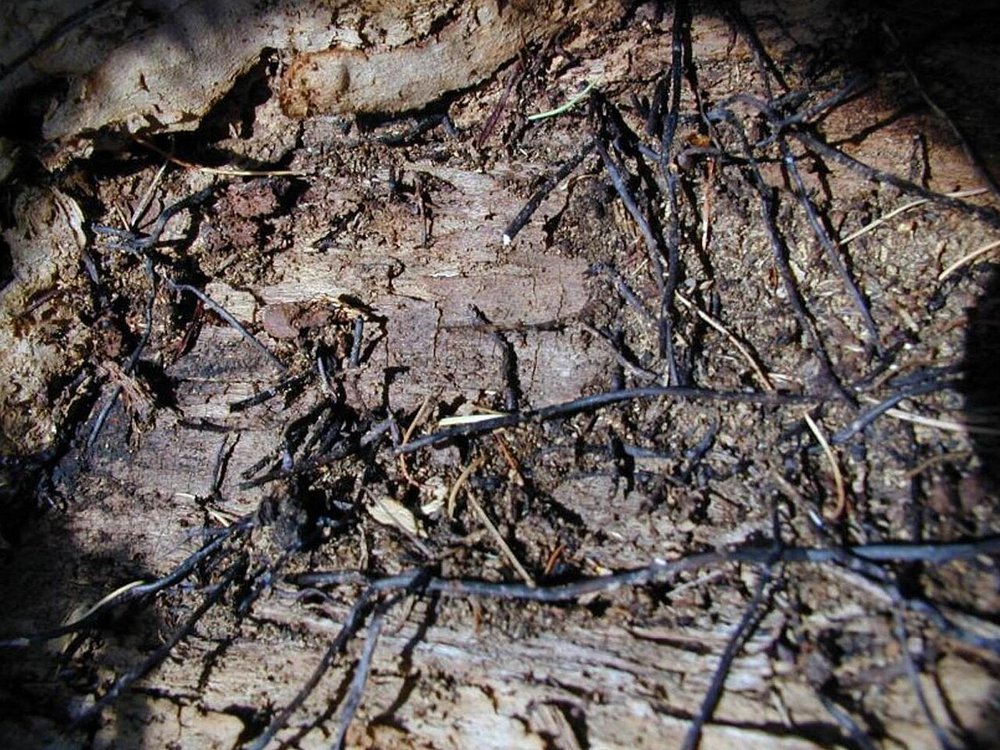
A parasite and decayer of roots that lives on both living and dead wood. It spreads underground by black, root-like cords called rhizomorphs, which can grow 0.9 m (3 ft) or more a year and infect healthy roots they touch. Under the bark at the base of an infected tree it forms white sheets of fungus with fan-like markings (mycelial fans) that have the texture of dry latex paint, and infected pines often ooze resin at the base. Once it girdles the root collar the tree yellows and dies, and the wood is left with a white rot that turns yellow, wet and stringy. In the Black Hills it most often kills seedlings and saplings, occasionally kills mature ponderosa pine and white spruce, and may weaken larger trees so bark beetles attack them more easily; Forest Service surveys found it and mountain pine beetle together in many of the same stands. It can survive for decades in old stumps and buried roots.
How do you identify Honey Mushroom?
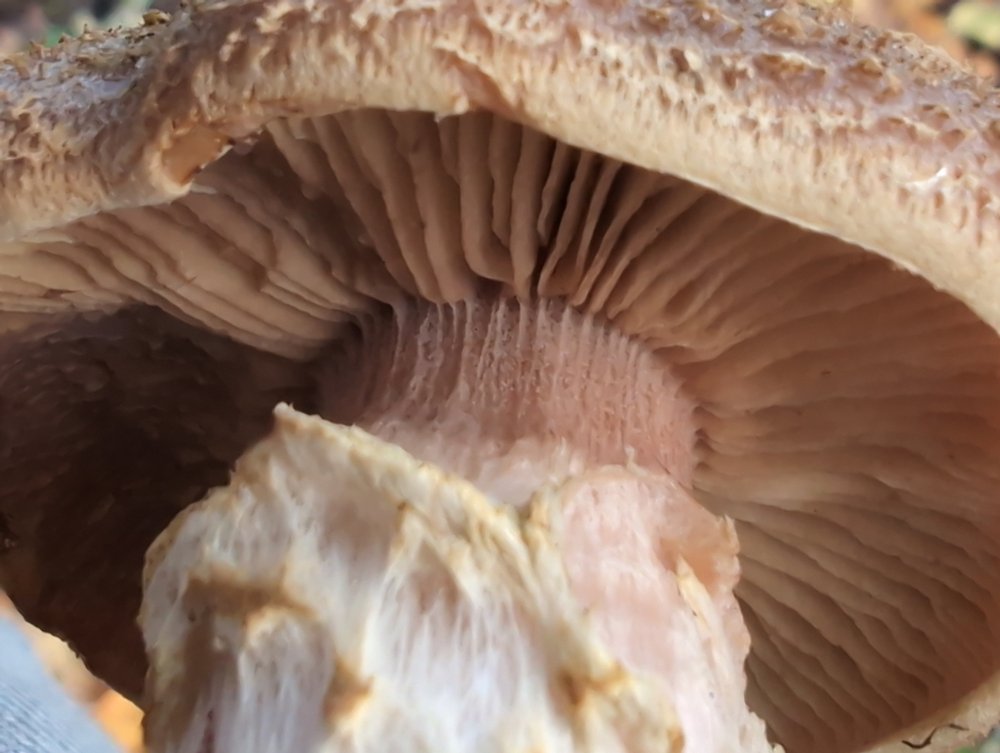
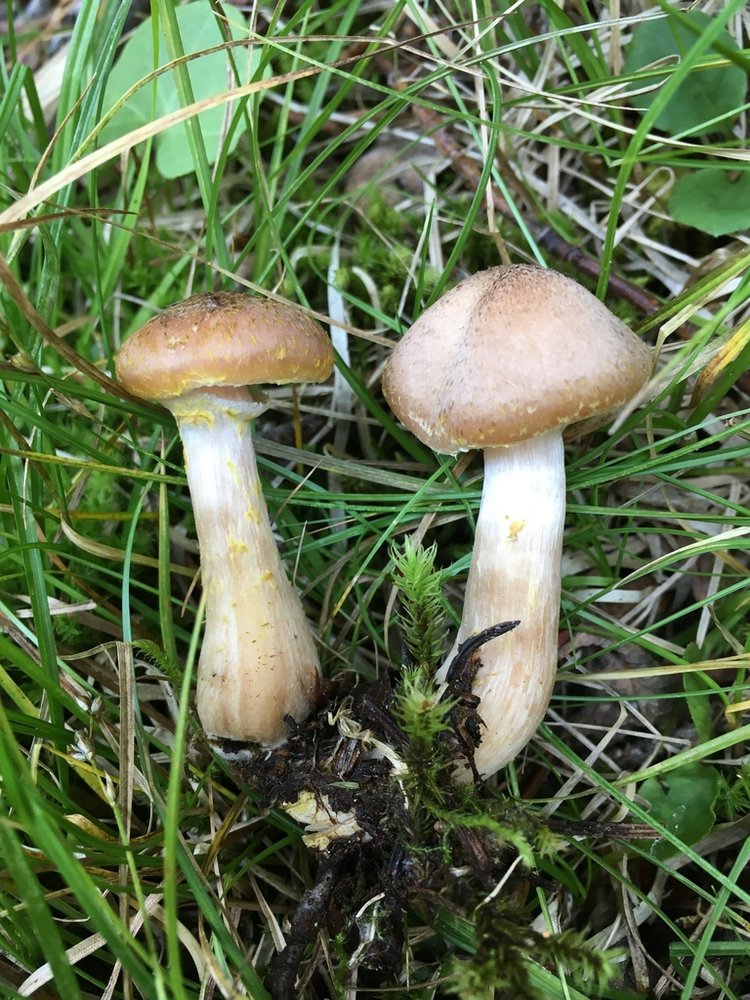
Look for dense clusters of mushrooms on a stump, a buried root or the foot of a living or dead tree. Caps are 3–13 cm (1–5 in) wide, light brown to honey-colored or pinkish brown, with small dark scales. The gills are whitish at first, later pinkish or spotted reddish brown, and attach broadly or run slightly down the stem. The stem is whitish to yellowish or light brown, darker toward the base, with a well-developed whitish ring just below the gills, and it is attached to long black cords (rhizomorphs) that run through the wood. The spore print is white. Deadly Galerina (Galerina marginata), reported on iNaturalist from Lawrence County, also grows in clusters on rotting wood and can have a thin ring, but it is smaller, with a sticky cap 1.5–5 cm (½–2 in) wide that dries two-toned, and its spore print is rusty brown. It contains amatoxins, which destroy the liver and kidneys. Scaly Pholiota (Pholiota squarrosa), which has research-grade Black Hills records on iNaturalist, is covered in upright scales on both cap and stem, has yellow gills that turn rusty brown and a brown spore print, and sometimes smells of onion or garlic.
When can you find it?
Late summer into October; Forest Service crews found it fruiting here in September; in dry country it fruits only now and then.
Where does it grow?
Stumps, roots and the base of conifers, less often aspen and other hardwoods. In the Black Hills the Forest Service has found the disease on ponderosa pine, white spruce and quaking aspen: a 1990 roadside survey found it in 34 of 44 townships, including the Bear Lodge Mountains, and a 1983 study found it in 89 percent of the ponderosa pine stands it sampled. A 2002 Forest Service report puts large disease centers in the northern Hills. Forest Service reports from 1974 to 1991 call it Armillaria mellea, a name then used for all honey mushrooms, and a 2002 report and a 2012 study call it A. ostoyae. A 1918 specimen from the national forest, filed as A. mellea, is in the U.S. National Fungus Collections, and iNaturalist has more than 40 Black Hills records of honey mushrooms, all still awaiting confirmation, most from September.
Sources: Armillaria Root Disease in Conifers of Western North America, Forest Insect and Disease Leaflet 188 (2024) — USDA Forest Service; Kuo, Armillaria solidipes (2023) — MushroomExpert.com; Kuo, Armillaria ostoyae (2023) — MushroomExpert.com; Species Fungorum: Armillaria solidipes — Royal Botanic Gardens, Kew; Species Fungorum: Armillaria ostoyae — Royal Botanic Gardens, Kew; Lundquist 1991, Distribution of Armillaria Root Disease in the Black Hills, Technical Report R2-49 — USDA Forest Service (Internet Archive); Lundquist 1991, Fungi Associated with Pines in the Black Hills, Technical Report R2-50 — USDA Forest Service (Internet Archive); Holah 1993, Armillaria Root Disease and Affected Acreage on Three Ranger Districts on the Black Hills National Forest, Technical Report R2-55 — USDA Forest Service (Internet Archive); Lessard et al. 1985, Association of Armillaria Root Disease with Mountain Pine Beetle Infestations on the Black Hills National Forest — USDA Forest Service (Internet Archive); Boldt & Van Deusen 1974, Silviculture of Ponderosa Pine in the Black Hills, Research Paper RM-124 — USDA Forest Service; South Dakota Forest Health Highlights 2002 — USDA Forest Service and SD Division of Resource Conservation & Forestry; Klutsch et al. 2012, Relationship of site and stand characteristics to Armillaria root disease incidence on ponderosa pine in the Black Hills, Forest Pathology 42: 160–170 (abstract, via OpenAlex); Kuo, Galerina marginata (2016) — MushroomExpert.com; Emberger, Galerina marginata (Deadly Galerina) — Fungi Growing on Wood, archived at MushroomExpert.com; Emberger, Pholiota squarrosa (Scaly Pholiota) — Fungi Growing on Wood, archived at MushroomExpert.com; Mushroom Poisoning Syndromes — North American Mycological Association; Beug, Summary of the Poisoning Reports in the NAMA Case Registry for 2006 through 2017 — North American Mycological Association; Beug, Summary of the Poisoning Reports in the NAMA Mushroom Poisoning Case Registry: 2018 through 2020 — North American Mycological Association; iNaturalist: Armillaria (all names) in the Black Hills places (Black Hills ecoregions, Black Hills National Forest, Wind Cave NP, Custer SP); iNaturalist: Galerina (all records, needs ID) in the Black Hills places (Black Hills ecoregions, Black Hills National Forest, Wind Cave NP, Custer SP); GBIF occurrence: Armillaria mellea, Black Hills National Forest, 1918 (BPI 752886); iNaturalist: Pholiota squarrosa in the Black Hills places (Black Hills ecoregions, Black Hills National Forest, Wind Cave NP, Custer SP).