Rocky Mountain Juniper
Juniperus scopulorum
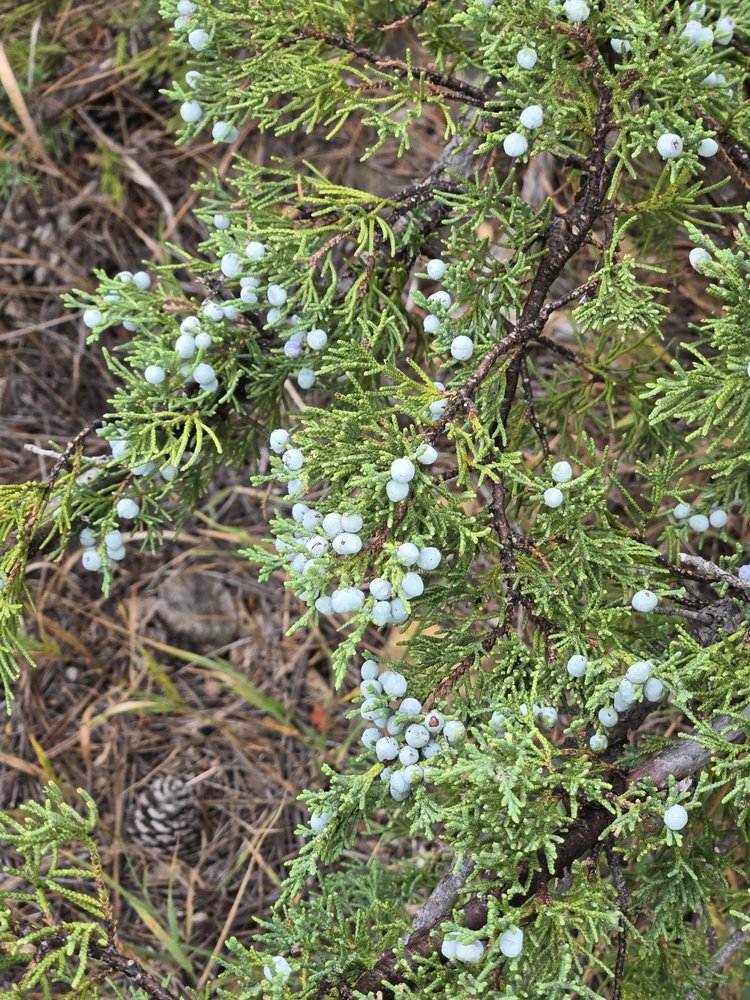
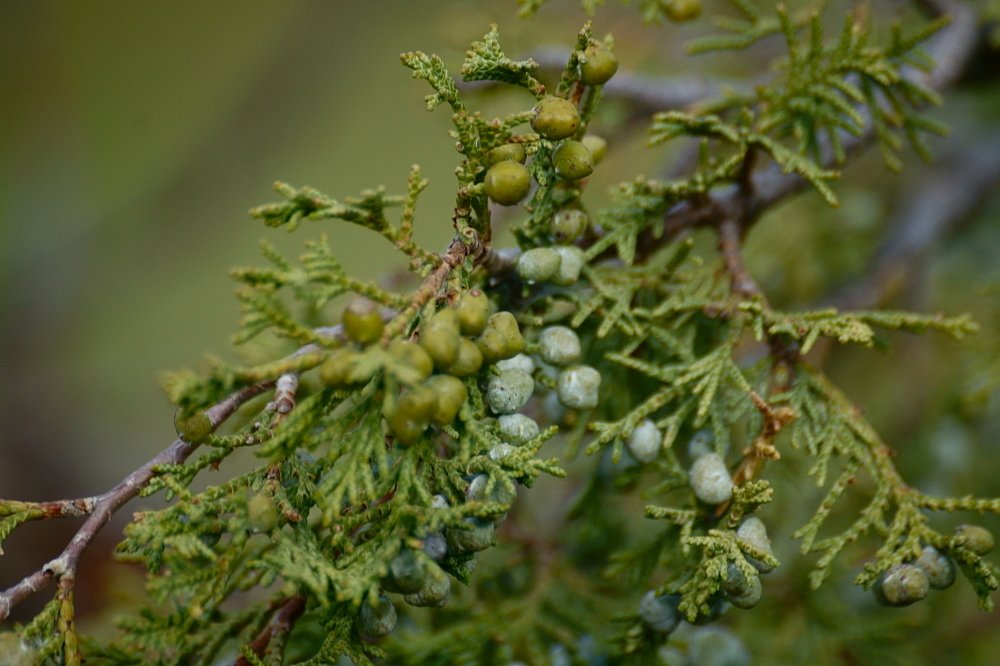
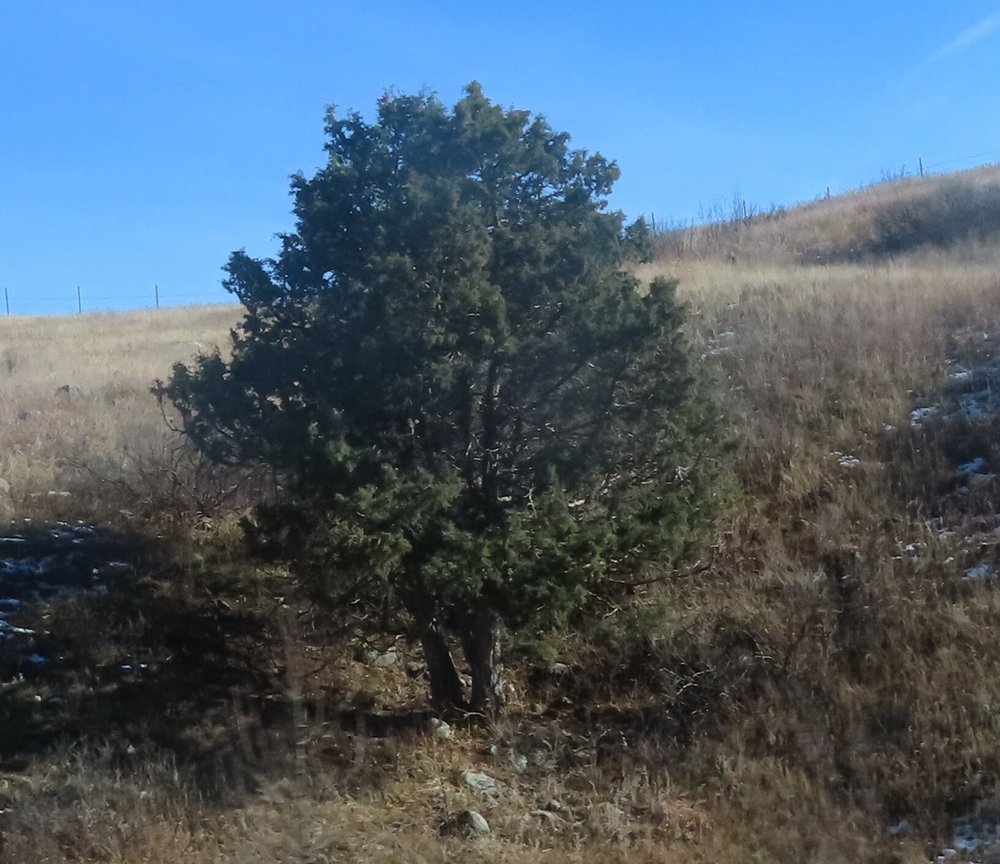
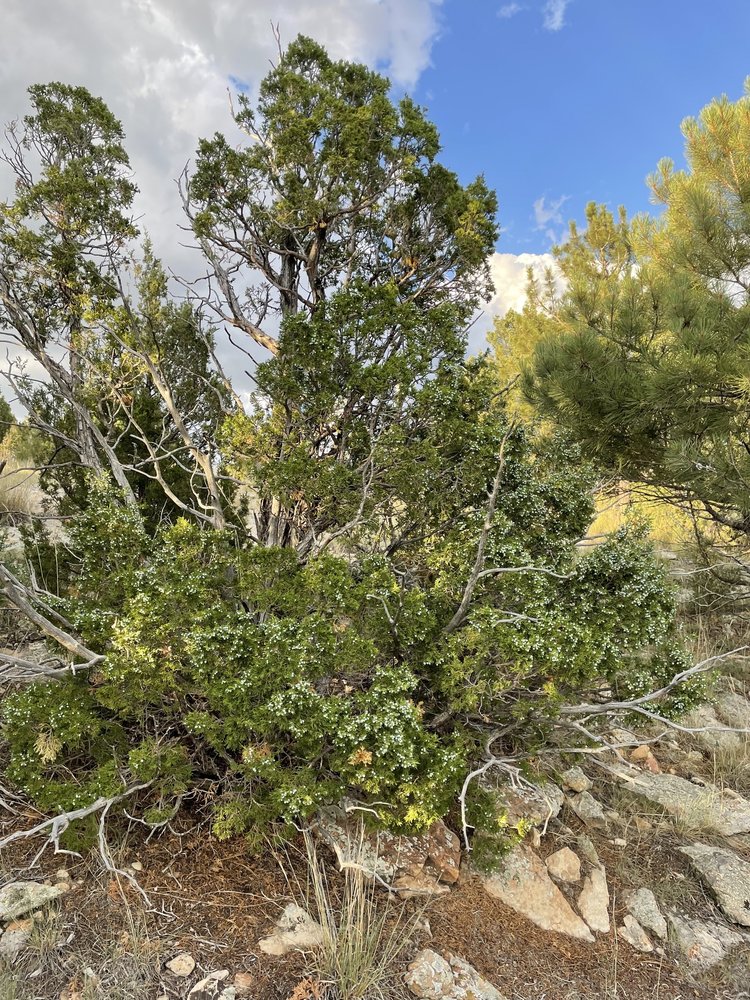
Rocky Mountain Juniper (Juniperus scopulorum) is the native "red cedar" of the Black Hills: a small evergreen tree with shaggy, stringy bark, tiny scale leaves and waxy blue-gray "berries" that take two years to ripen. It grows on dry foothills, canyon walls, limestone ledges and rocky breaks around the edge of the Hills, and male trees shed pollen in spring, about April into May.
Free photos from other sources
| Family | Cupressaceae · Cypress |
|---|---|
| Status | Native tree |
| Blooms | Pollen about April into May; berries ripen in the second fall |
| Height | 3–9 m (10–30 ft) |
| Where | Dry, rocky foothills, canyon walls, limestone ledges and breaks |
| Also called | Rocky Mountain Red Cedar, Red Cedar, Rocky Mountain Cedar, Mountain Red Cedar, Colorado Red Cedar |
| Synonym | Sabina scopulorum, Juniperus virginiana var. scopulorum |
| Toxicity | Wyoming State Forestry notes that the tree is harmful to cattle. |
| Traditional use | Hart's studies of Cheyenne plant use record the Cheyenne using Rocky Mountain Juniper as incense, as a medicine for coughs and fevers, and for flutes. Sitting Bull College's 1998 Culturally Important Plants of the Lakota, in an entry for eastern red cedar and common juniper, says juniper leaves were burned in ceremonies, especially to cure the fear of thunder. |
Roots, seeds & germination
Root: Sources disagree: USDA describes a deep, wide-spreading root system, and British Columbia's tree guide calls it shallow but fairly extensive. On thin, rocky sites the roots work into cracks in limestone and sandstone. It doesn't resprout from the roots or stump, so a tree killed by fire is gone.
Seed: Each berry holds 1–3 hard, bony seeds. Birds spread almost all of them, including waxwings, robins, Townsend's solitaires, jays and wild turkeys. Heavy crops come every 2–5 years.
Germination: The seed has a deep, double dormancy. In the wild it sprouts the second spring after ripening. Nurseries get the most even sprouting with a warm, moist period followed by a cold one, such as 16 weeks warm and then 13 weeks cold, from seed collected in western South Dakota.
How do you identify Rocky Mountain Juniper?
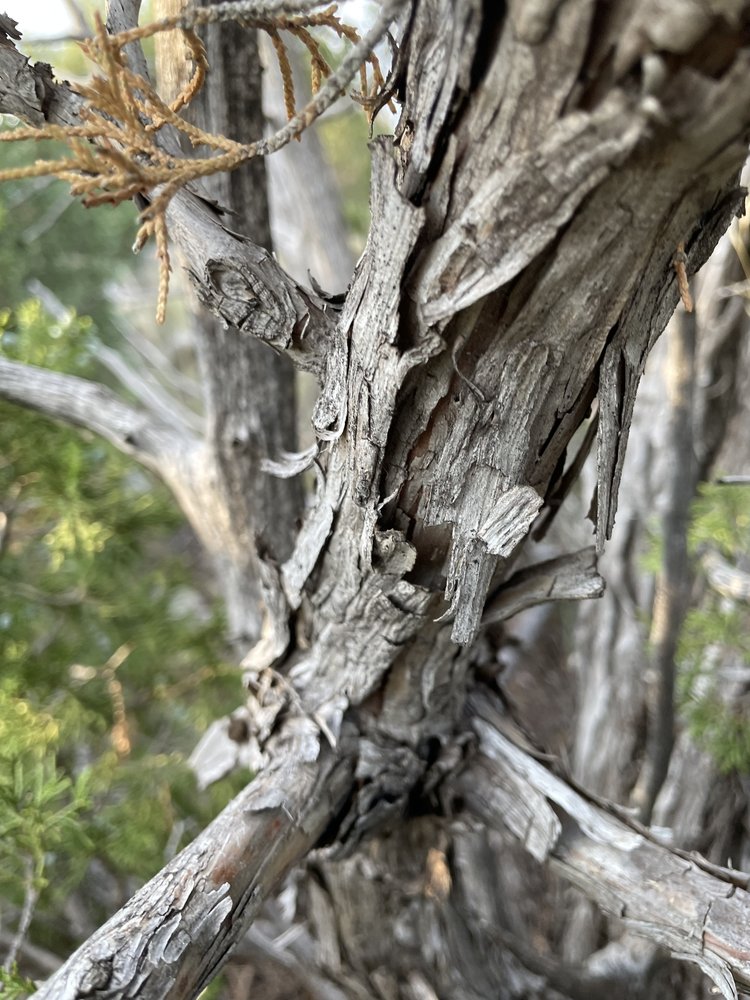
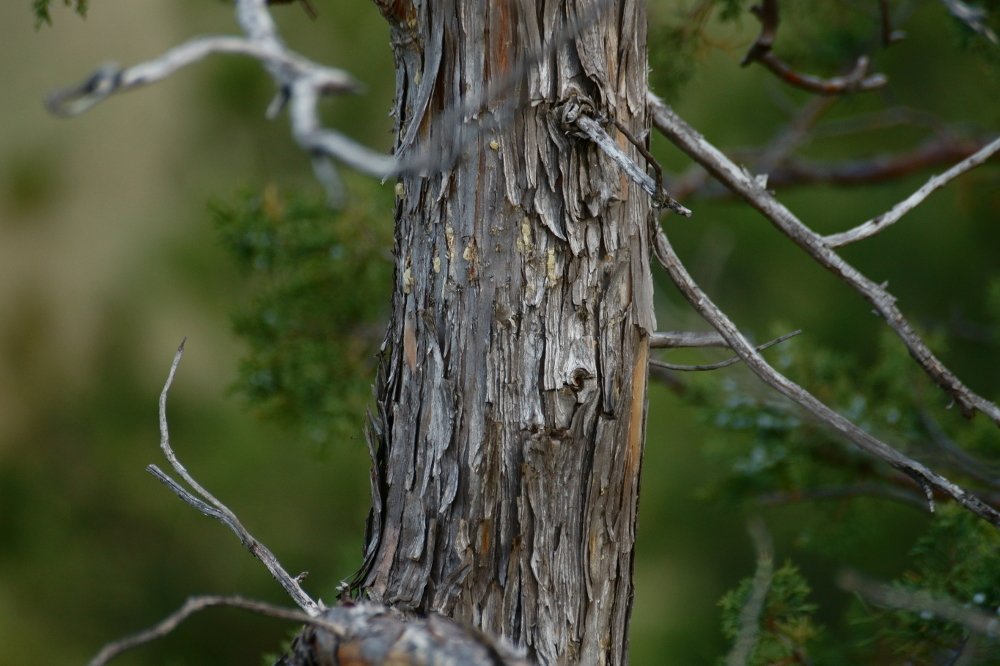
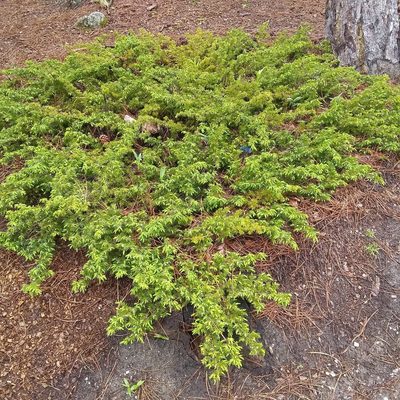
The leaves are tiny scales 1–3 mm long, pressed tight in four rows so the twigs look like braided cord, frosty gray-green to blue-green all winter. The bark is thin and peels in long, narrow, shaggy strips. Female trees bear waxy, sky-blue berries 6–9 mm (¼–⅜ in) across, and because they take two years to ripen, small green first-year cones and plump blue ones often hang together. Eastern Red Cedar, planted in windbreaks, ripens its smaller berries in one year, has sharper, more overlapping scales and stiffer branchlets, and often turns rusty brown in winter. Common Juniper is a low shrub with sharp needles in threes and no scale leaves.
When does it bloom?
Pollen about April into May; berries ripen in the second fall.
Where does it grow?
Dry, rocky, sunny or north-facing ground: foothill slopes, canyon walls and rims, limestone ledges, hogbacks, buttes and eroded breaks, mostly around the outer edge of the Hills and in the southern and western limestone country, often with Ponderosa Pine. Labeled Black Hills specimens run from about 990 m (3,250 ft) to 1,830 m (6,000 ft). The 1986 Jewel Cave plant survey lists it, it is on the Wind Cave, Mount Rushmore and Devils Tower species lists, and 122 herbarium specimens come from all seven Black Hills counties.
Other plants to compare
Sources: Flora of North America Vol. 2: Juniperus scopulorum (eFloras); Flora of North America Vol. 2: Juniperus virginiana (eFloras); Flora of North America Vol. 2: Juniperus, genus treatment and key (eFloras); Scher, J.S. 2002. Juniperus scopulorum. Fire Effects Information System (FEIS), USDA Forest Service; USDA NRCS Plant Guide: Rocky Mountain Juniper, Juniperus scopulorum (Stevens); USDA NRCS Plant Fact Sheet: Rocky Mountain Juniper; Barbour, J. 2002. Rocky Mountain Juniper Study: Preliminary Results. USDA Forest Service RMRS-P-24 (Native Plant Network); The Gymnosperm Database (Earle): Juniperus scopulorum; Wyoming State Forestry Division, Native Tree ID: Rocky Mountain juniper; Utah State University Extension: Rocky Mountain Juniper; BC Ministry of Forests Tree Species Compendium: Rocky Mountain juniper; Reese, R.N. 2015. Cupressaceae: Juniperus virginiana. South Dakota Native Plant Research, SDSU Open PRAIRIE; NDSU Extension Tree Handbook: Eastern Red-cedar; Marriott, H. & Hartman, R. 1986. Vegetation of Jewel Cave National Monument (npshistory.com); NPSpecies checklist: Wind Cave National Park, vascular plants; NPSpecies checklist: Jewel Cave National Monument, vascular plants; NPSpecies checklist: Mount Rushmore National Memorial, vascular plants; NPSpecies checklist: Devils Tower National Monument, vascular plants; GBIF occurrence search: Juniperus scopulorum, preserved specimens, South Dakota; GBIF occurrence search: Juniperus scopulorum, preserved specimens, Wyoming; iNaturalist: Juniperus scopulorum observations, Black Hills radius; Black Elk, L.S. & Flying By, W.D. 1998. Culturally Important Plants of the Lakota. Sitting Bull College; Gilmore, M.R. 1919. Uses of Plants by the Indians of the Missouri River Region. BAE 33rd Annual Report (archive.org), pp. 63-64; Comparative Siouan Dictionary: "juniper, red cedar" (Proto-Siouan *xąte; Lakota xąté; Dakota ḣaŋté); Native American Ethnobotany Database (BRIT): Juniperus scopulorum uses.