Woolly Velvet Polypore
Onnia tomentosa
Woolly Velvet Polypore (Onnia tomentosa) is a velvety, yellow-brown polypore on a short central stem that comes up from the ground over the buried roots of conifers, mostly spruce, in late summer. It causes red root rot, and a fungus isolated from white spruce in Pennington County in 2022 was identified as this species from its DNA.
Free photos from other sources
| Family | Hymenochaetaceae · Hymenochaete |
|---|---|
| Type | Shelf fungus |
| Season | Late summer into early fall; the Black Hills specimens are from late July and early August |
| Size | Cap 5–12 cm (2–4¾ in) across, on a stem 3–4 cm (1¼–1½ in) long |
| Grows on | The ground over buried roots of spruce and other conifers; sometimes the base of a trunk |
| Also called | Velvet Rosette, Tomentosus Root Rot, Red Root Rot |
| Synonym | Inonotus tomentosus, Polyporus tomentosus, Coltricia tomentosa, Pelloporus tomentosus |
| Eating | This guide doesn't say which mushrooms are safe to eat. |
| Note | Older guides call it Inonotus tomentosus. |
How it lives
A root-rot fungus of conifers, mostly spruce. Its spores can infect wounds on the roots or at the base of the tree, and the fungus decays the roots and butt for many years before it fruits. It may also grow from tree to tree where roots touch, which elsewhere kills trees in patches. The rot is a white pocket rot: the wood first turns reddish, then fills with small white pockets about 2 by 10 mm (1/13 by 3/8 in). Infected trees grow slowly, thin out and often break or blow over in storms. In the Rocky Mountain Region it fruits heavily in some years, but no major damage from it has been documented.
How do you identify Woolly Velvet Polypore?
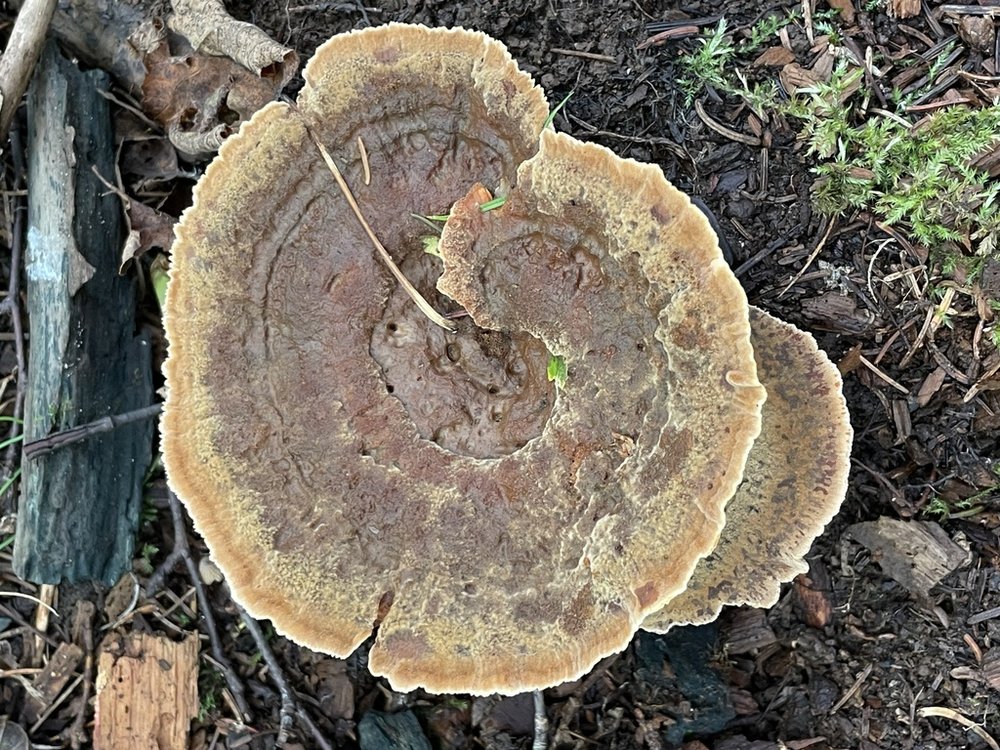
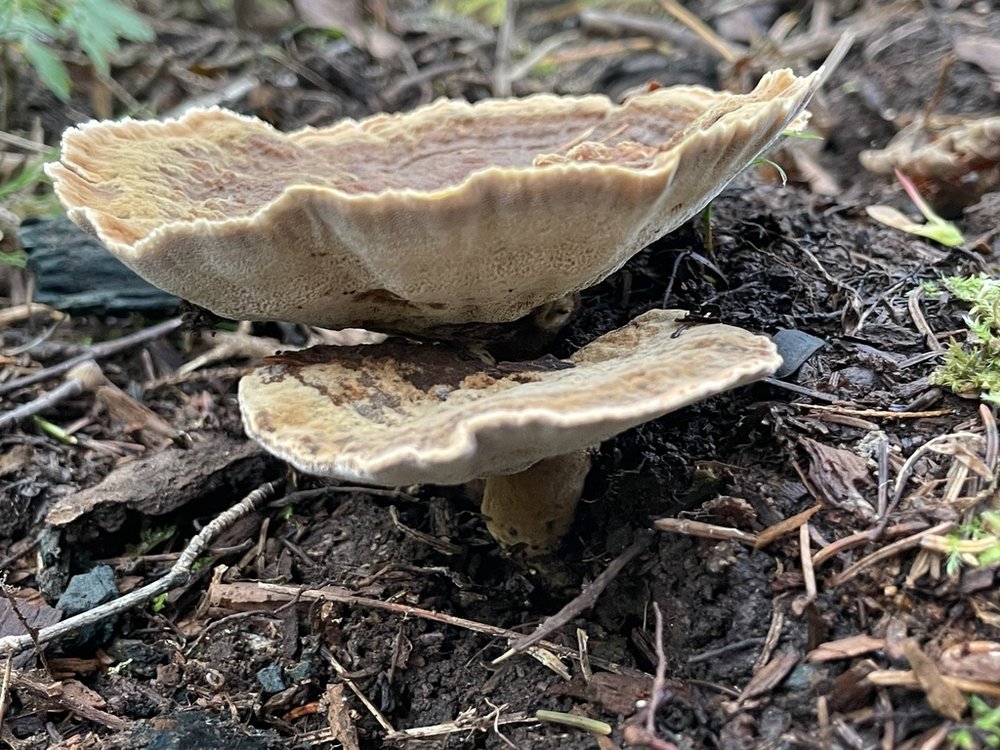
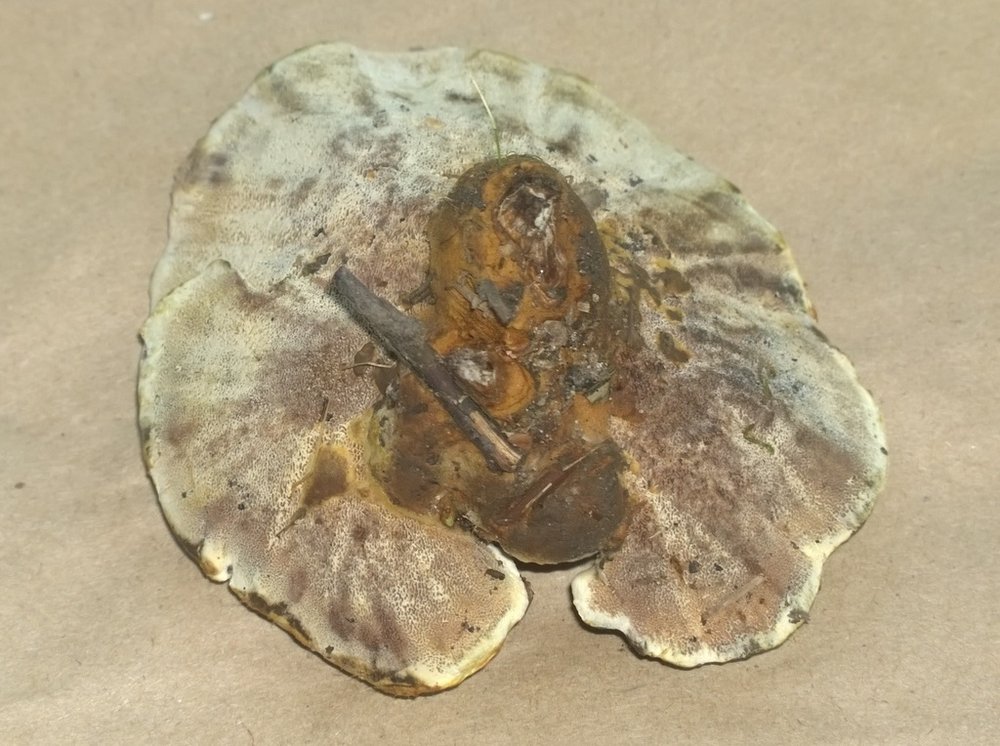
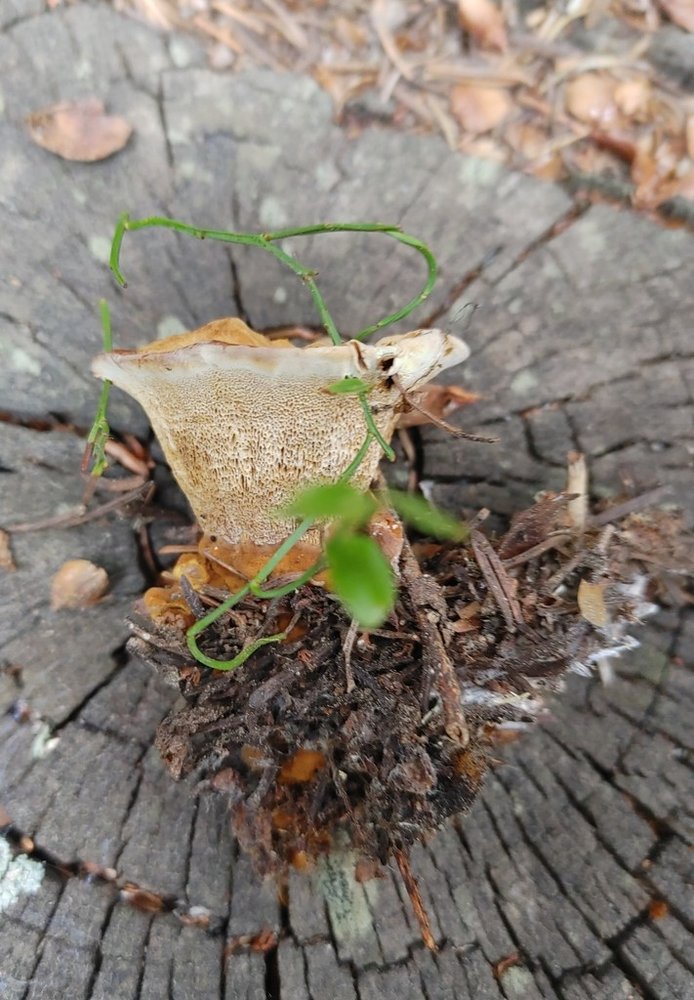
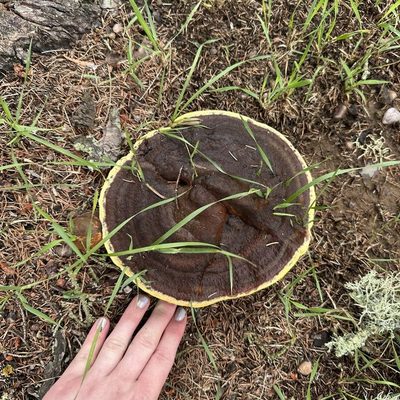
Look on the ground near spruce, or now and then pine, for a round cap 5–12 cm (2–4¾ in) across, flat or with a sunken center. The top is velvety and dull brownish yellow to yellow-brown, often darker in the middle, and it is not zoned or only faintly so. It sits on a short, velvety, yellow-brown stem 3–4 cm (1¼–1½ in) long, usually in the center, which is joined through the soil to a buried root. The pore surface is pale grayish to pale brown, darkening with age, with angular pores, and it bruises brown. The flesh is dark brownish yellow, tough and stringy. Dyer's Polypore can look like it, especially when old and faded, but young Dyer's Polypores are bright yellow to orange, colors this fungus lacks when young. Onnia leporina, the other red-root-rot fungus in the Forest Service's regional guide, is almost impossible to tell apart in the field; its conks are more often on the base of the tree itself and fewer in number.
When can you find it?
Late summer into early fall; the Black Hills specimens are from late July and early August.
Where does it grow?
On the ground, alone or in troops, rows or rings around an infected conifer, attached to its buried roots, and now and then on the base of a trunk or stump. In the Rocky Mountain Region it infects mostly spruce. In the Black Hills, a fungus isolated from white spruce in Pennington County in 2022 by J. Blodgett of the Forest Service was sequenced as Onnia tomentosa by Colorado State University researchers studying North American Onnia. A 1991 Forest Service list of fungi on Black Hills pines reports it, as Inonotus tomentosus, with root rot in natural stands in Pennington County in 1990. Two herbarium specimens collected in the Black Hills in 1918, one from Custer County, are filed under the old name Polyporus tomentosus.
Other mushrooms to compare
Sources: Onnia tomentosa (M. Kuo, 2022) — MushroomExpert.com; Phaeolus schweinitzii (M. Kuo, 2022), comparison with Onnia tomentosa — MushroomExpert.com; Field Guide to Diseases and Insects of the Rocky Mountain Region, RMRS-GTR-241 (2010), Big white pocket rot and red root rot — USDA Forest Service; Red Root Rot (J. Worrall) — forestpathology.org; Tomentosus root rot — Natural Resources Canada, Trees, insects, mites, and diseases of Canada's forests; Tomentosus root rot — University of Minnesota Extension; Lundquist 1991, Fungi Associated with Pines in the Black Hills (Technical Report R2-50) — USDA Forest Service; Onnia tomentosa isolate WRDRMRS0013f, ITS sequence PZ483877 (host Picea glauca, collected 2022 by J. Blodgett, USDA Forest Service; Lindeman et al., Colorado State University) — European Nucleotide Archive; Onnia tomentosa in Black Hills counties (sequence records of isolate WRDRMRS0013f, Pennington County) — GBIF; Onnia tomentosa specimens in South Dakota, BPI 222490 and 222502 (1918, as Polyporus tomentosus) — GBIF; Onnia tomentosa specimens in Wyoming (collection months) — GBIF; Onnia tomentosa, synonymy — Species Fungorum (Index Fungorum); Onnia tomentosa, names (Woolly Velvet Polypore, velvet rosette, Tomentosus Root Rot) — iNaturalist.