Dyer's Polypore
Phaeolus hispidoides
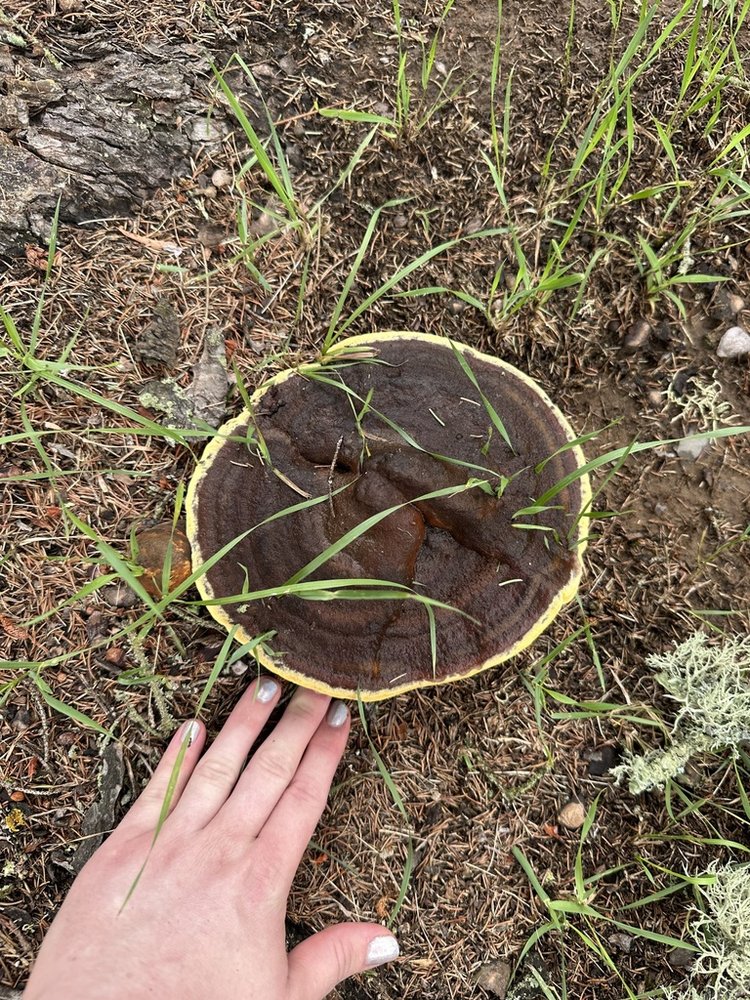
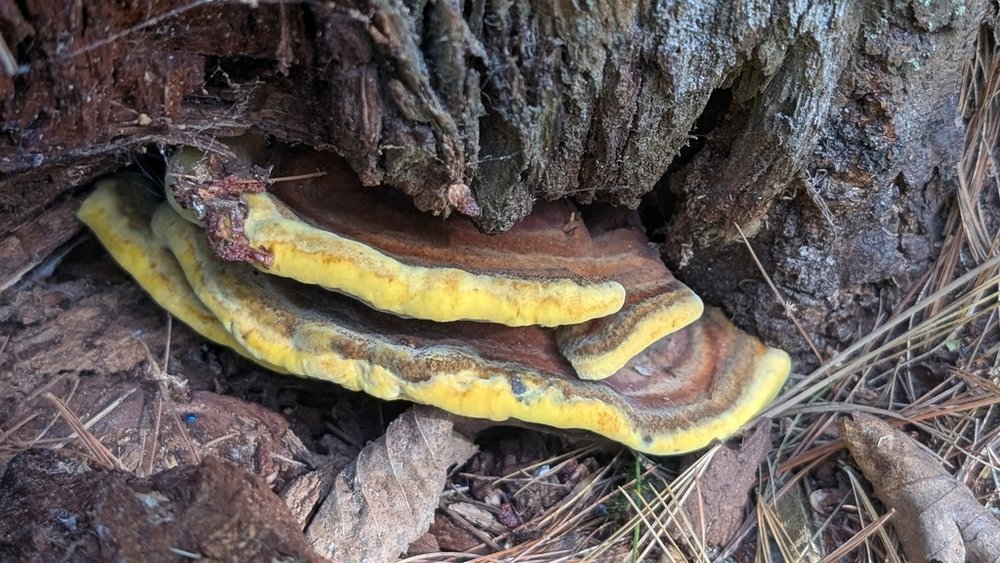
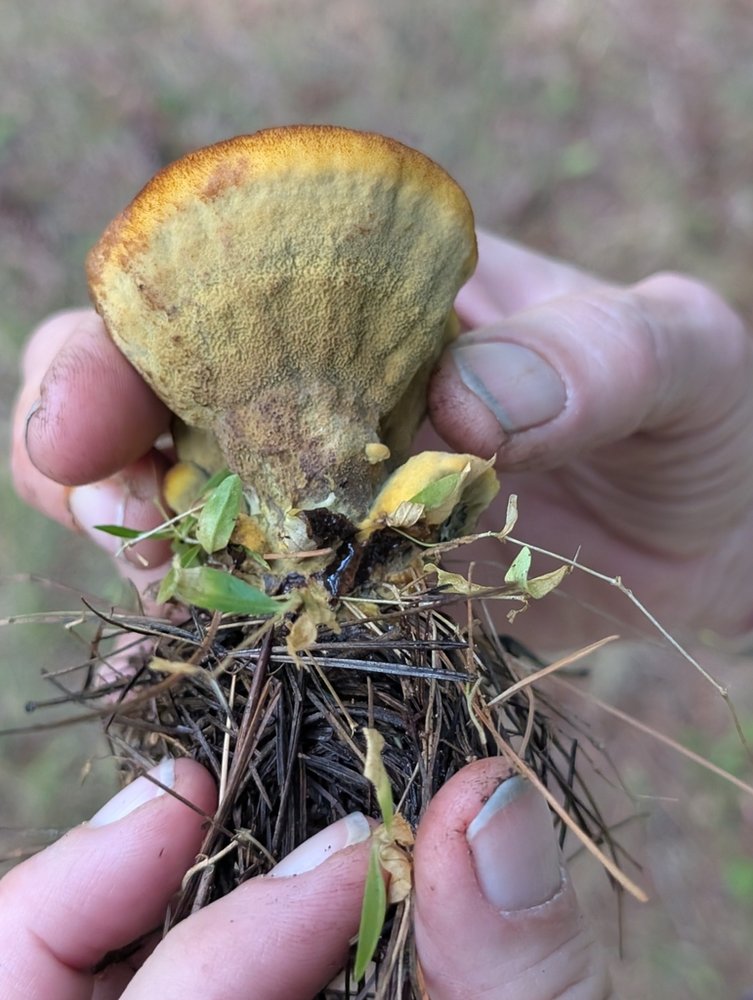
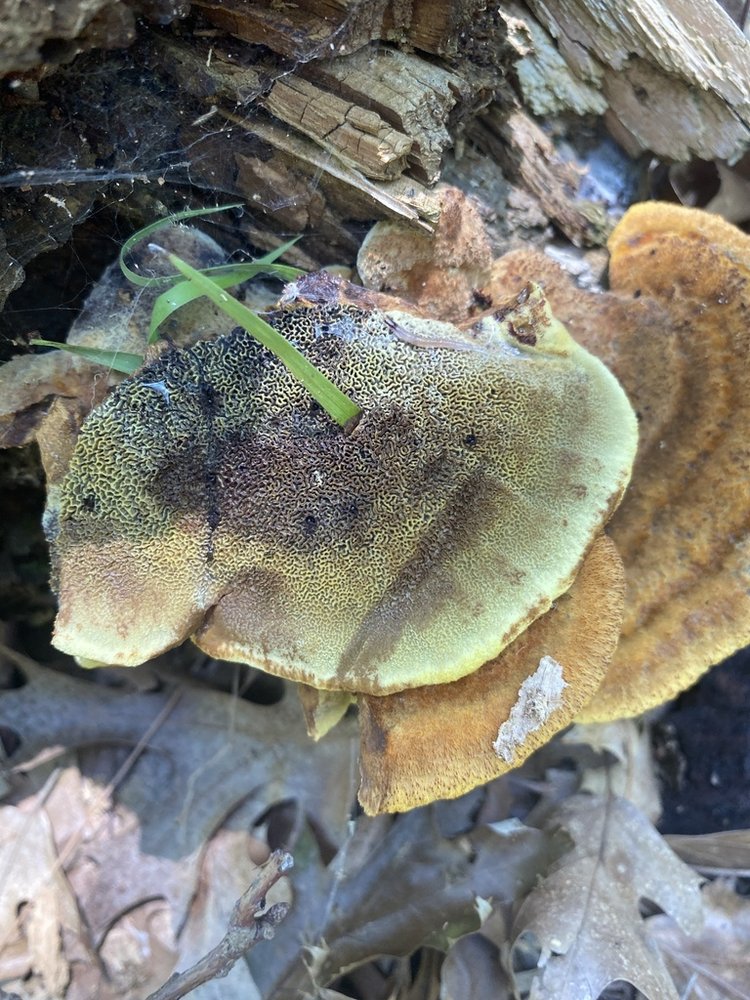
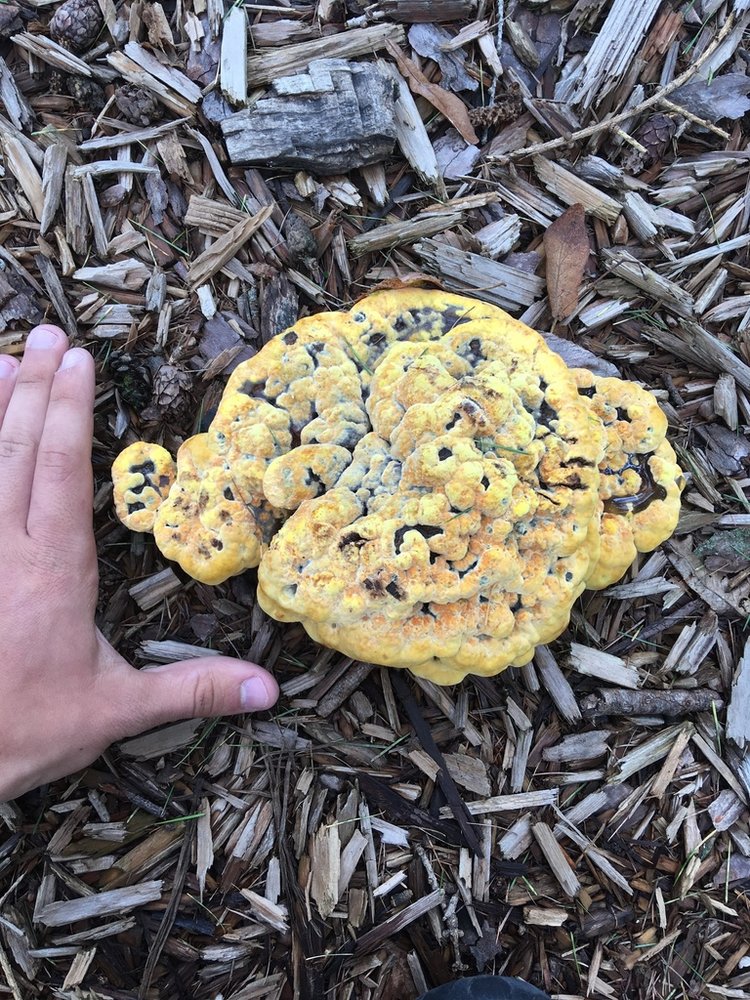
Dyer's Polypore (Phaeolus hispidoides) is a large, velvety, rusty-brown polypore with a yellow to orange edge and a greenish-yellow underside that bruises dark brown. It comes up from the roots at the base of living or dead pines and causes a root and butt rot. Forest Service records place it in the Black Hills since 1936, and Black Hills records run from late July into September.
Free photos from other sources
| Family | Laetiporaceae · Chicken of the woods |
|---|---|
| Type | Shelf fungus |
| Season | July into September |
| Size | Cap 7–30 cm (3–12 in) across, on a stem 2.5–5 cm (1–2 in) long |
| Grows on | The ground at the base of living or dead ponderosa pine, from the roots; sometimes on a stump or trunk base |
| Spore print | Whitish to yellowish |
| Also called | Velvet-top Fungus, Cowpie Fungus |
| Synonym | Polyporus hispidoides |
| Eating | This guide doesn't say which mushrooms are safe to eat. |
| Note | Older guides call it Phaeolus schweinitzii, a name now kept for the European species. |
How it lives
A parasite of living conifers that also lives on in dead wood. It gets in through wounds at the base, especially fire scars and damaged roots, and rots the heartwood of the roots and the lowest 3 m (10 ft) of the trunk. The rot is a red-brown brown rot: the fungus breaks down the cellulose and leaves the lignin, so the wood turns brown, dry and crumbly and cracks into cubes. Infected trees rarely show it until they break or blow over, and the fungus can live for years in stumps and dead trees. It spreads mainly by wind-borne spores and seldom from root to root.
How do you identify Dyer's Polypore?
Look on the ground at the base of a pine or stump for a flat or bowl-shaped cap 7–30 cm (3–12 in) across on a short, thick, velvety stem, or for shelves fused to the base of the trunk. Young caps are velvety, with bright yellow to orange colors, brightest at the edge; older ones are rusty brown, dark brown or olive with rings of color and a paler yellow rim. The pore surface runs down the stem. It is orange to bright yellow when young, then greenish yellow to olive and finally brown, and it bruises dark brown to nearly black almost at once. The pores are angular and fairly large, 1 to 3 per millimeter. The flesh is pale brown to rusty brown, soft when young, then stringy and leathery. Old caps turn all brown and brittle, like a dried cow pie. Onnia tomentosa, a cause of red root rot, also comes up from conifer roots, but its cap is smaller, up to 11 cm (4 in), it lacks the bright yellow or orange colors when young, and its pore surface is pale brown.
When can you find it?
July into September.
Where does it grow?
On the ground at the base of living or dead conifers, rising from decayed roots, and now and then on a stump or the base of a trunk. It is especially common in old timber with fire scars at the base. In the Rocky Mountain Region its main host is Douglas-fir, but the Black Hills Forest Service records are on ponderosa pine. A 1991 Forest Service list of fungi on Black Hills pine reports it fruiting on the ground at the base of a dead pine in Lawrence County in late July 1936, on living trees in 1962, and on three trees in a 1990 survey of Lawrence County. iNaturalist has 4 research-grade Black Hills records, August and September, from Lawrence, Pennington and Custer counties, 2021 to 2026. An undated herbarium specimen, collected by J.R. Weir, is labeled from the Black Hills.
Sources: Field Guide to Diseases and Insects of the Rocky Mountain Region, RMRS-GTR-241 (2010), Schweinitzii root and butt rot; Red root rot; white and brown rot — USDA Forest Service; Phaeolus schweinitzii (M. Kuo, 2022) — MushroomExpert.com; Fungi Associated with Pines in the Black Hills, Technical Report R2-50 (Lundquist 1991) — USDA Forest Service; Name search: Phaeolus hispidoides (Peck) D.W. Li, Y.C. Dai, Kaishian & Yuan Yuan 2025 — Index Fungorum; Phaeolus hispidoides, synonymy (Polyporus hispidoides) — Species Fungorum (Index Fungorum); Cui et al., Phylogeny, divergence times, and biogeography of the phytopathogenic fungal genus Phaeolus, Journal of Systematics and Evolution 64: 4–18 (abstract) — Journal of Systematics and Evolution; Phaeolus taxa, including P. schweinitzii as European Dyer's Polypore — iNaturalist; Phaeolus hispidoides, research-grade records in the Black Hills — iNaturalist; Phaeolus schweinitzii in Black Hills counties (DPI DAR00066949a, Black Hills, J.R. Weir, undated) — GBIF.