Purplepore Bracket
Trichaptum abietinum
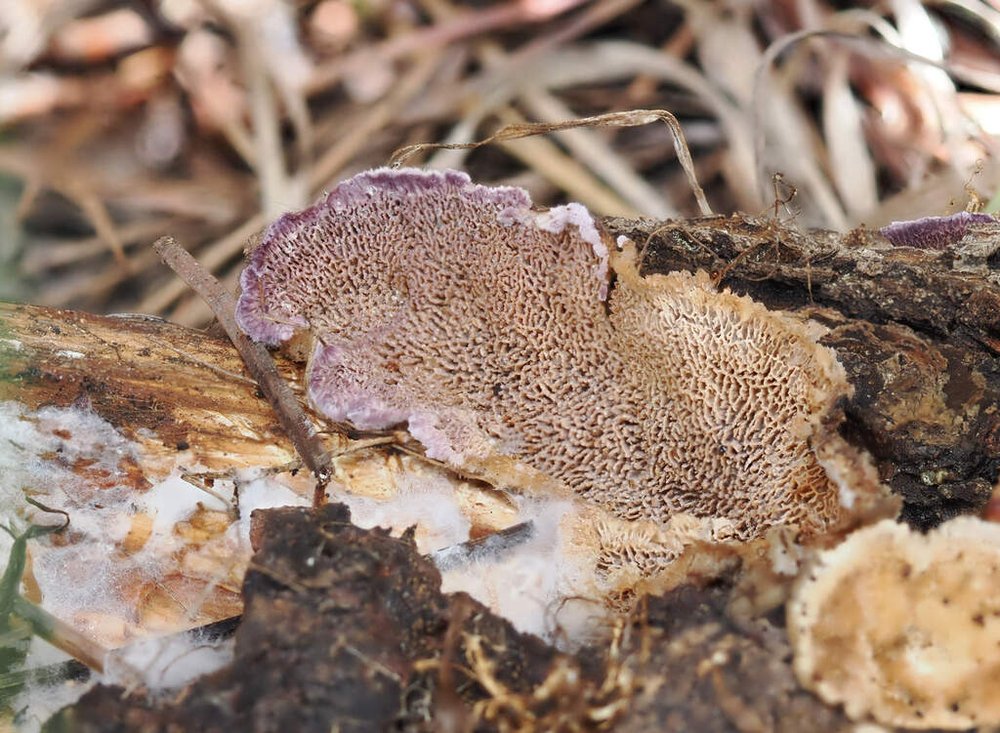
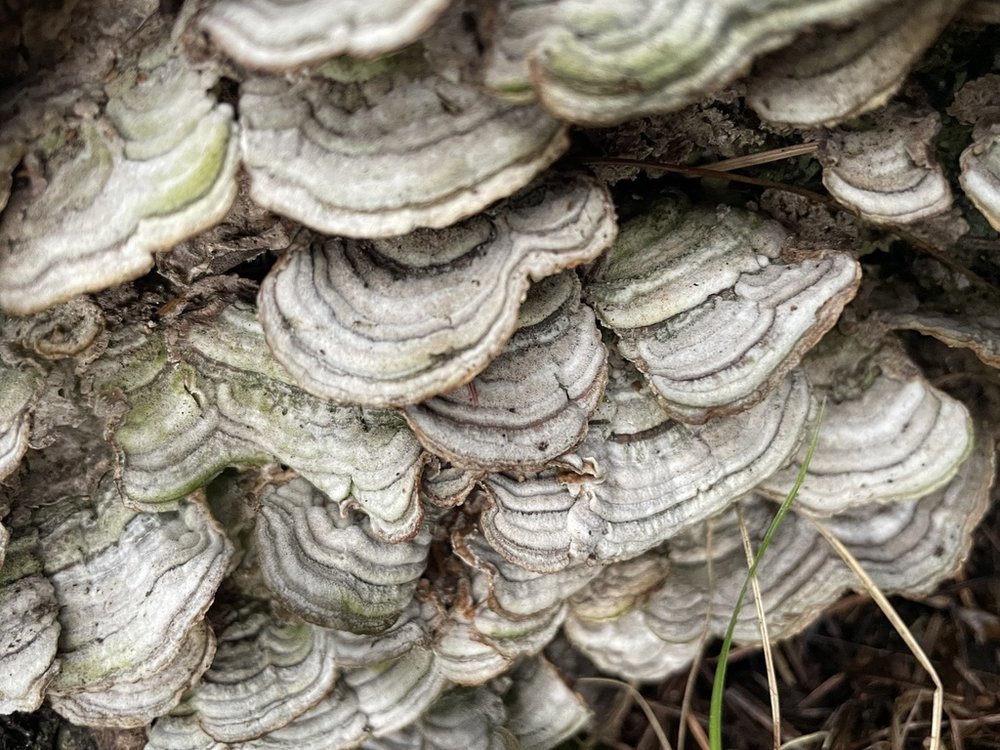
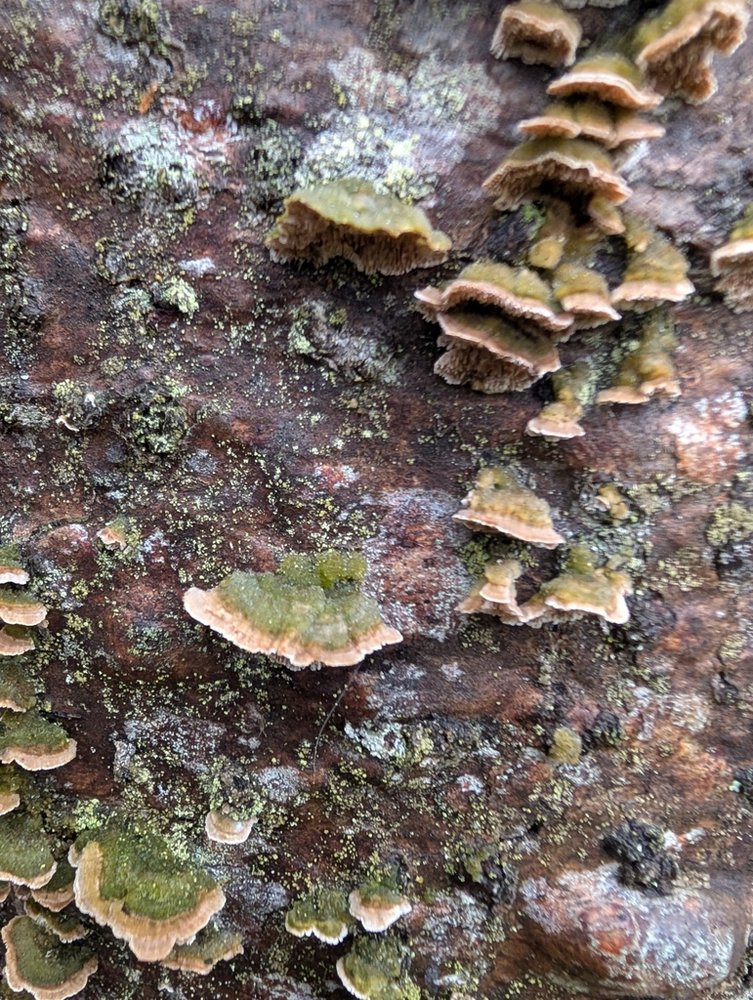
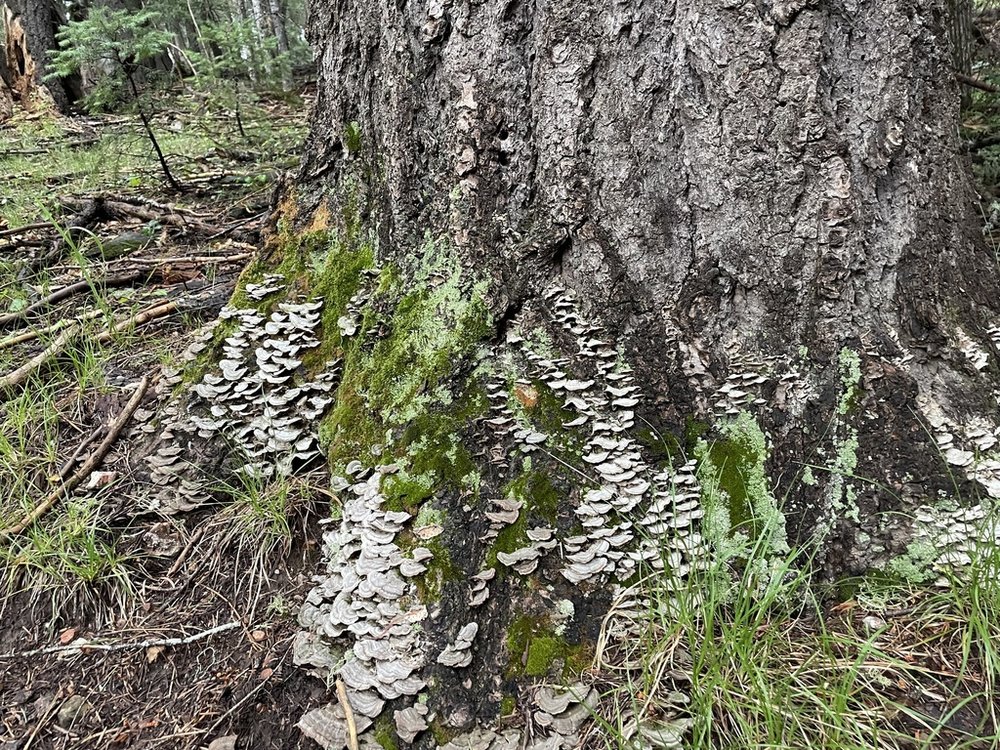
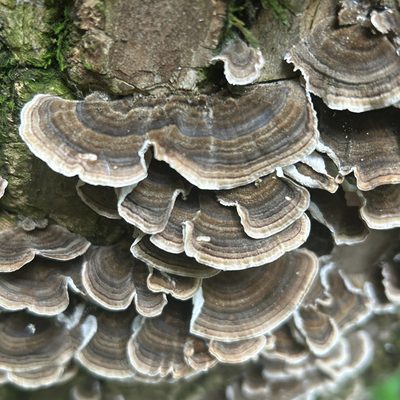
Purplepore Bracket (Trichaptum abietinum) is a small, thin, grayish bracket fungus that grows in crowded rows on dead conifer wood, with a pore surface that is bright purple when fresh and fades to brown. Black Hills herbarium specimens date back to 1909, several on ponderosa pine and spruce, and the tough brackets can be found in any month.
Free photos from other sources
| Family | Hymenochaetaceae · Hymenochaete |
|---|---|
| Type | Shelf fungus |
| Season | All year; Black Hills collections and records date from January and from May to October |
| Size | Caps 1–4 cm (½–1½ in) wide and up to about 4 mm (⅙ in) thick |
| Grows on | Dead conifers, including ponderosa pine and spruce: logs, stumps, standing dead trunks and branches |
| Spore print | White (reported) |
| Also called | Purple Conk Fungus, Purple-toothed Polypore, Violet-toothed Polypore, Pitted Sap Rot |
| Synonym | Hirschioporus abietinus, Polyporus abietinus, Polystictus abietinus, Coriolus abietinus |
| Eating | This guide doesn't say which mushrooms are safe to eat. |
How it lives
A saprobe and one of the first fungi to rot dead conifers. It lives only in the sapwood and causes a white pitted sap rot, breaking down both cellulose and lignin. The sapwood first turns light yellow to tan and soft, then small, whitened streaks along the grain become pits, until the wood is fragile and lacy, honeycombed in cross section. New brackets form each year once the wood is well colonized. Where storms, fire or insects kill many trees, this rot cuts the amount of sound wood that can be salvaged.
How do you identify Purplepore Bracket?
Look for thin, tough brackets 1–4 cm (½–1½ in) wide and only a few millimeters thick, often in overlapping rows or fused patches on bark, logs and stumps; some lie nearly flat with only a turned-back edge. The top is white to gray, velvety to hairy and somewhat zoned, often with a purplish edge when fresh, and it often turns green with algae. The underside gives it away: bright purple when fresh, strongest near the edge, fading to lilac, then tan or reddish brown. The pores are angular, 2–4 per millimeter, and with age their walls tear into teeth, so the surface looks toothy. The flesh is whitish and leathery. Turkey Tail has a similar top, but it is usually wider, with dark and light bands, and its pore surface is tan to white, never purple. Trichaptum biforme, on Mount Rushmore's species list and collected in the Black Hills on aspen, birch and oak, looks nearly identical but grows on hardwoods.
When can you find it?
All year; Black Hills collections and records date from January and from May to October.
Where does it grow?
On dead conifers: standing trunks, logs, stumps and fallen branches, in the sapwood of recently dead trees, and rarely on living trees where big wounds expose the sapwood. It is a pioneer decayer where fire, insects or wind kill many trees. In the Black Hills, herbarium specimens from Lawrence, Pennington and Custer counties date from 1909 to 1962, several labeled on ponderosa pine or spruce, and a 1991 Forest Service list of fungi on Black Hills pines adds collections from 1938 and 1960, the second with lichens on a dead branch. iNaturalist has 1 research-grade Black Hills record, from Lawrence County in October 2025.
Other mushrooms to compare
Sources: Trichaptum abietinum (M. Kuo, 2016) — MushroomExpert.com; Trichaptum abietinum — Fungi on Wood (Gary Emberger); Pitted sap rot (B.E. Callan, 2024) — Natural Resources Canada, Trees, insects, mites, and diseases of Canada's forests; Lundquist 1991, Fungi Associated with Pines in the Black Hills (Technical Report R2-50) — USDA Forest Service; Trichaptum abietinum specimens in South Dakota, 1909–1962 (as Polyporus, Coriolus and Trichaptum abietinum) — GBIF; Trichaptum biforme specimens in South Dakota (as Polyporus pargamenus and others; hosts aspen, paper birch, oak) — GBIF; NPSpecies checklist: Fungi, Mount Rushmore National Memorial — National Park Service; Trichaptum abietinum, synonymy — Species Fungorum (Index Fungorum); Trichaptum abietinum, names (Purplepore Bracket) — iNaturalist; Trichaptum abietinum, research-grade records in the six Black Hills places — iNaturalist.