Turkey Tail
Trametes versicolor
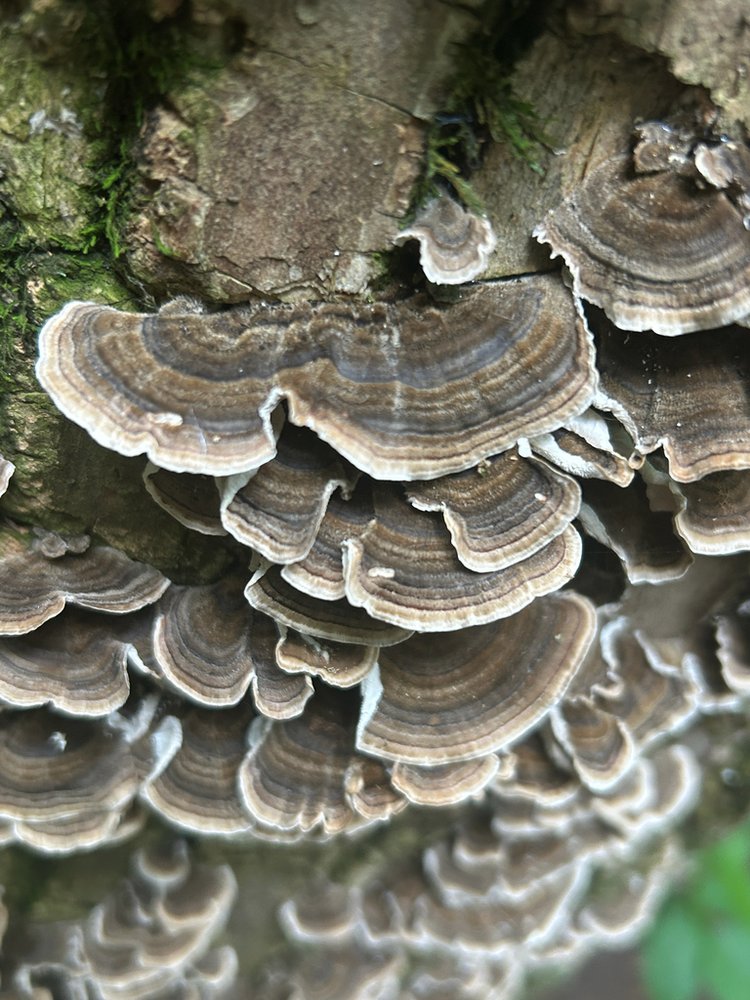
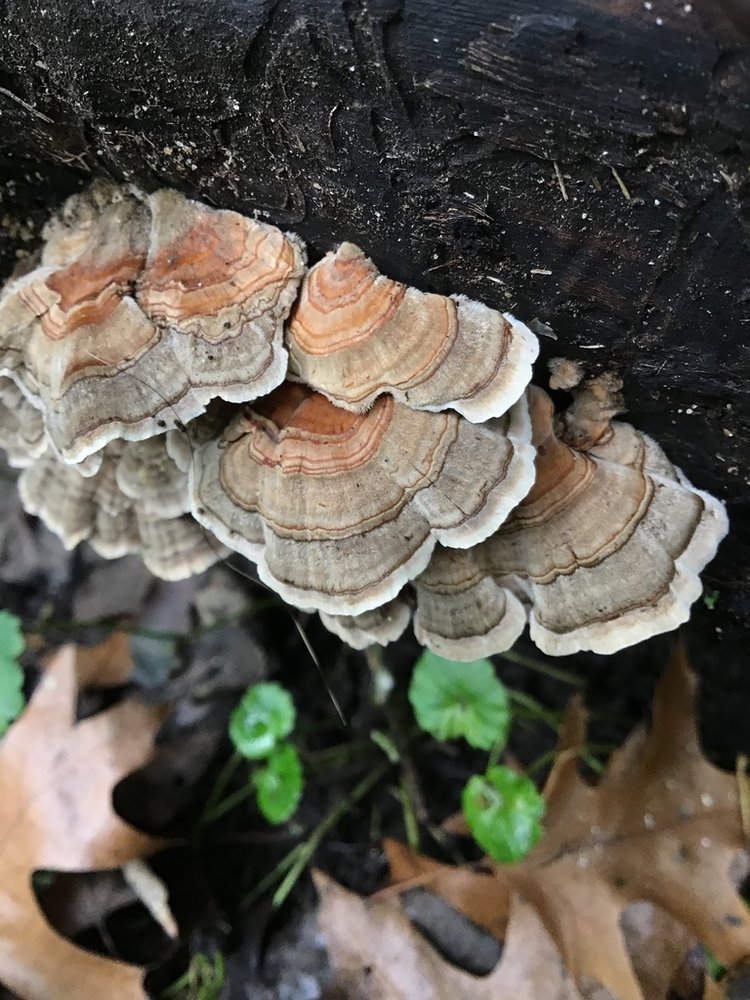
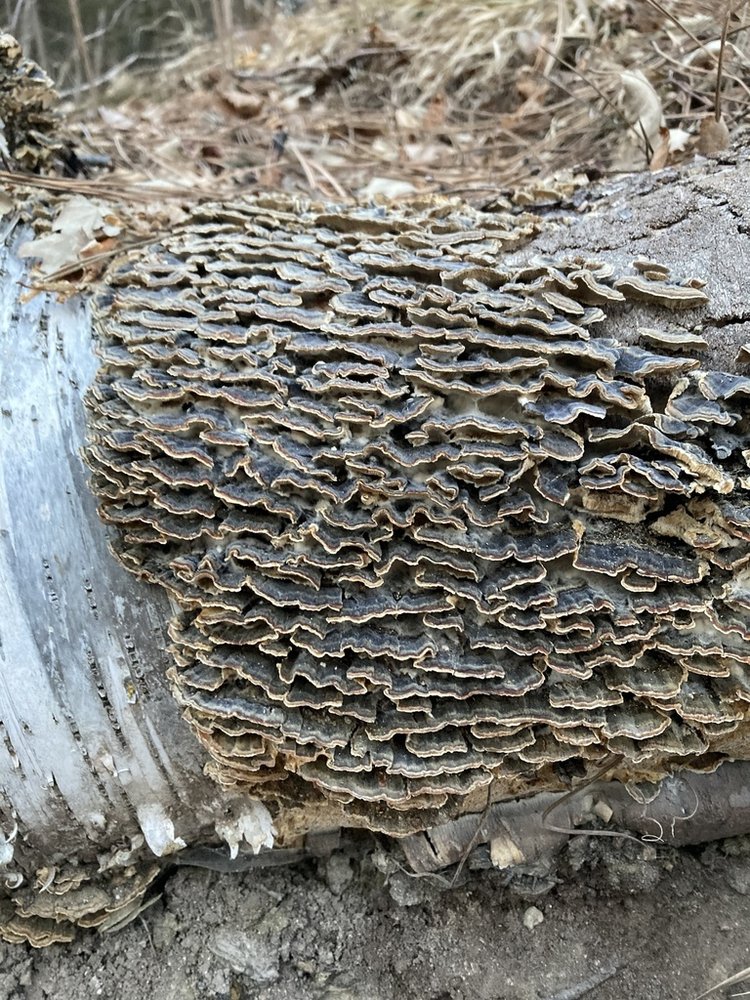
Turkey Tail (Trametes versicolor) is a thin, leathery bracket fungus that grows in overlapping tiers and rosettes on dead hardwood, its velvety caps banded in brown, gray, tan and sometimes blue or orange, with a whitish pore surface underneath. It is seldom recorded in the Black Hills: iNaturalist has 4 research-grade records here, and three specimens were collected in Pennington County in 1926 and 1927. The tough brackets can be found in any month.
Free photos from other sources
| Family | Polyporaceae · Polypores |
|---|---|
| Type | Shelf fungus |
| Season | All year: the tough brackets last a long time and sometimes overwinter. Black Hills iNaturalist records run from February to August |
| Size | Caps 2–8 cm (¾–3 in) across and only 1–2 mm (1/16 in) thick |
| Grows on | Dead hardwood logs and stumps, rarely conifer wood |
| Spore print | Whitish |
| Also called | Many-zoned Polypore, čháŋ siŋté (Lakota) |
| Synonym | Coriolus versicolor, Polyporus versicolor, Polystictus versicolor |
| Eating | This guide doesn't say which mushrooms are safe to eat. |
How it lives
A saprobe: it lives on dead wood and causes a white rot of the sapwood, breaking down the lignin, the stiff material that binds wood fibers, and leaving the cellulose behind. Now and then it grows on dying trees.
How do you identify Turkey Tail?
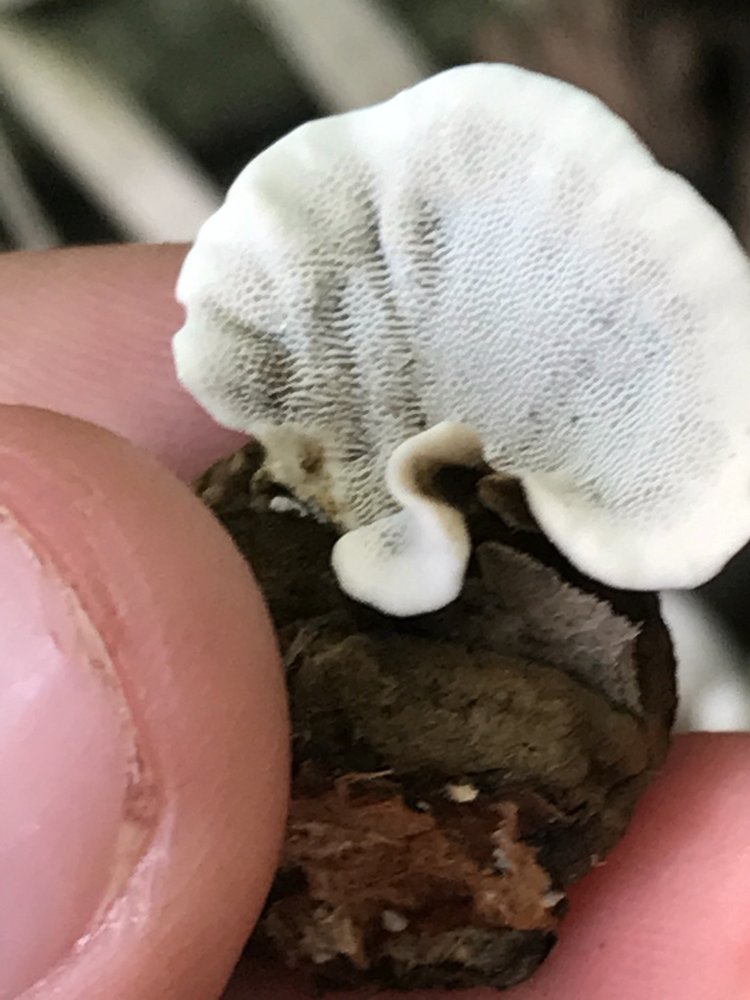
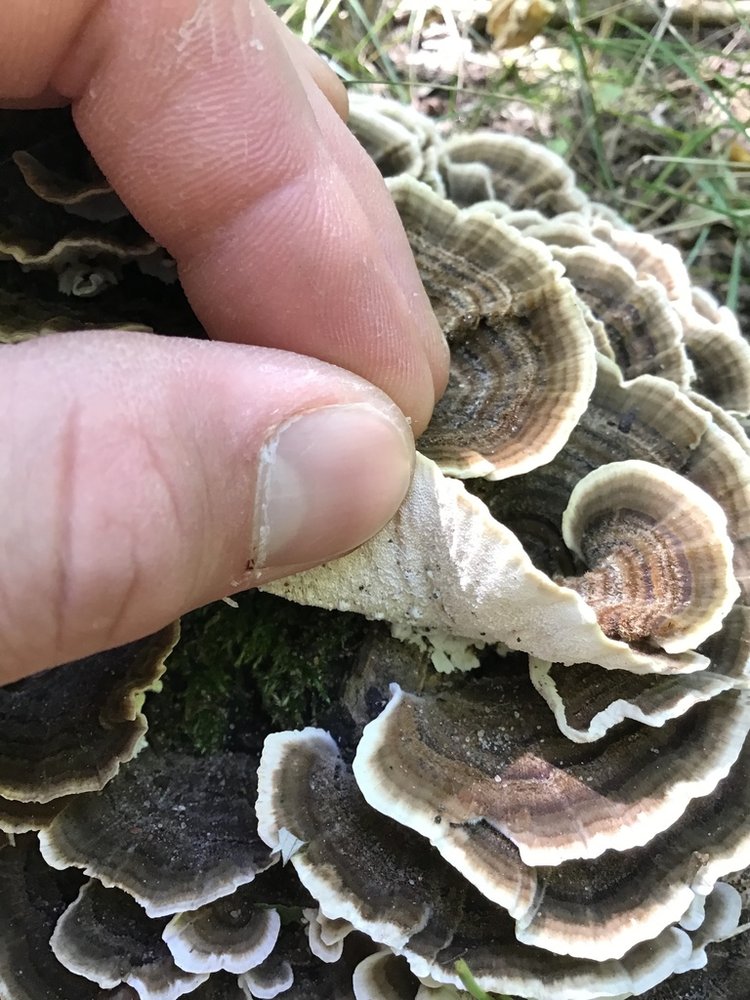
Look for thin, flexible brackets with no stem, 2–8 cm (¾–3 in) across, often fused in overlapping tiers or rosettes. The top is velvety, in sharply contrasting bands of white, gray, brown, cinnamon and reddish brown, sometimes blue, green or orange, and the outer band is usually the palest. Turn one over: the underside is whitish and covered in pores so tiny, 3–6 per millimeter, that it can look smooth at a glance. False turkey tails (Stereum crusts, one of which is recorded in the Black Hills) look much the same on top but have a smooth underside with no pores at all. Trametes hirsuta, collected in the Black Hills between 1918 and 1938, has a densely hairy cap that is grayish, yellowish or brownish rather than brightly banded. Multicolor Gill Polypore (Trametes betulina, also called Lenzites betulinus) has tough, gill-like plates underneath instead of pores.
When can you find it?
All year: the tough brackets last a long time and sometimes overwinter. Black Hills iNaturalist records run from February to August.
Where does it grow?
On dead hardwood logs and stumps, sometimes on dying trees, and rarely on conifer wood. It is not often recorded in the Black Hills: iNaturalist has 4 research-grade and 4 unconfirmed records, from Lawrence, Meade, Pennington and Custer counties and Crook County, Wyoming. The U.S. National Fungus Collections hold three specimens collected in Pennington County in 1926 and 1927 under the old name Polyporus versicolor, two of them from decaying logs.
Sources: Trametes versicolor: The Turkey Tail — MushroomExpert.com (Michael Kuo); Stereum ostrea — MushroomExpert.com (Michael Kuo); Fungus of the Month, August 1997: Trametes versicolor — Tom Volk, University of Wisconsin-La Crosse; Turkey Tail Mushroom — Missouri Department of Conservation Field Guide; Trametes versicolor — Fungi on Wood (Gary Emberger); Trametes hirsuta — Fungi on Wood (Gary Emberger); Lenzites betulinus — Fungi on Wood (Gary Emberger); Fungi Associated with Pines in the Black Hills (Lundquist 1991), Stereum hirsutum — USDA Forest Service; Culturally Important Plants of the Lakota (Black Elk and Flying By 1998), entry 310 — Sitting Bull College; Trametes versicolor — Species Fungorum, Royal Botanic Gardens, Kew; Black Hills records of Trametes versicolor — iNaturalist; Trametes versicolor, Black Hills records by month — iNaturalist; Specimen BPI 223776, Pennington County, 1926 — GBIF; Specimen BPI 224140, Pennington County, 1927 — GBIF; Specimen BPI 224480, Pennington County, 1927 — GBIF; Trametes hirsuta specimens in South Dakota — GBIF.