Juniper Broom Rust
Gymnosporangium nidus-avis
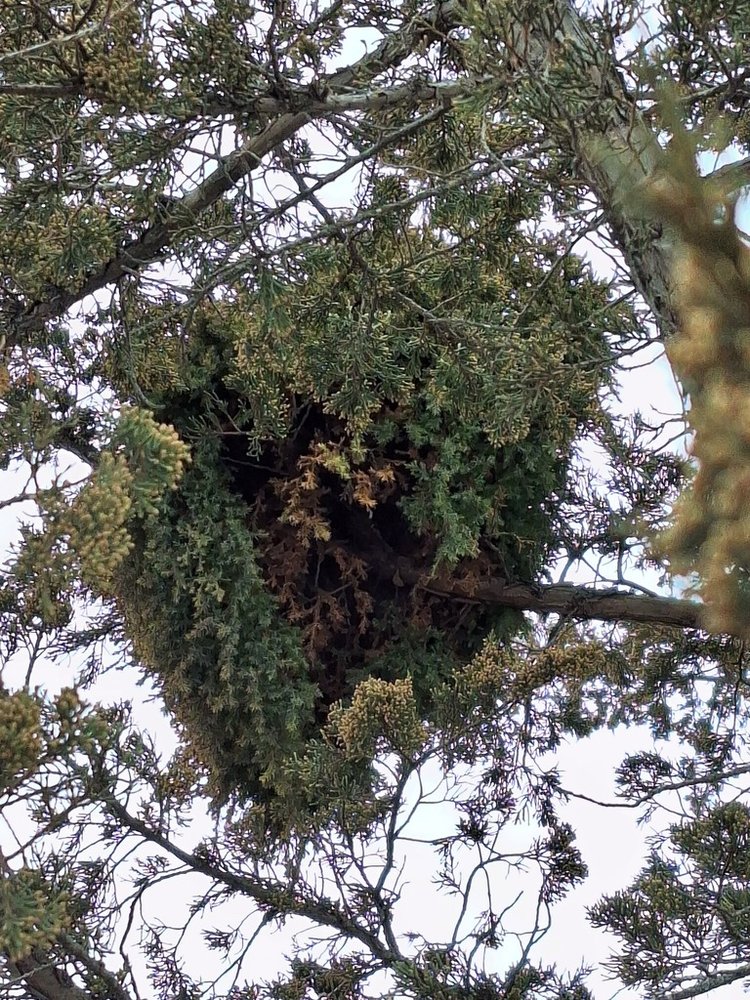
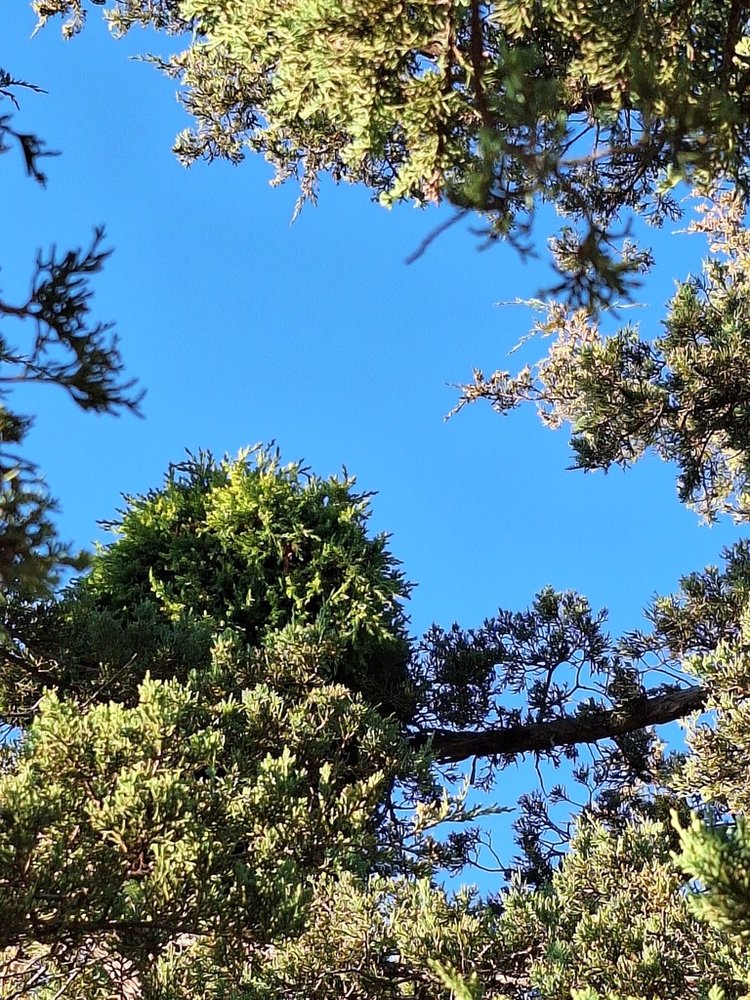
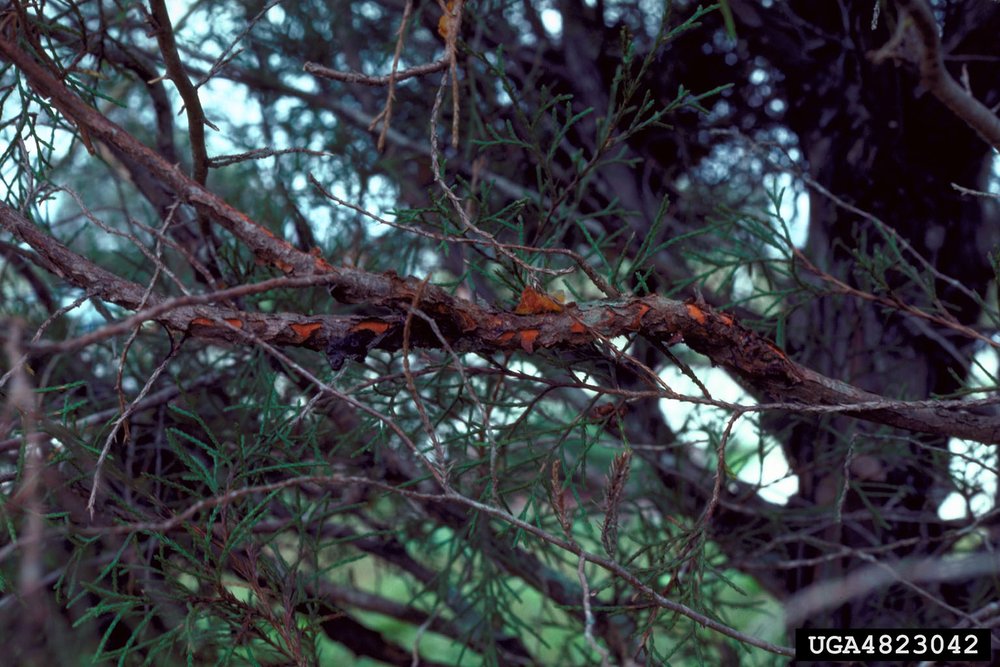
Juniper Broom Rust (Gymnosporangium nidus-avis) is a rust fungus that makes rounded witches' brooms and long, rough-barked swellings on junipers, which put out orange jelly in wet spring weather. Its other host is serviceberry, where it spots the leaves and grows white, tube-shaped spore structures in July. Herbarium specimens from 1897 to 1959 show it on serviceberry and juniper in and around the Black Hills, and a 1990 Forest Service survey found broom rust symptoms on Black Hills junipers.
Free photos from other sources
| Family | Gymnosporangiaceae · Cedar rust |
|---|---|
| Type | Rust |
| Season | All year; orange jelly on juniper in wet spring weather, white spore tubes on serviceberry in July |
| Size | Brooms can reach 58 by 77 cm (2 by 2½ ft); swellings on trunks 70–175 cm (2¼–5¾ ft) long |
| Grows on | Branches and trunks of junipers; leaves, twigs and fruit of serviceberry |
| Synonym | Gymnosporangium juvenescens |
| Eating | This guide doesn't say which mushrooms are safe to eat. |
How it lives
A rust fungus that alternates between juniper and serviceberry. On juniper its mycelium is perennial: it lives for years in the branches and trunk, making brooms and long swellings, and a large swelling can girdle and kill a branch. In wet spring weather the infected bark puts out orange, jelly-like spore masses. Their spores infect serviceberry, where the rust lives for only one season in the leaves, stems and fruit, and spores from serviceberry carry it back to juniper.
How do you identify Juniper Broom Rust?
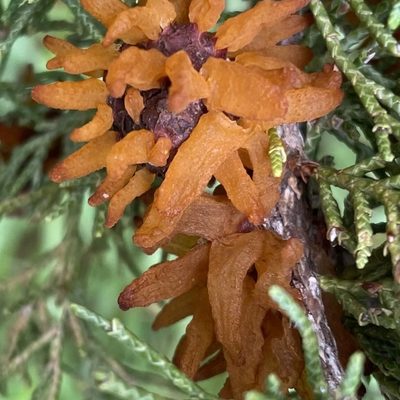
On Rocky Mountain juniper, look for witches' brooms: rounded clumps of many small branches scattered through the crown. Infected branches without brooms show swollen, elongate areas of rough, cracked bark, and the rust can also swell part or all of a trunk. In wet spring weather, orange jelly forms on the needles and oozes from cracks in the infected bark. On serviceberry, the other host, it makes small yellow to orange leaf spots with red borders that grow into large brown blotches with red margins, swollen yellow spots on leaf veins, leaf stalks and green twigs, and in July white, tube-shaped spore structures on twigs, leaf stalks and under the leaf spots. Cedar-apple rust makes round, brown, woody galls 6–25 mm (¼–1 in) across on juniper twigs, which put out bright orange, tentacle-like horns in wet spring weather. Another rust recorded on common juniper in the Black Hills, Gymnosporangium clavariiforme, can also cause witches' brooms as well as woody swellings.
When can you find it?
All year; orange jelly on juniper in wet spring weather, white spore tubes on serviceberry in July.
Where does it grow?
Junipers with serviceberry nearby, since the rust needs both hosts. A 1991 Forest Service review says it was collected on Rocky Mountain juniper in Custer County in 1960, and a 1990 Forest Service survey found junipers with broom rust symptoms in the Black Hills. Herbarium specimens from 1897 to 1959 come from Lawrence, Custer and Pennington counties, including Wind Cave National Park, and from Crook and Weston counties in Wyoming; most are on serviceberry, and the Weston County ones include common and Rocky Mountain juniper. A 1967 study of western juniper rusts found it locally common to abundant on Rocky Mountain juniper and serviceberry in the Great Basin states of Wyoming, Idaho and Utah. The 2024 South Dakota forest health report lists juniper broom rust among diseases confirmed in the state. iNaturalist has no Black Hills records.
Other mushrooms to compare
Sources: Lundquist 1991, Tree Disease Survey of Conifers in the Black Hills - 1990, Technical Report R2-51 — USDA Forest Service; South Dakota Forest Health Highlights 2024 — SD DANR and USDA Forest Service; What's wrong with my plant? Juniper: unusual growths on branches — University of Minnesota Extension; What's wrong with my plant? Serviceberry: leaves discolored and wilted — University of Minnesota Extension; Thaxter 1891, The Connecticut Species of Gymnosporangium (Cedar Apples), Bulletin 107 — Connecticut Agricultural Experiment Station; Peterson 1967, Studies of Juniper Rusts in the West, Madroño 19: 79–91; Long 1945, Notes on Four Eastern Species of Gymnosporangium, Journal of the Washington Academy of Sciences 35: 182–188; Gymnosporangium nidus-avis, record 162482 — Species Fungorum; Gymnosporangium nidus-avis (incl. G. juvenescens) specimens, South Dakota — GBIF; Gymnosporangium nidus-avis (incl. G. juvenescens) specimens, Wyoming — GBIF; Black Hills observations of Gymnosporangium nidus-avis (research) — iNaturalist.