Conifer Mazegill
Gloeophyllum sepiarium
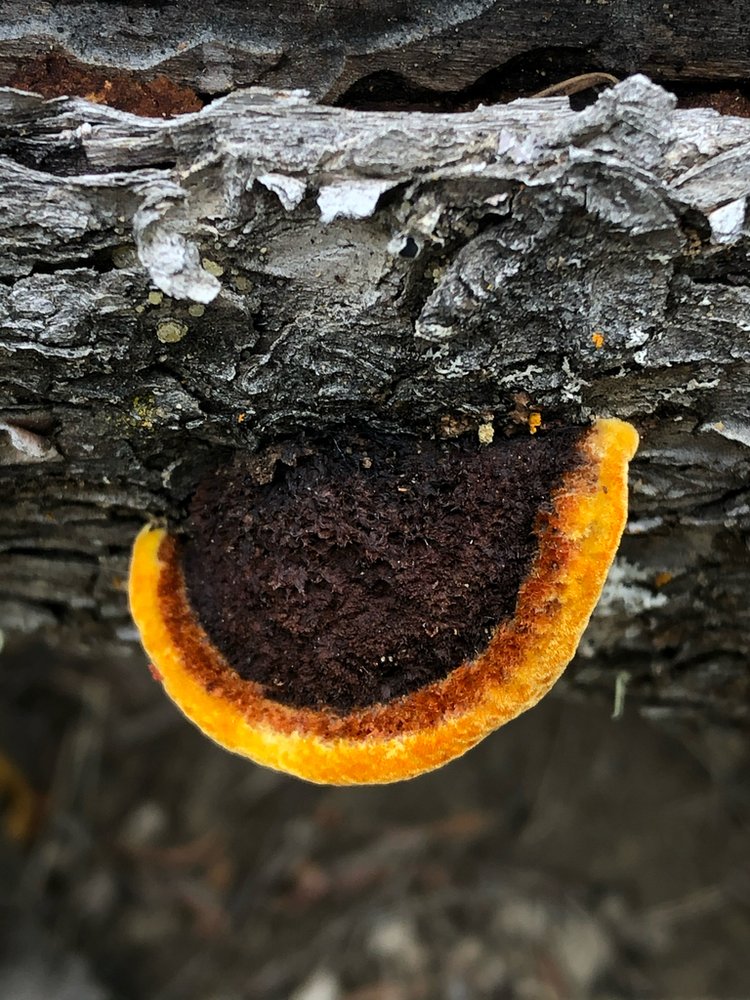
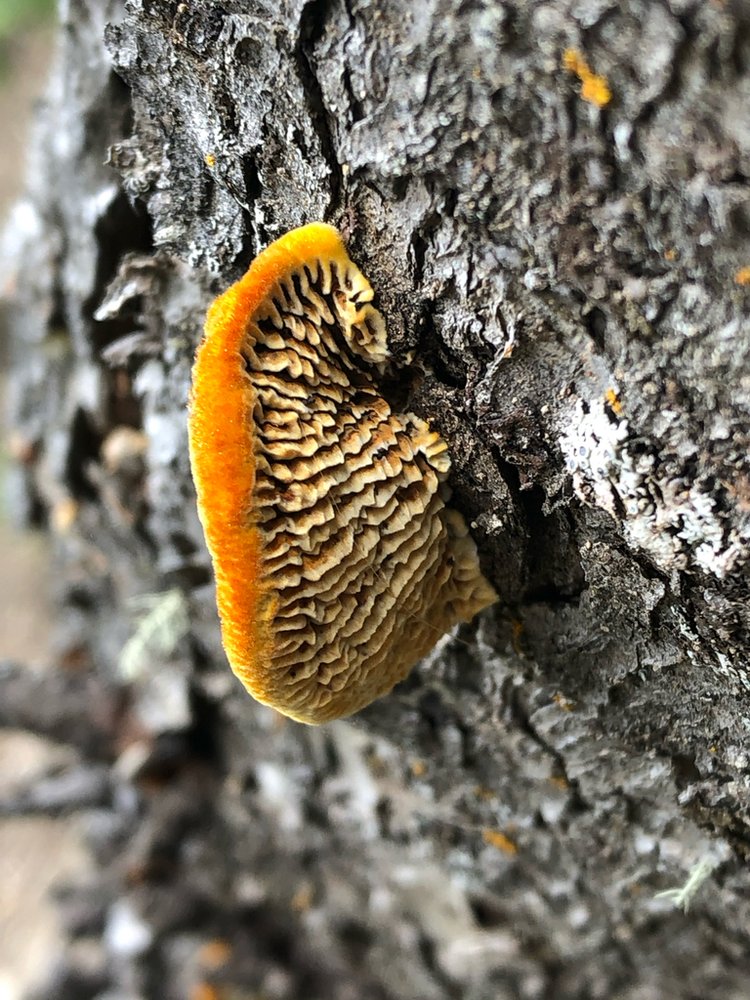
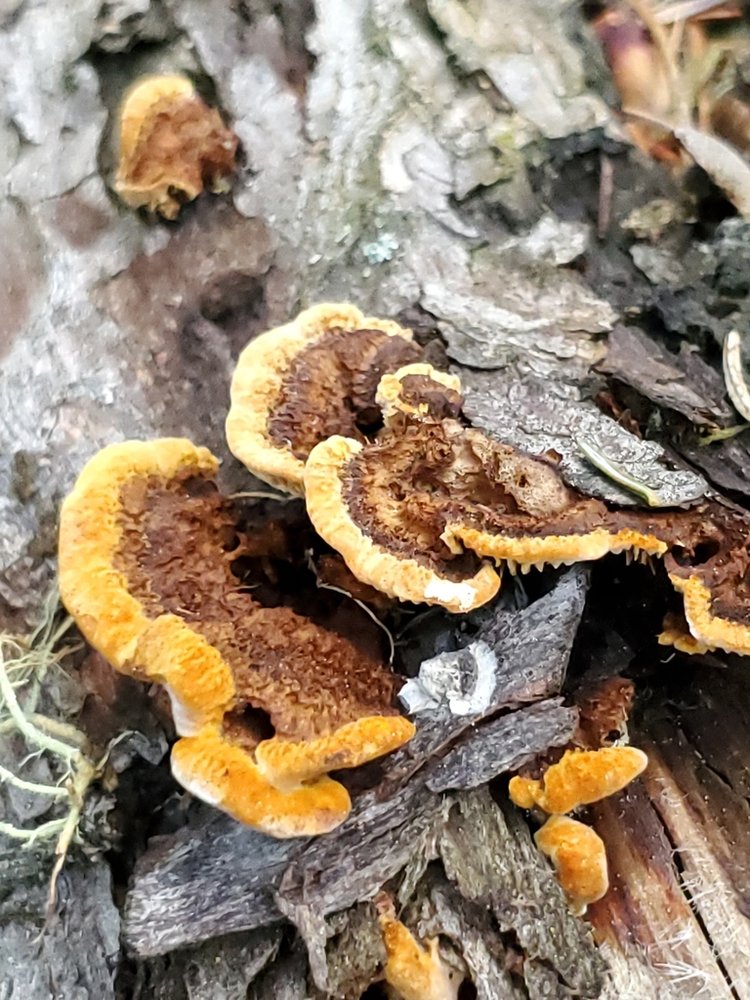
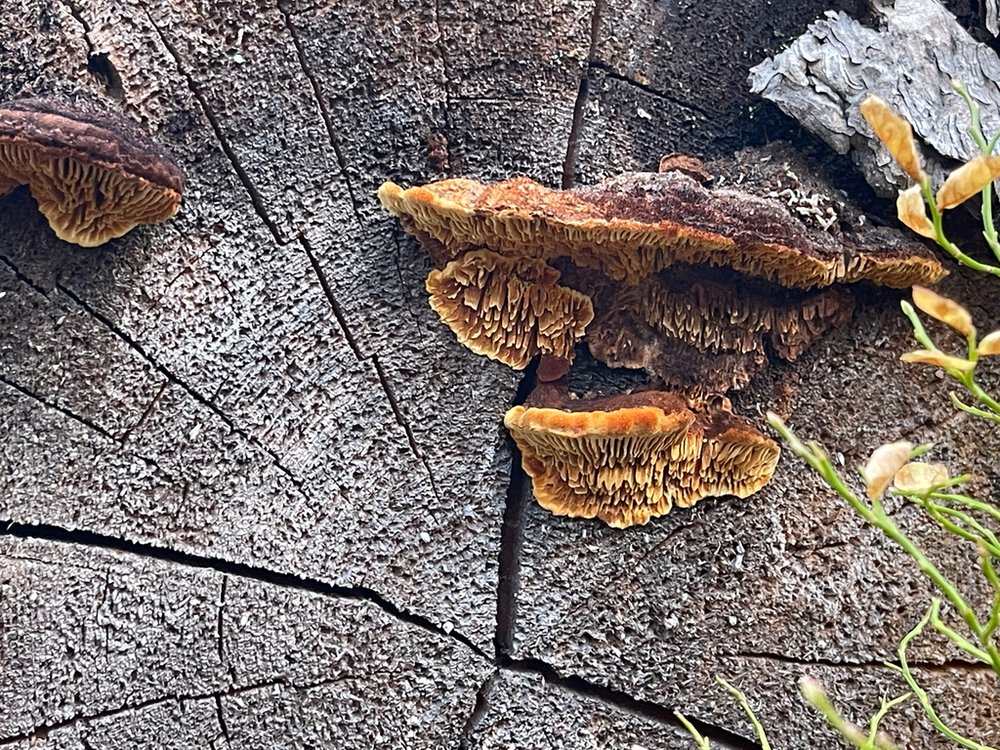
Conifer Mazegill (Gloeophyllum sepiarium) is a tough, hairy shelf fungus, rusty to dark brown with a bright orange or yellow growing edge, and with gills underneath instead of pores. It grows on dead conifer logs, stumps and slash, and Black Hills specimens go back to 1927.
Free photos from other sources
| Family | Gloeophyllaceae · Mazegill |
|---|---|
| Type | Shelf fungus |
| Season | Summer and fall; Black Hills iNaturalist research-grade records run from May to September |
| Size | Up to about 12 cm (4¾ in) across and 8 cm (3 in) deep |
| Grows on | Dead conifer logs, stumps, slash and lumber, including ponderosa pine; now and then aspen |
| Spore print | White |
| Synonym | Lenzites sepiaria |
| Eating | This guide doesn't say which mushrooms are safe to eat. |
How it lives
A saprobe on dead wood that causes a brown rot. Brown rot breaks down the cellulose and leaves the lignin, so the wood turns brown, shrinks into cube-shaped checks and finally crumbles to powder. The brackets are annual, but some revive and keep growing the next year.
How do you identify Conifer Mazegill?
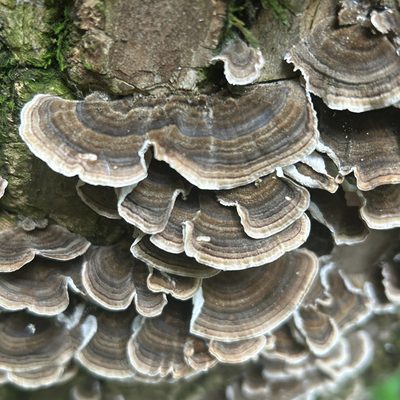
Look for a flat, rugged, semicircular or kidney-shaped bracket up to about 12 cm (4¾ in) across, alone or in groups, with no stem. The top is velvety to hairy with rings of color and texture: yellow to orange when young, turning yellow-brown to dark brown or nearly black toward the wood, while the growing edge usually stays yellow to orange. Turn it over and you see gills, not pores: irregular and often fused, fairly close, up to 1 cm deep, cream to pale brown with yellow-brown edges that darken with age, often mixed with slot-like pores. Break it and the flesh is dark rusty brown and corky. Gilled Polypore, which is on Mount Rushmore's species list, also has gills under a hairy, zoned cap, but its gills and flesh are white and it grows on hardwoods. Turkey Tail is much thinner, with zones of many colors on top; underneath it is whitish with tiny pores and no gills, and its flesh is white.
When can you find it?
Summer and fall; Black Hills iNaturalist research-grade records run from May to September.
Where does it grow?
Dead conifer wood: logs, stumps, slash and even lumber, now and then aspen in conifer forest. A 1991 Forest Service list of fungi on Black Hills pine reports it with brown sapwood rot, and sometimes heart rot, of pine logs, timber and slash in 1965. Herbarium specimens were collected in Custer County in 1927, and Mushroom Observer has a 2010 collection from Custer State Park. iNaturalist has 6 research-grade Black Hills records, May to September, from Custer State Park and Custer and Pennington counties.
Other mushrooms to compare
Sources: Gloeophyllum sepiarium (M. Kuo, 2010) — MushroomExpert.com; Lenzites betulinus (M. Kuo, 2024) — MushroomExpert.com; Trametes versicolor (M. Kuo, 2017) — MushroomExpert.com; Fungi Associated with Pines in the Black Hills, Technical Report R2-50 (Lundquist 1991) — USDA Forest Service; Field Guide to Diseases and Insects of the Rocky Mountain Region, RMRS-GTR-241 (2010), white and brown rot — USDA Forest Service; Gloeophyllum sepiarium in Black Hills counties, including NY 1964367 and 1964370 (1927) — GBIF; Observations in the Black Hills, including 52050 (Custer State Park, 2010) — Mushroom Observer; Gloeophyllum sepiarium, research-grade records in the Black Hills — iNaturalist; Gloeophyllum sepiarium, Black Hills research-grade records by month — iNaturalist; NPSpecies checklist, Mount Rushmore National Memorial, fungi (Lenzites betulina present) — National Park Service; Gloeophyllum sepiarium, synonymy (Lenzites sepiarius) — Species Fungorum (Index Fungorum).