Black Knot
Apiosporina morbosa
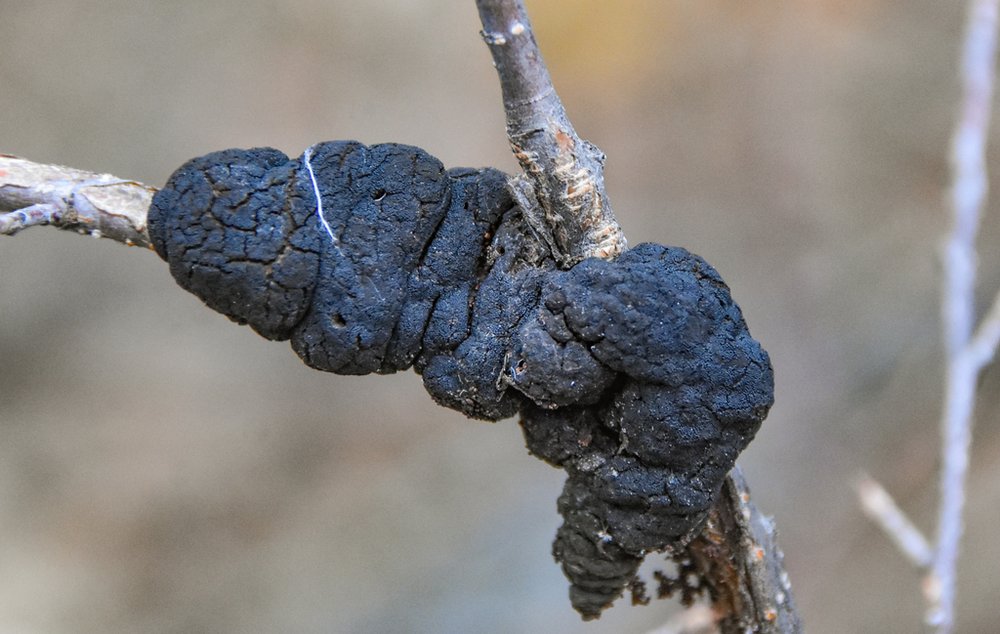
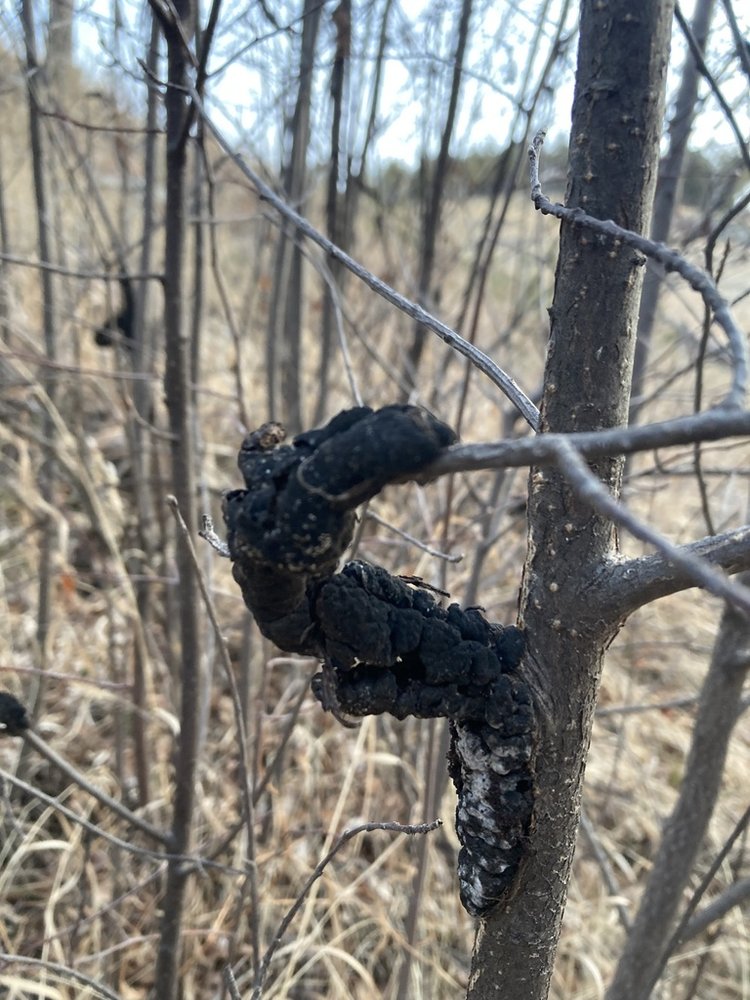
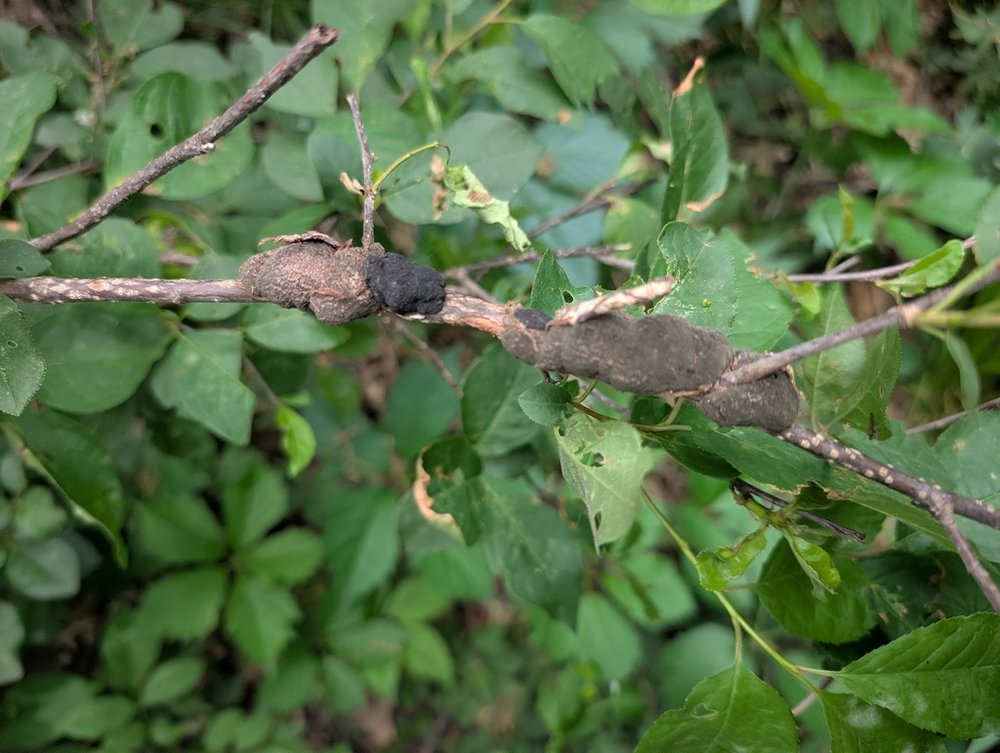
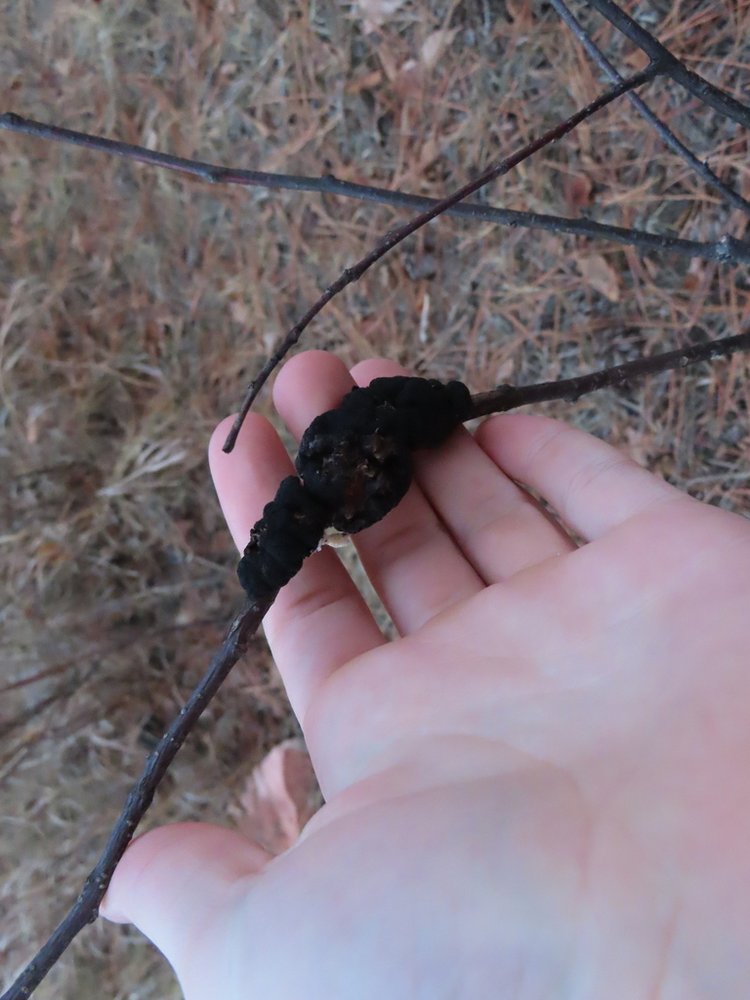
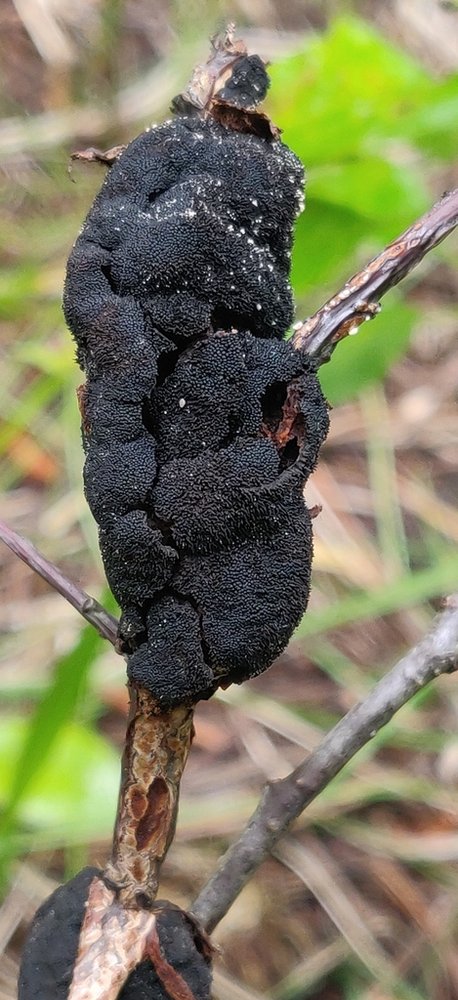
Black Knot (Apiosporina morbosa) is a fungus disease that makes hard, black, rough knots around the twigs and branches of chokecherry and, less often, plum. The knots stay on the shrub all year and stand out most in winter, while new ones turn olive-green and velvety in late spring. South Dakota's forest health specialist calls it common on chokecherry, Jewel Cave lists it on its chokecherries, and iNaturalist has 29 research-grade Black Hills records, including some from Wind Cave National Park.
Free photos from other sources
| Family | Venturiaceae · Venturia |
|---|---|
| Type | Gall |
| Season | All year; new knots turn olive-green and velvety in late spring, black by fall |
| Size | Knots 2.5–20 cm (1–8 in) long and 8–25 mm (⅓–1 in) thick; old ones to 30 cm (1 ft) or more |
| Grows on | Live twigs and branches of chokecherry; now and then plums |
| Synonym | Dibotryon morbosum, Plowrightia morbosa, Sphaeria morbosa |
| Eating | This guide doesn't say which mushrooms are safe to eat. |
How it lives
A parasite of live cherry and plum wood. In spring, rain shoots spores out of mature knots, and wind and splashing rain carry them to the current year's green shoots. A swelling shows a few months later or the next spring, and the knot makes its own spores one to two years after infection. Knots grow longer each year and girdle the twig, killing the growth beyond. A knot on the main stem can kill the whole shrub, and heavily infected cherries and plums bear less fruit.
How do you identify Black Knot?
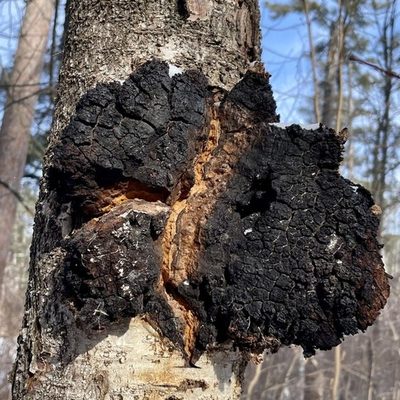
Look for a hard, black, rough swelling that wraps around a twig or branch of chokecherry or another wild cherry or plum. It is shaped like a cylinder or spindle, often irregular, and usually 2.5–20 cm (1–8 in) long. A new infection starts as a small, pale brown or greenish swelling. In late spring of the next year it turns soft and is covered with a velvety olive-green layer, then darkens over the summer and is hard, brittle and black by fall. Old knots can turn white or pinkish where other fungi move in, and the twig beyond a knot often dies. Chaga, a black, cracked growth on the trunks and big limbs of birch, can look similar, but chaga does not grow on cherry, and black knot sits mostly on small twigs.
When can you find it?
All year; new knots turn olive-green and velvety in late spring, black by fall.
Where does it grow?
Live branches of chokecherry, its main host in South Dakota, and now and then plums. South Dakota's state forest health specialist calls it common on chokecherry, and the National Park Service says black knot is so closely tied to chokecherry at Jewel Cave that a tree with black knot there is a chokecherry. iNaturalist has 65 Black Hills records (29 research grade) from every month of the year, including Wind Cave National Park and Custer State Park. Herbarium specimens were collected on western chokecherry in Custer County between 1914 and 1935, and on a wild cherry or plum in Crook County, Wyoming, in 1911. The state's 2024 forest health report lists it among confirmed tree diseases.
Other mushrooms to compare
Sources: Pest Update, 25 April 2018: black knot — South Dakota Department of Agriculture and Natural Resources; Mushrooms and Other Fungi — Jewel Cave National Monument, National Park Service; Field Guide to Diseases & Insects of the Rocky Mountain Region, RMRS-GTR-241 (2010): Black Knot of Cherry and Plum — USDA Forest Service; Black Knot, Apiosporina morbosa (S. Mahr) — University of Wisconsin-Madison Extension; Fact sheet PLPATH-FRU-31, black knot — Ohio State University Extension (Ohioline); Spinosa & Bunyard 2012, chaga lookalikes, FUNGI 5(3): 45–47; South Dakota Forest Health Highlights 2024 — SD DANR and USDA Forest Service; Apiosporina morbosa, record 292632 — Index Fungorum; Name search: Plowrightia morbosa, current name Apiosporina morbosa — Index Fungorum; Black Hills observations of Apiosporina morbosa — iNaturalist; Apiosporina morbosa, Black Hills records by month — iNaturalist; Apiosporina morbosa specimens, South Dakota — GBIF; Apiosporina morbosa specimens, Wyoming — GBIF; Prunus melanocarpa, accepted as Prunus virginiana var. demissa, western chokecherry — ITIS; Prunus demissa, accepted as Prunus virginiana var. demissa — ITIS.