Bur Oak
Quercus macrocarpa
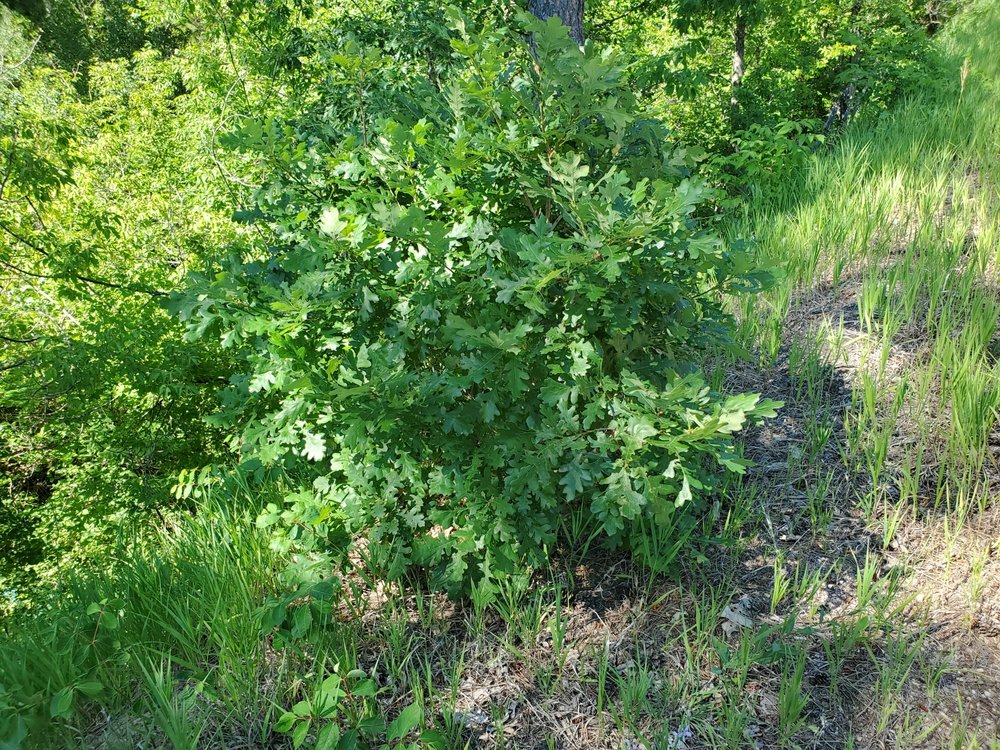
Bur Oak (Quercus macrocarpa) is the only native oak in the Black Hills, a slow-growing deciduous tree or shrub known by its deeply lobed leaves and its acorns set in a shaggy, fringed cup. It sheds pollen from hanging catkins in April and May, just after the leaves come out, and it grows mostly in the northern and eastern foothills, draws and canyon bottoms, where the parks at Wind Cave, Mount Rushmore and Devils Tower all list it.
Free photos from other sources
| Family | Fagaceae · Beech |
|---|---|
| Status | Native tree |
| Blooms | Catkins in April and May |
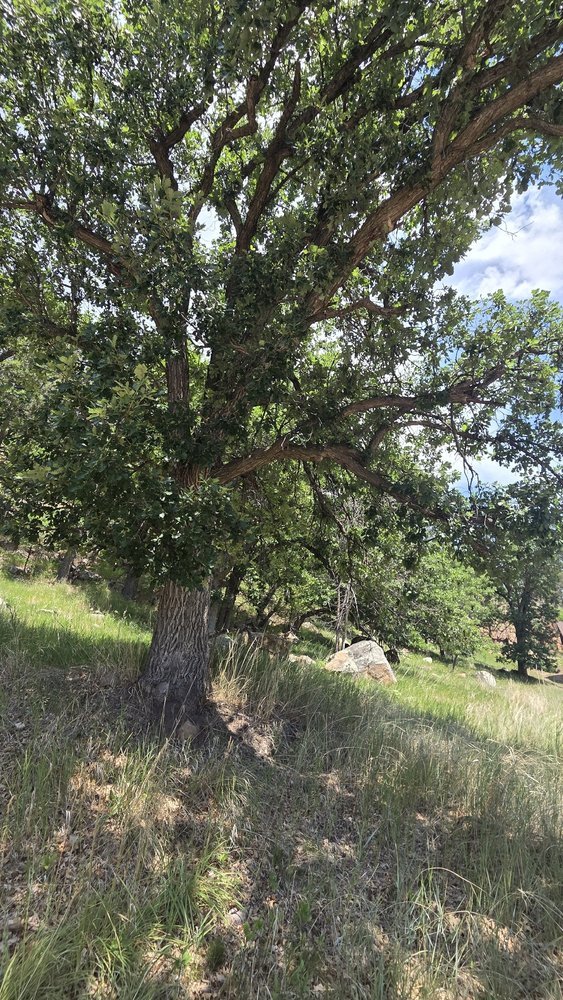
| Height | Usually a shrub 3–6 m (10–20 ft); up to 21 m (69 ft) along streams |
| Where | Foothills, draws, canyon bottoms and rocky slopes, often under pine |
| Also called | Mossycup Oak, Mossy-overcup Oak, Scrub Oak, uskúyeča hú (Lakota), útahu čháŋ (Lakota) |
| Synonym | Quercus mandanensis, Quercus macrocarpa var. depressa, Quercus macrocarpa var. oliviformis |
| Toxicity | Cattle can be poisoned by a diet made up mostly of oak. |
| Traditional use | Sitting Bull College's 1998 Culturally Important Plants of the Lakota says the acorns were boiled over and over to remove the bitter tannin, then eaten whole, roasted or ground into flour for bread. A weak tea of the bark and root bark was used for diarrhea, and a tea boiled from the bark for poison ivy and other seeping, wet rashes. |
Roots, seeds & germination
Root: A deep taproot that starts early and can go more than 1 m (3 ft) down in the first season, plus a wide spread of side roots on older trees. Prairie Bur Oak roots have been traced 3–6 m (10–20 ft) down. Top-killed stems resprout from the root crown.
Seed: An acorn that ripens in one season and falls between August and November; in South Dakota, SDSU says to collect them in October, when they begin to fall. Trees start bearing at about 35 years, with good crops every 2–3 years, and squirrels and other rodents bury many of the acorns. Northern trees, including Black Hills ones, have small acorns in thinner, shallower cups.
Germination: Acorns die if they dry out. Northern acorns usually wait for spring and do better after cold, moist stratification; USDA suggests 30–60 days at 1–5°C (34–41°F). SDSU says fall sowing is essential, and USDA says to plant them 1.2–2.5 cm (½–1 in) deep.
How do you identify Bur Oak?
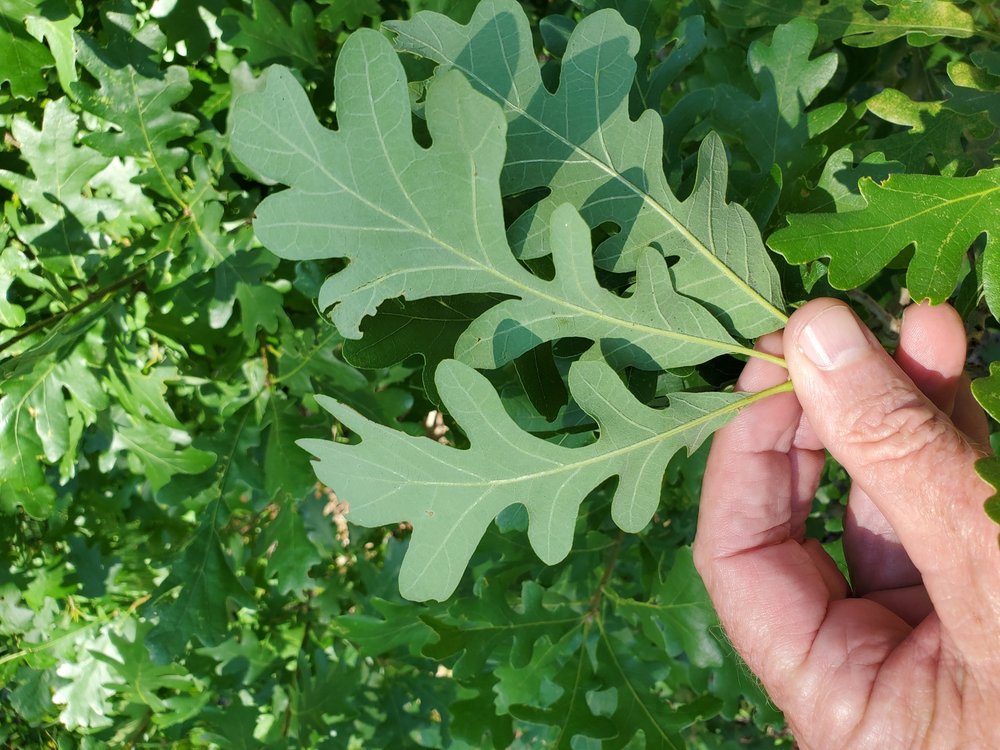
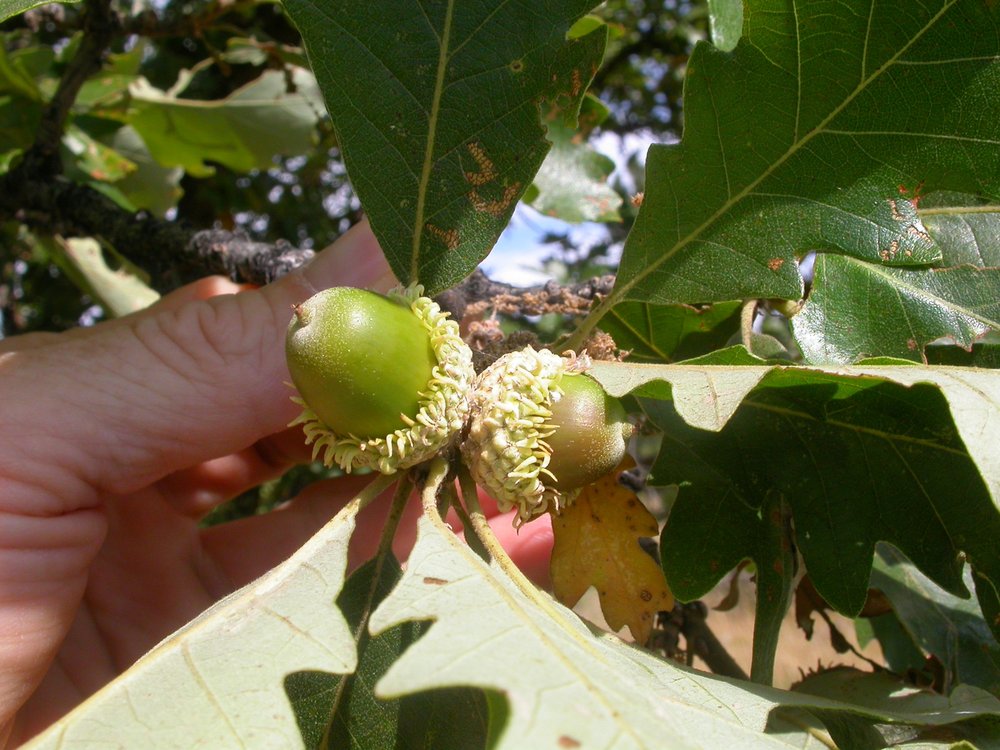
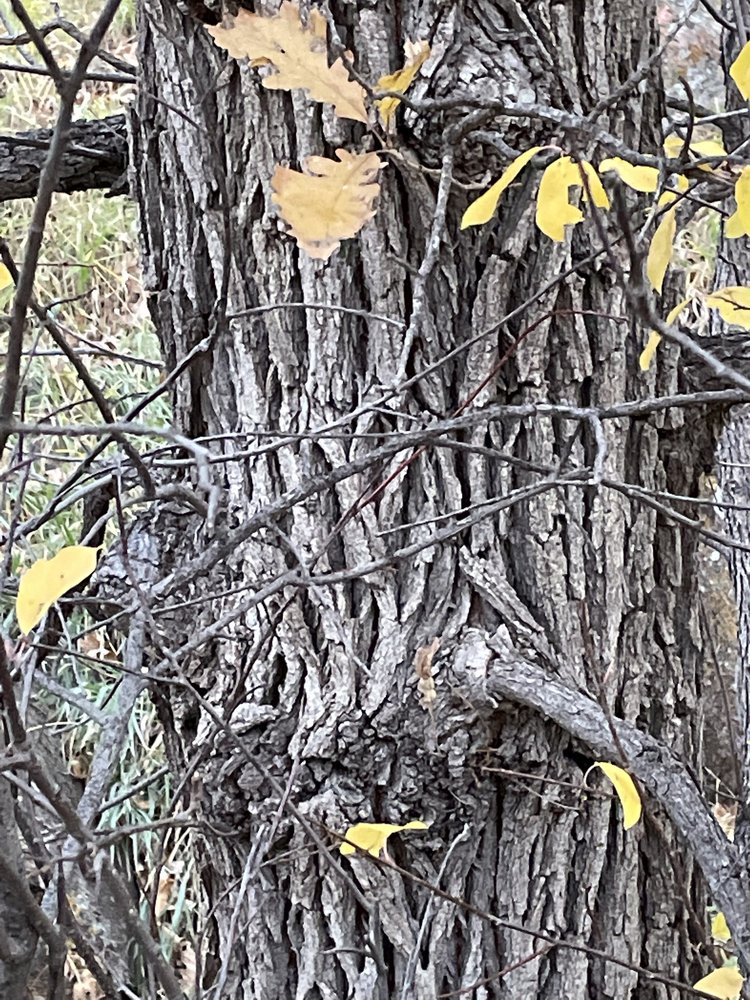
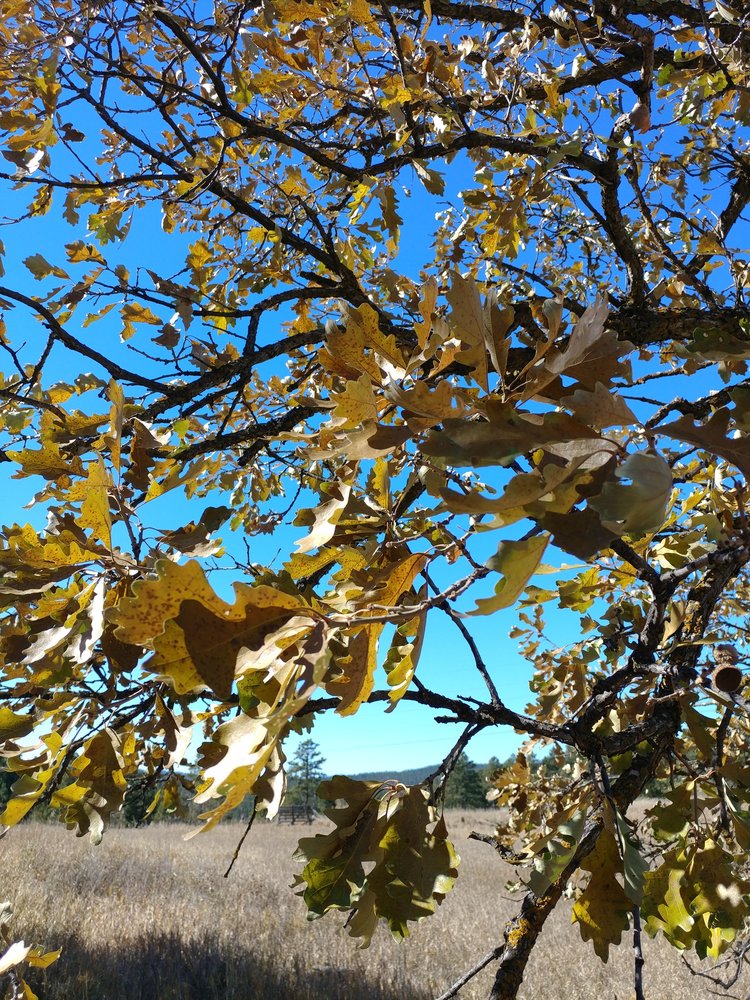
Any wild oak in the Black Hills is Bur Oak. The leaves are 10–25 cm (4–10 in) long, shaped like a fiddle and widest above the middle, with 2–3 rounded lobes on the upper half and 5–7 deeper lobes on the lower half, and pale and hairy underneath. The acorn sits in a deep, thick cup that covers half or more of the nut, with a fringe of long, narrow scale tips around the rim. The bark is thick, gray and deeply furrowed.
When does it bloom?
Catkins in April and May.
Where does it grow?
Foothills, draws, canyon bottoms and rocky slopes where the pine forest meets the prairie, often as a shrub under Ponderosa Pine, at about 950–2,000 m (3,100–6,600 ft). It is most common in the northern Hills, the Bear Lodge Mountains and around Devils Tower, and it grows along the eastern edge south to Custer State Park. Herbarium specimens come mostly from Lawrence and Crook counties, and none from Fall River or Weston counties. The National Park Service lists it for Wind Cave, Mount Rushmore and Devils Tower, but not Jewel Cave. The Black Hills and the nearby Alzada area are the western edge of its range.
Sources: USDA Forest Service Fire Effects Information System (FEIS): Quercus macrocarpa (Gucker 2011); Johnson, P.S. 1990. Bur oak. Silvics of North America, vol. 2, Hardwoods. USDA Agric. Handb. 654 (PDF via Virginia Tech); USDA NRCS Plant Guide: Bur Oak, Quercus macrocarpa; USDA NRCS Plant Fact Sheet: Bur Oak, Quercus macrocarpa (Bridger PMC); Reese, R.N. Fagaceae: Quercus macrocarpa. South Dakota Native Plant Research, SDSU Open PRAIRIE; ITIS: Quercus macrocarpa Michx. (TSN 19287), with synonyms; GBIF: Quercus macrocarpa Michx. (accepted) and synonyms; Shepperd, W.D. & Battaglia, M.A. 2002. Ecology, silviculture, and management of Black Hills ponderosa pine. USDA Forest Service RMRS-GTR-97 (bur oak habitat types; bur oak section); Chechowitz, N., Chappell, D.M., Guttman, S.I. & Weigt, L.A. 1990. Morphological, electrophoretic, and ecological analysis of Quercus macrocarpa populations in the Black Hills of South Dakota and Wyoming. Canadian Journal of Botany 68: 2185-2194 (abstract); Heidel, B. 1993. Survey for Quercus macrocarpa in the Powder River Resource Area, Miles City District, BLM, Montana. Montana Natural Heritage Program; Rydberg, P.A. 1896. Flora of the Black Hills of South Dakota. Contributions from the U.S. National Herbarium 3(8); NPS Devils Tower National Monument: Trees and Shrubs; NPSpecies checklist, Wind Cave National Park vascular plants; NPSpecies checklist, Mount Rushmore National Memorial vascular plants; NPSpecies checklist, Devils Tower National Monument vascular plants; NPSpecies checklist, Jewel Cave National Monument vascular plants (bur oak not listed); Marriott, H. & Hartman, R.L. 1986. A Survey of the Vegetation of Jewel Cave National Monument (bur oak not listed); GBIF occurrence search: Quercus macrocarpa, preserved specimens, South Dakota; GBIF occurrence search: Quercus macrocarpa, preserved specimens, Wyoming; Black Elk, L. & Flying By, W. 1998. Culturally Important Plants of the Lakota (entry 250, Quercus macrocarpa); Gilmore, M.R. 1919. Uses of Plants by the Indians of the Missouri River Region. 33rd Annual Report, Bureau of American Ethnology; Riggs, S.R. 1890. A Dakota-English Dictionary (ed. J.O. Dorsey): úta, útahu, útahučaŋ, uskúyeča; iNaturalist: Quercus macrocarpa (taxon 54781).