Spruce Broom Rust
Chrysomyxa arctostaphyli
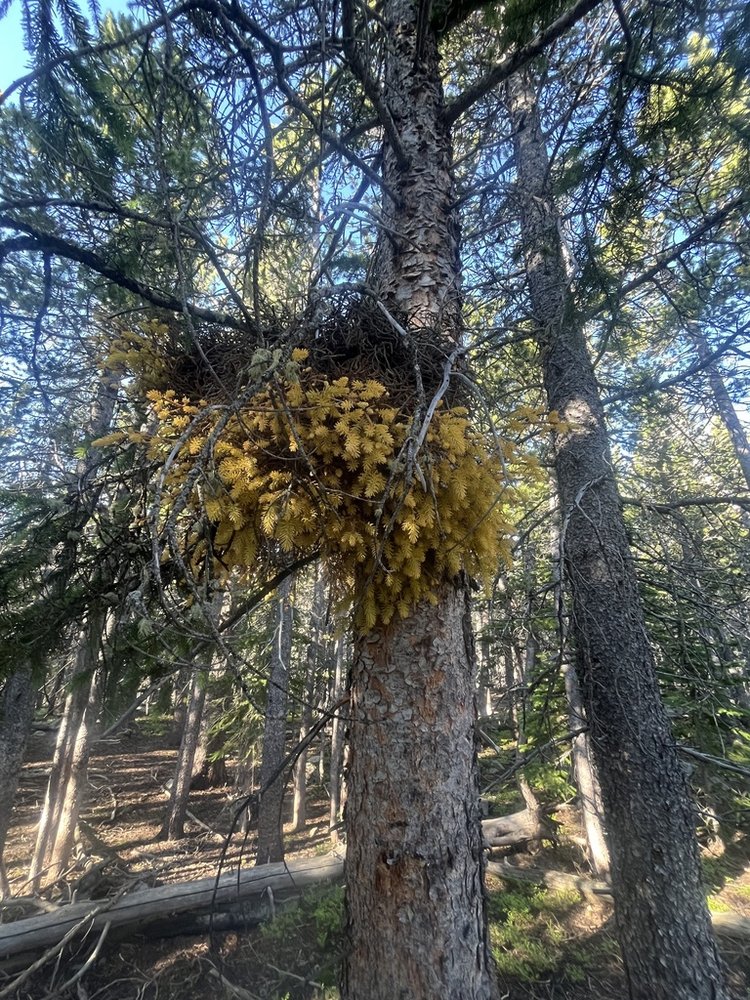
Spruce Broom Rust (Chrysomyxa arctostaphyli) is a rust fungus that makes a dense, rounded witches' broom on spruce, bright yellow in early summer and bare and brown in winter. Its second host is kinnikinnick (bearberry). Herbarium specimens collected from 1914 to 1961 show it on spruce and kinnikinnick in the Black Hills, in Lawrence, Custer and Pennington counties.
Free photos from other sources
| Family | Coleosporiaceae · Needle rust |
|---|---|
| Type | Rust |
| Season | All year; yellow needles and orange spores in early summer, bare in winter |
| Size | Brooms reach 1 m (3 ft) across after many years, sometimes 2 m (6½ ft) |
| Grows on | Branches and trunks of live spruce; leaves of kinnikinnick |
| Also called | Yellow Witches' Broom of Spruce, Yellow Witches' Broom Rust |
| Synonym | Peridermium coloradense, Melampsoropsis arctostaphyli |
| Eating | This guide doesn't say which mushrooms are safe to eat. |
How it lives
A rust fungus with two hosts, spruce and kinnikinnick, and a two-year cycle. In spring, spores from kinnikinnick leaves infect the new needles and buds of spruce. The fungus then lives on inside the branch and makes it sprout many short shoots, building a broom that keeps growing for decades. In early summer the broom's needles release orange spores that can infect only kinnikinnick, where they make purplish leaf spots, and spores formed there in turn infect spruce. Brooms slow the tree's growth, can kill the top or a branch and let decay fungi into the trunk, and they can carry fire up into the crown.
How do you identify Spruce Broom Rust?
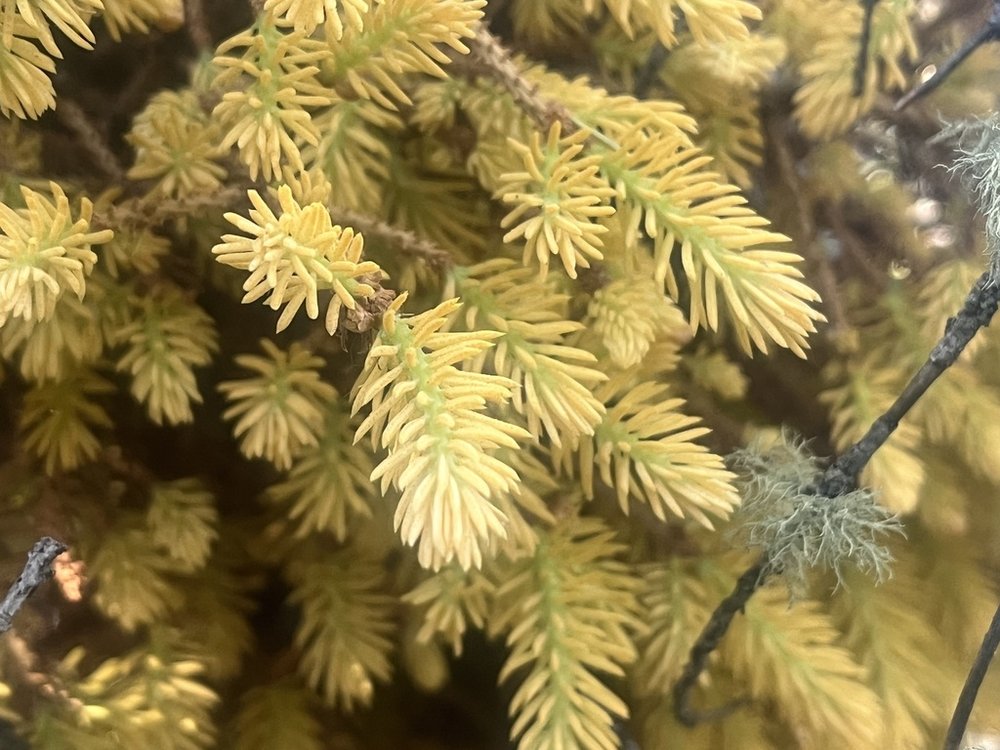
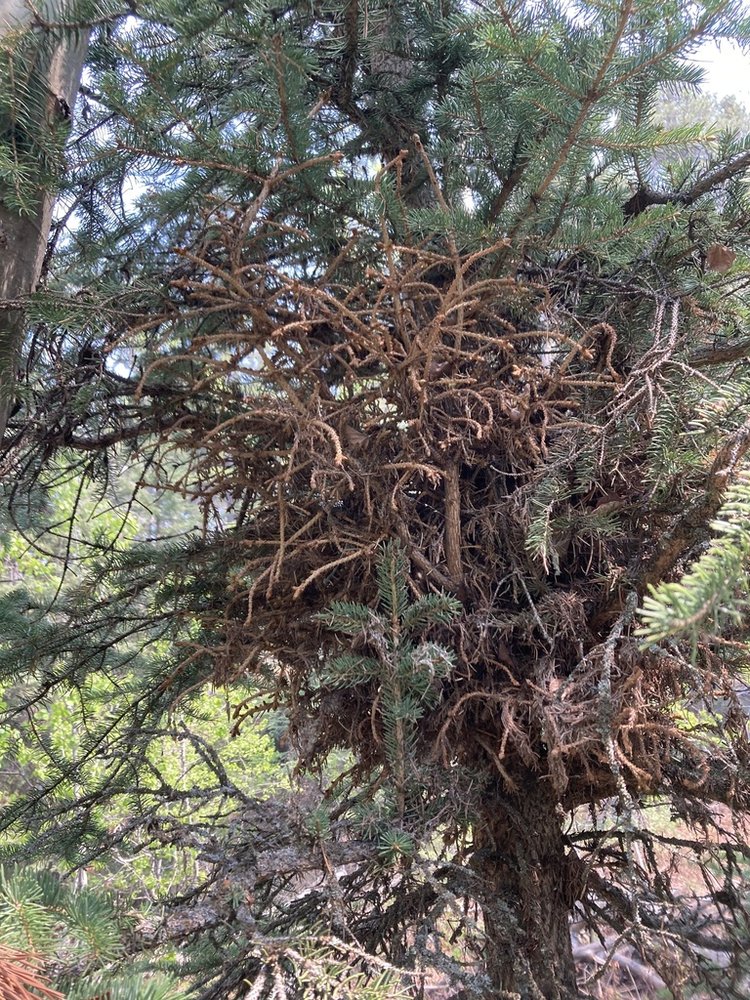
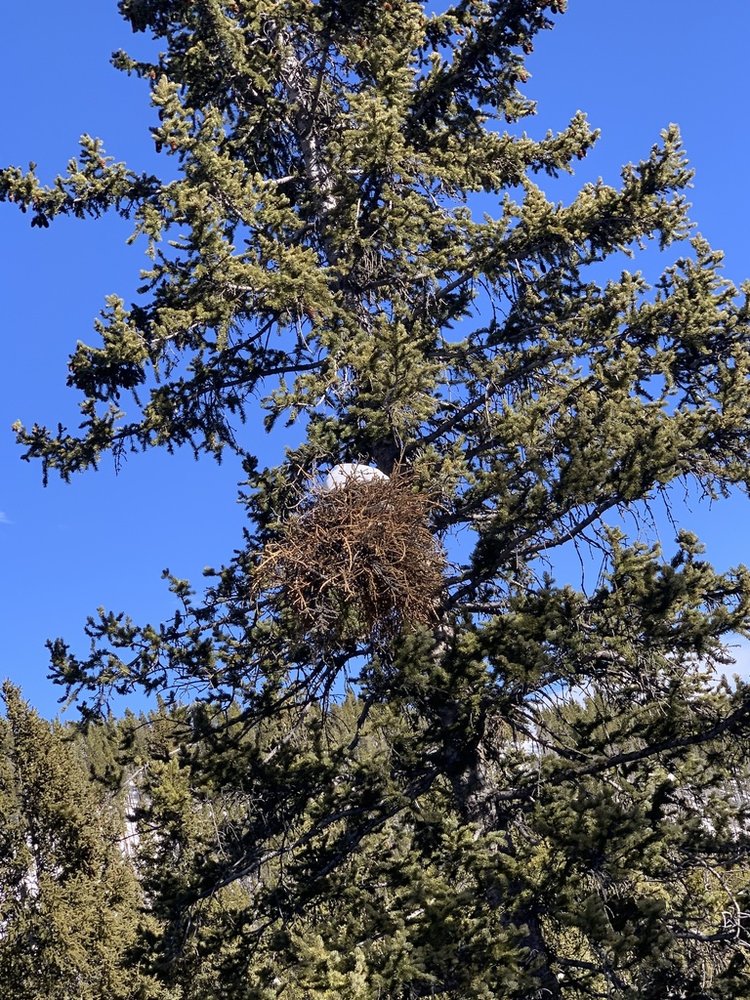
Look for a witches' broom on spruce: a dense, rounded mass of short, thick twigs on a branch or on the trunk. In spring and early summer the needles in the broom are short, thick and pale yellow, standing out against the rest of the tree, and in early summer they carry bright orange spore pustules, so the whole broom looks yellow-orange. The needles fall each autumn, so in winter the broom looks dead and brown, then it grows new yellow needles the next spring. Brooms can be more than 30 years old and up to 2 m (6½ ft) across. Dwarf mistletoe brooms are looser, stay green all year and show small mistletoe shoots, but dwarf mistletoe has never been found in the Black Hills. Elytroderma needle cast, recorded widely in the Black Hills, makes dense, rounded brooms in ponderosa pine, not spruce. On kinnikinnick, the rust makes purplish spots on the leaves.
When can you find it?
All year; yellow needles and orange spores in early summer, bare in winter.
Where does it grow?
Spruce with kinnikinnick growing nearby. In the Black Hills the host is white spruce, the variety Picea glauca var. densata, which grows in nearly pure stands along streams, on lower slopes and on north-facing slopes of the northern Hills, and is absent from the Bear Lodge Mountains. Herbarium specimens show the rust on spruce in Custer County (1914 and 1933), Lawrence County (1918, filed both under Chrysomyxa arctostaphyli and under its old spruce-stage name Peridermium coloradense) and Pennington County (1921), and on kinnikinnick in Pennington County (1961). iNaturalist has 4 reports from the Black Hills, mostly the northern Hills, none yet research grade.
Sources: Field Guide to Diseases & Insects of the Rocky Mountain Region, RMRS-GTR-241 (2010): Broom Rusts of Spruce and Fir — USDA Forest Service; Spruce broom rust (A.C. Skinner) — Natural Resources Canada, Trees, insects, mites, and diseases of Canada's forests; Chrysomyxa arctostaphyli datasheet — EPPO Global Database; Boldt & Van Deusen 1974, Silviculture of Ponderosa Pine in the Black Hills, Research Paper RM-124 — USDA Forest Service; Lundquist 1991, Fungi Associated with Pines in the Black Hills, Technical Report R2-50 (Elytroderma deformans) — USDA Forest Service; Chrysomyxa arctostaphyli, record 216716 — Index Fungorum; Peridermium coloradense, record 187926 — Index Fungorum; Chrysomyxa arctostaphyli specimens, South Dakota — GBIF; Peridermium coloradense specimens, South Dakota — GBIF; Picea canadensis, accepted as Picea glauca (white spruce) — ITIS; Black Hills observations of Chrysomyxa arctostaphyli — iNaturalist.