Pine Bracket
Porodaedalea pini
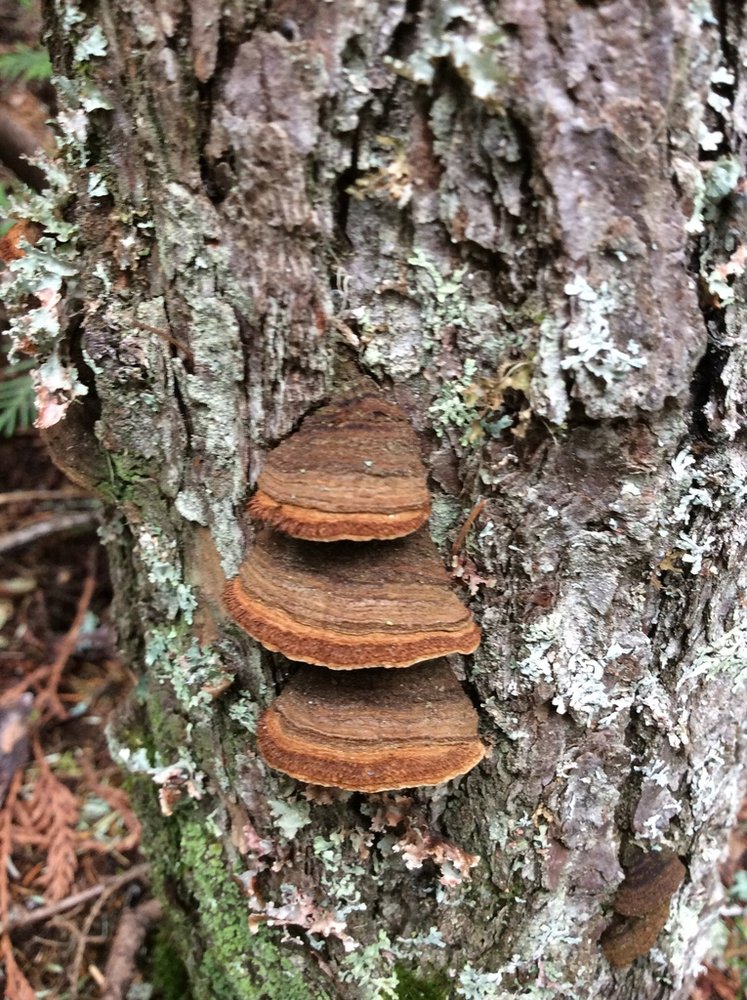
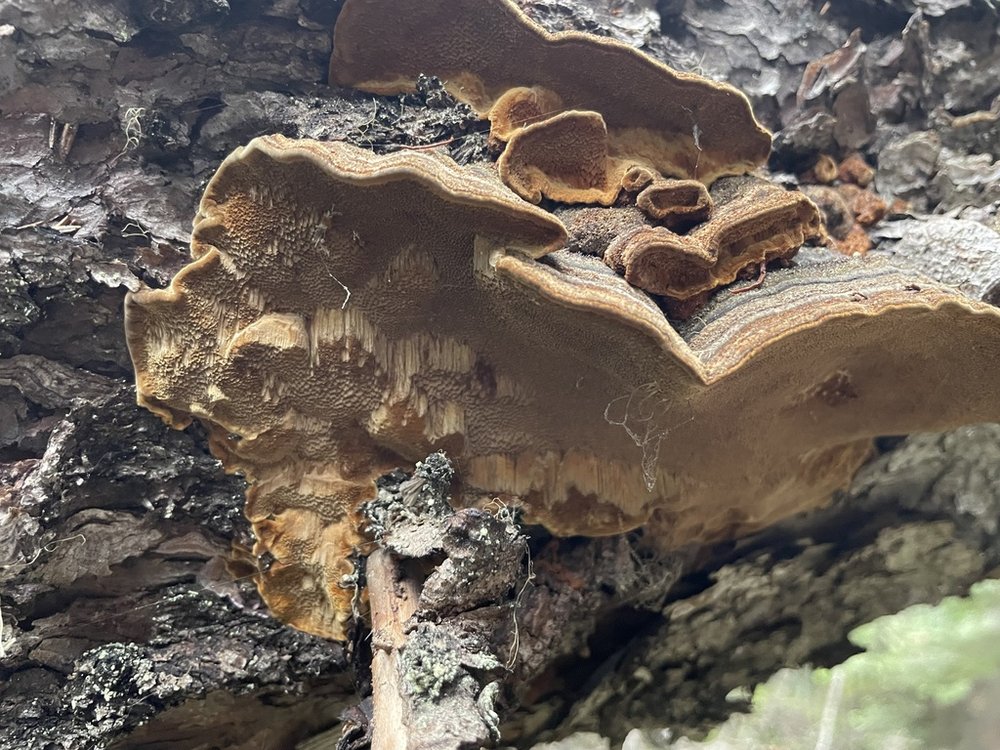
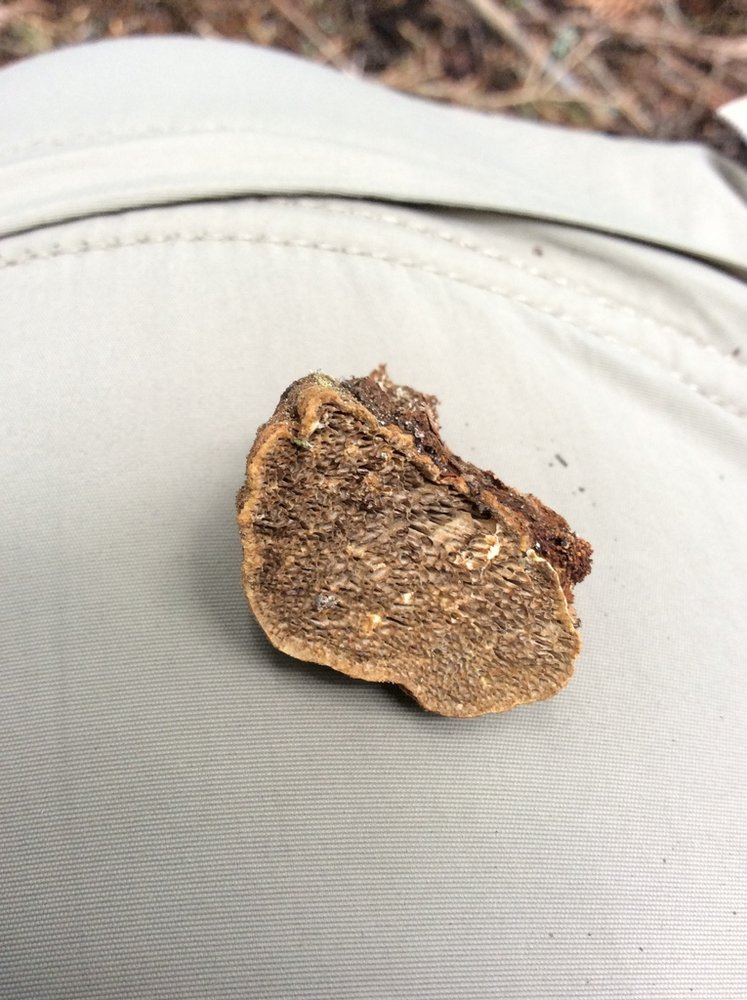
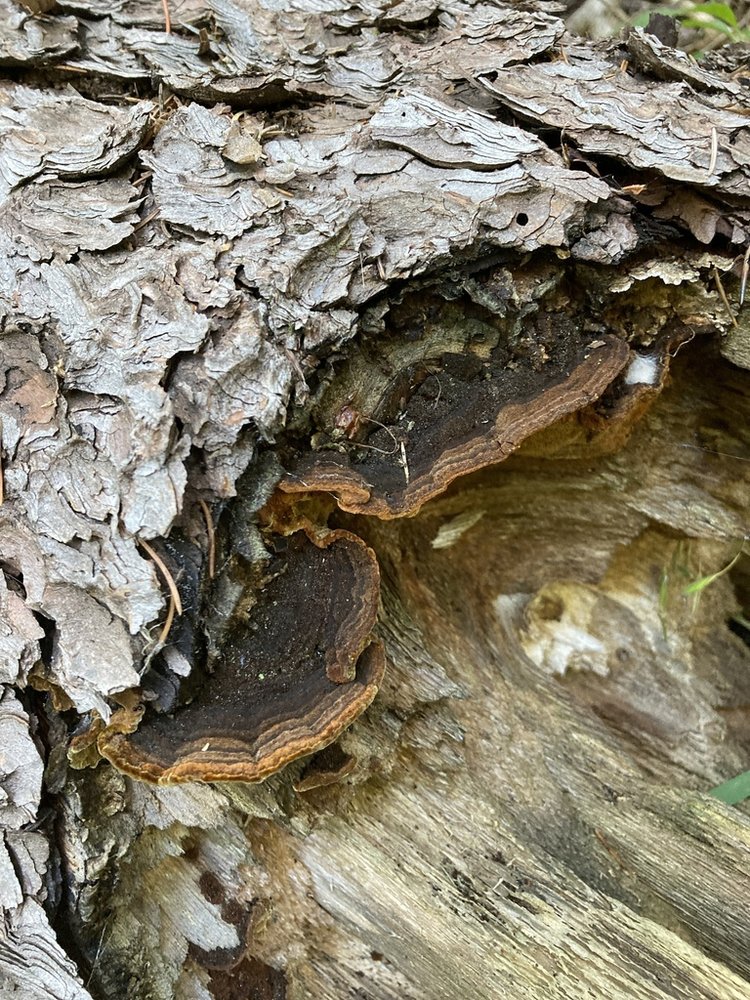
Pine Bracket (Porodaedalea pini) is a hard, perennial conk with a rough, furrowed, reddish-brown to black top and a yellow-brown underside of angular pores, usually growing below a branch stub on a conifer trunk. It causes red ring rot, a heart rot of living conifers. Black Hills records are few: a 1933 herbarium specimen from Custer County and a 1961 Forest Service collection from Pennington County, both on ponderosa pine.
Free photos from other sources
| Family | Hymenochaetaceae · Hymenochaete |
|---|---|
| Type | Shelf fungus |
| Season | All year; the conks are perennial and stay on the tree season after season |
| Size | Conk up to about 25 cm (10 in) across and 15 cm (6 in) deep |
| Grows on | Trunks of living and dead conifers, at branch stubs and knots; in the Black Hills, ponderosa pine |
| Also called | Red Ring Rot, Ring-scale Fungus |
| Synonym | Phellinus pini, Fomes pini, Trametes pini, Polyporus pini |
| Eating | This guide doesn't say which mushrooms are safe to eat. |
| Note | Not the 'red rot' of Black Hills ponderosa pine, which is a different fungus, Dichomitus squalens. |
How it lives
A heart rot of living conifers that also lives on in dead wood. Wind-borne spores can infect small wounds, twig stubs or branch stubs and grow into the inner wood, and 10 to 20 years or more may pass before a conk forms. Early on, the decay shows as reddish to purple arcs that follow the annual rings, which gives red ring rot its name; later the wood fills with small, mostly hollow white pockets, a white pocket rot sometimes called white speck. Decay can reach 1.2 m (4 ft) above and 1.5 m (5 ft) below a conk or punk knot, can grow into the sapwood and large roots, and sometimes makes living trees break. Animals may use the decayed wood for nesting, denning or hiding.
How do you identify Pine Bracket?
Look for a woody conk with no stem, up to about 25 cm (10 in) across, hoof-shaped to shelf-like, or thin and shell-shaped, alone or in overlapping groups. It usually sits just below an old branch stub or knot on the trunk. The top is reddish brown to gray-brown, dark brown or black, zoned and furrowed, and hairy toward the margin. The underside slopes and is yellow-brown, with angular to nearly slot-like or maze-like pores, 1–4 per millimeter. The flesh is reddish brown to yellow-brown and corky to woody. Many infected trees have no conks, so look also for punk knots: swollen or sometimes sunken, resinous knots that the tree doesn't grow over. Shaved with a knife, they show reddish to golden-brown fungus tissue. The 'red rot' of Black Hills ponderosa pine is a different fungus, Dichomitus squalens. It seldom shows on standing trees; its fruiting body is a flat, annual layer of white pores, aging yellow, on the underside of dead branches, most often on dead wood lying on the ground.
When can you find it?
All year; the conks are perennial and stay on the tree season after season.
Where does it grow?
Trunks of living and dead conifers. Most conifers in the Rocky Mountain Region can be infected; Engelmann spruce, lodgepole pine, subalpine fir and Douglas-fir are commonly infected in parts of the region, and Natural Resources Canada lists ponderosa pine and white spruce among the main hosts in Canada. A 1991 Forest Service list of fungi on Black Hills pines has a single record, a 1961 collection from a dead, standing ponderosa pine in Pennington County. The U.S. National Fungus Collections hold a 1933 specimen on ponderosa pine from Custer County, filed as Fomes pini. Recent studies show that the true Porodaedalea pini, described from Europe, apparently doesn't grow in North America; forest pathologist Jim Worrall calls the common North American red-ring-rot fungus Porodaedalea piceina.
Sources: Field Guide to Diseases and Insects of the Rocky Mountain Region, RMRS-GTR-241 (2010), Red Ring Rot and Red Ray Rot — USDA Forest Service; Porodaedalea pini (M. Kuo, 2010) — MushroomExpert.com; Red Ring Rot (J. Worrall) — forestpathology.org; Porodaedalea in North America (J. Worrall, 2020) — forestpathology.org; Red ring rot — Natural Resources Canada, Trees, insects, mites, and diseases of Canada's forests; Lundquist 1991, Fungi Associated with Pines in the Black Hills (Technical Report R2-50) — USDA Forest Service; Boldt and Van Deusen 1974, Silviculture of Ponderosa Pine in the Black Hills (Research Paper RM-124), Red Rot — USDA Forest Service; Porodaedalea pini specimens in South Dakota, BPI 232864 (1933, as Fomes pini, on Pinus ponderosa) — GBIF; Porodaedalea pini, synonymy — Species Fungorum (Index Fungorum); Porodaedalea pini, names (Pine Bracket, Red Ring Rot) — iNaturalist.