Giant Sawgill
Neolentinus ponderosus
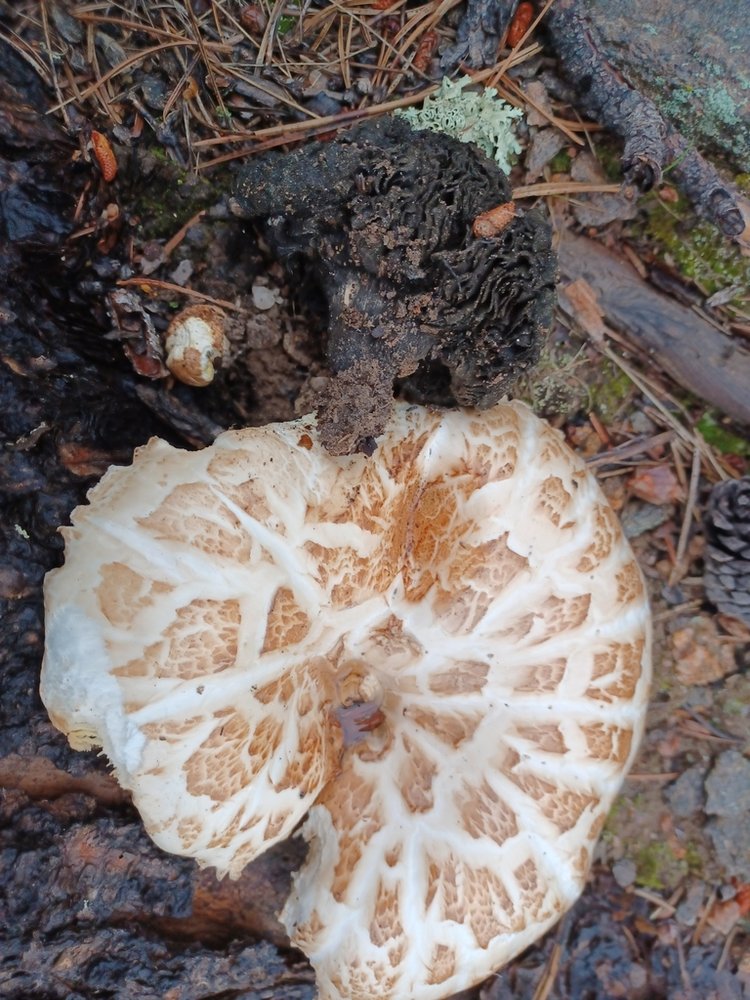
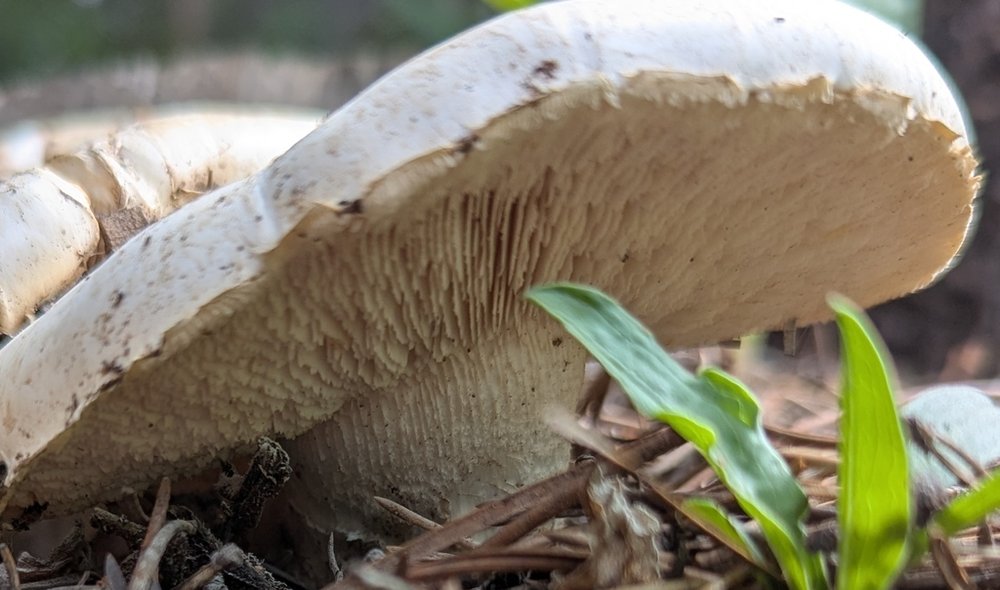
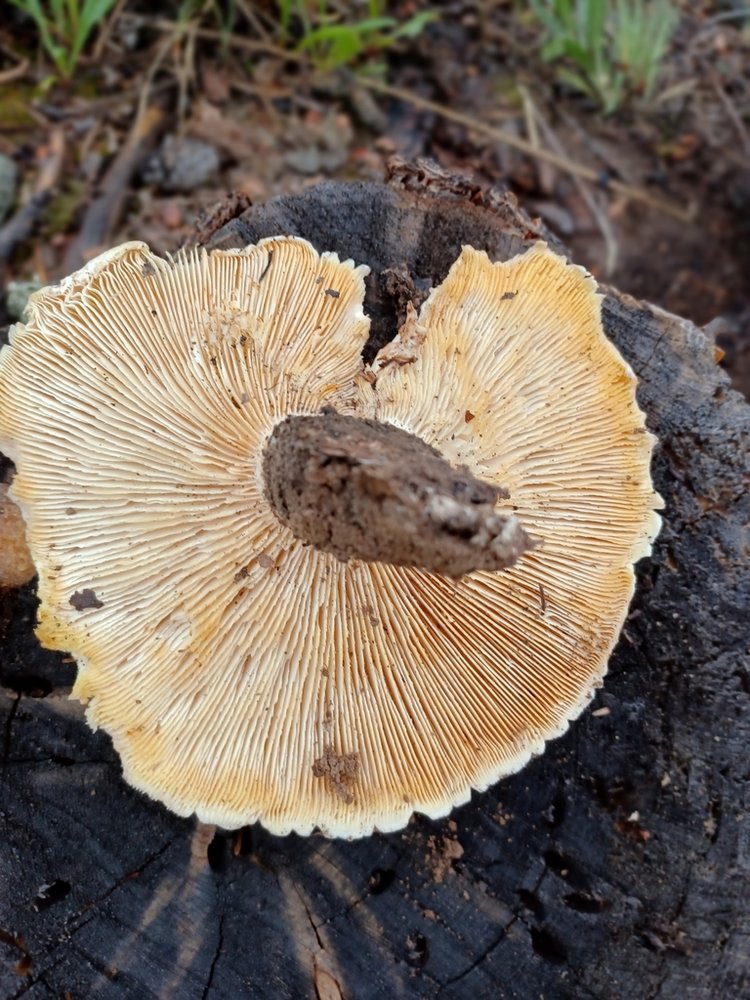
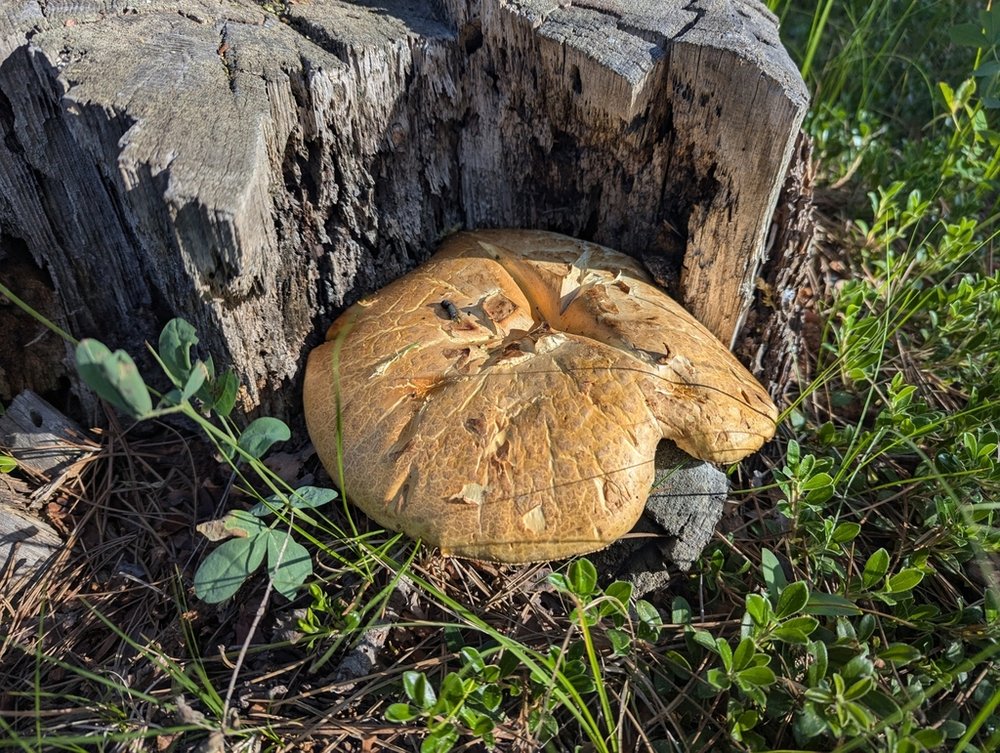
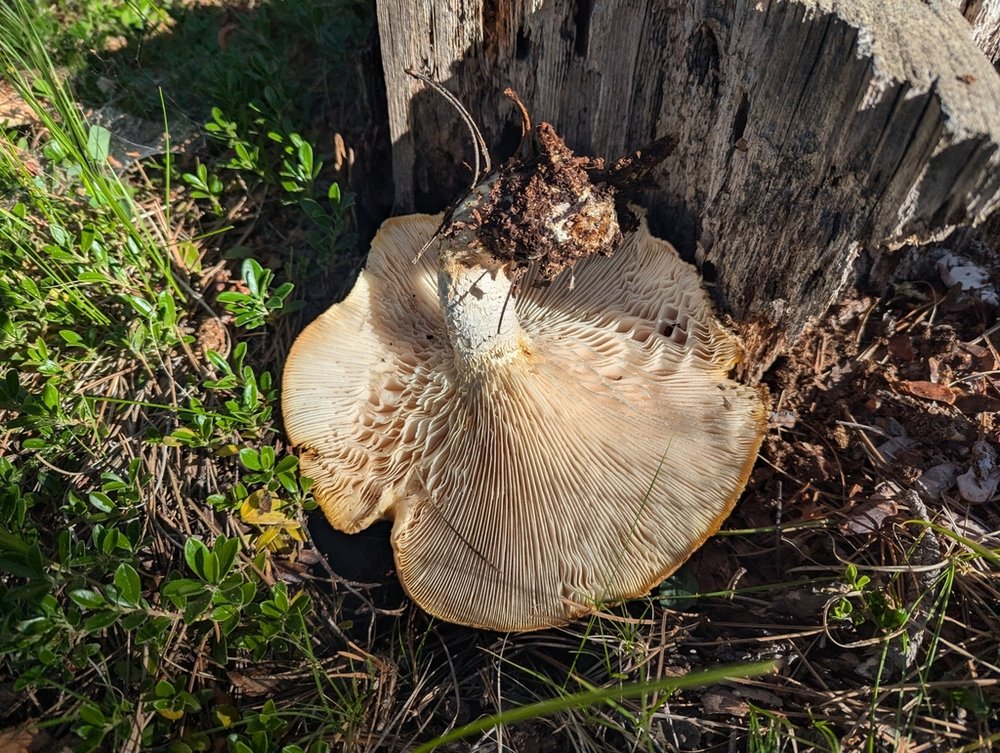
Giant Sawgill (Neolentinus ponderosus) is a big, very tough mushroom with a pale cap covered in brown scales and white gills with jagged, saw-toothed edges, growing from old, barkless stumps and logs, mostly of ponderosa pine. iNaturalist has 5 research-grade Black Hills records, from June to August.
Free photos from other sources
| Family | Gloeophyllaceae · Mazegill |
|---|---|
| Type | Gilled mushroom |
| Season | June into August on iNaturalist's Black Hills records; Kuo says the hotter, drier summer months |
| Size | Cap 5–30 cm (2–12 in) or more wide; stem 3–10 cm (1¼–4 in) tall and 2–4 cm (¾–1½ in) thick |
| Grows on | Old, barkless stumps and logs of ponderosa pine and other conifers |
| Spore print | White |
| Also called | Ponderous Lentinus, Large Lentinus |
| Synonym | Lentinus ponderosus |
| Eating | This guide doesn't say which mushrooms are safe to eat. |
How it lives
It is a decomposer of dead conifer wood and causes brown rot: the fungus removes the wood's cellulose and leaves the lignin behind, so the wood turns brown, shrinks, cracks into cubes and crumbles. Though it has gills, DNA work places it close to the Conifer Mazegill (Gloeophyllum sepiarium).
How do you identify Giant Sawgill?
Look for a large, tough mushroom on old conifer wood, often on a stump. The cap is 5–30 cm (2–12 in) or more across, convex and then broadly convex, dry, and buff to pinkish under large, flat, brownish scales, with an edge rolled under when young. The gills are white to orangish white, close, broadly attached or notched at the stem, and their edges are ragged and saw-toothed; they discolor brownish to yellowish. The stem is 3–10 cm (1¼–4 in) long and 2–4 cm (¾–1½ in) thick, very tough, finely scaly or ridged, with scales turning reddish brown toward the base, and it has no ring. The flesh is white to pinkish white, thick and tough, and doesn't change color when cut. The spore print (the dust the gills drop) is white. Neolentinus lepideus is similar but usually smaller, with a thinner stem, recurved scales on the cap and stem, and a short-lived ring that shows only on young buttons. Kuo adds that in the West it is more likely on lumber such as fence wood and railroad tracks, while the Giant Sawgill favors natural stumps. iNaturalist has no Black Hills records of N. lepideus.
When can you find it?
June into August on iNaturalist's Black Hills records; Kuo says the hotter, drier summer months.
Where does it grow?
Old, well-decayed, barkless stumps and logs of ponderosa pine and other conifers, alone or in small troops. Kuo describes it from western North America and notes that it comes up in the hotter, drier summer months; the Matchmaker guide adds that it can look as if it grows from the ground near dead conifers. In the Wyoming Rockies, herbarium specimens were collected on decaying stumps and a charred log. iNaturalist has 5 research-grade Black Hills records, 2020 to 2024: 3 from Custer County, one of them in Custer State Park, 1 from Pennington County and 1 from Crook County, Wyoming. No Black Hills herbarium specimen turned up in GBIF, and no published Black Hills source opened for this guide names it.
Sources: Neolentinus ponderosus (M. Kuo, 2025) — MushroomExpert.com; Neolentinus lepideus (M. Kuo, 2025) — MushroomExpert.com; Neolentinus ponderosus, Matchmaker: Mushrooms of the Pacific Northwest — Canadian Forest Service; Neolentinus ponderosus: species synonyms — Species Fungorum; Field Guide to Diseases & Insects of the Rocky Mountain Region, RMRS-GTR-241 (Table 3, white and brown rot) — USDA Forest Service; Neolentinus ponderosus taxon record (common name Giant Sawgill) — iNaturalist API; Giant Sawgill research-grade records in the six Black Hills places — iNaturalist API; Neolentinus lepideus records in the Black Hills places (none) — iNaturalist API; Neolentinus ponderosus herbarium specimens from South Dakota and Wyoming (all Wyoming Rockies) — GBIF.