Chanterelle
Cantharellus sp.
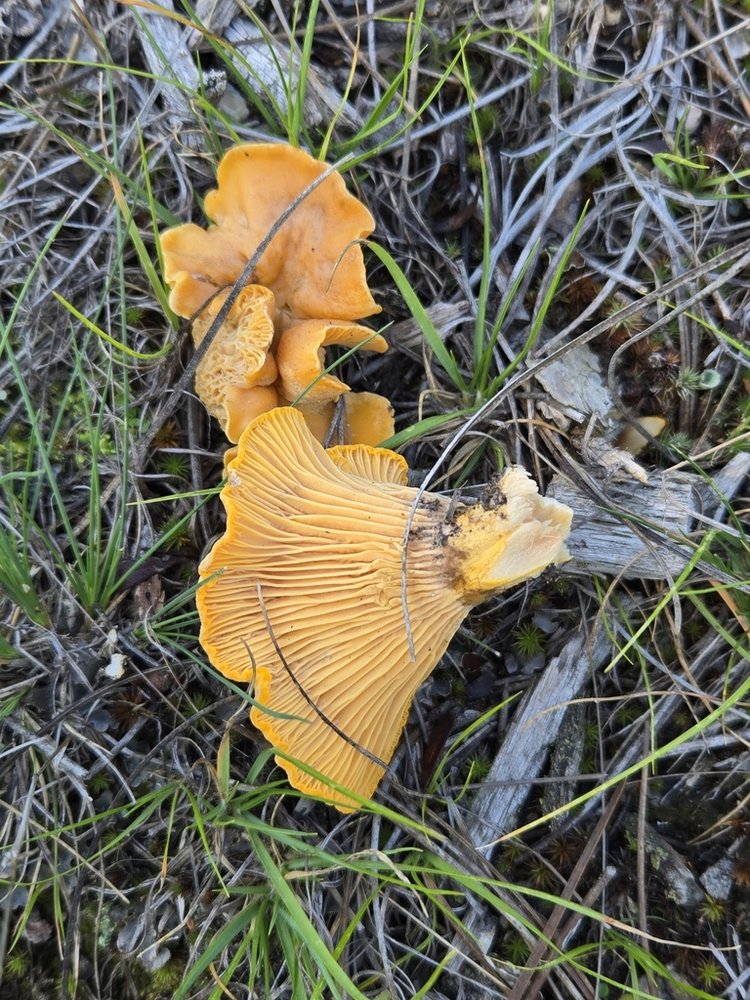
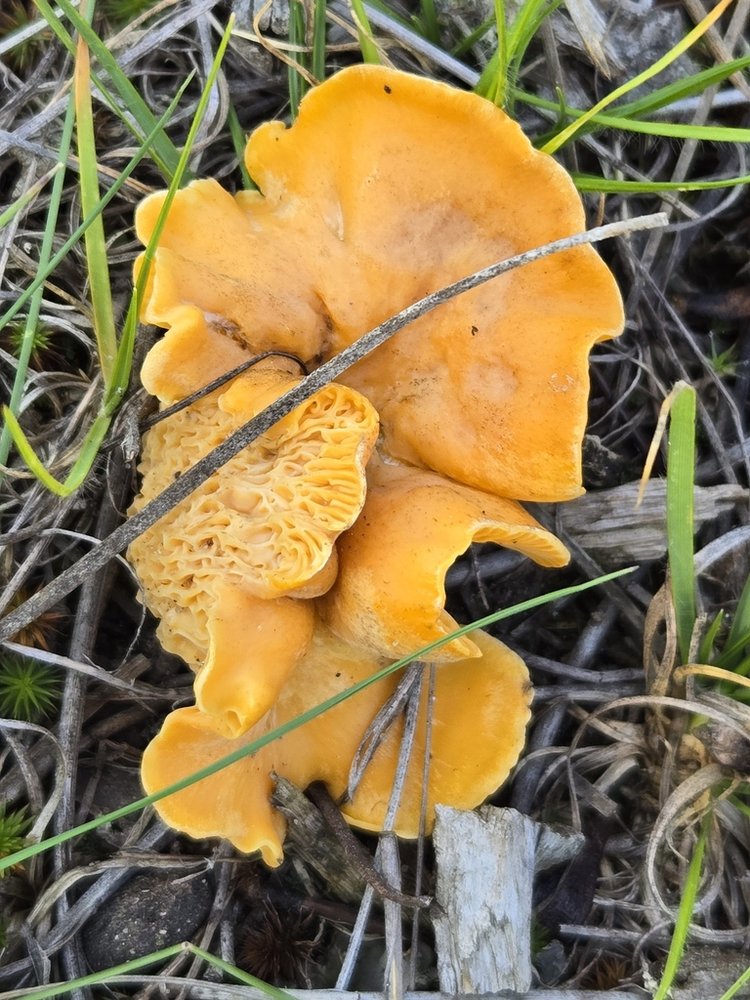
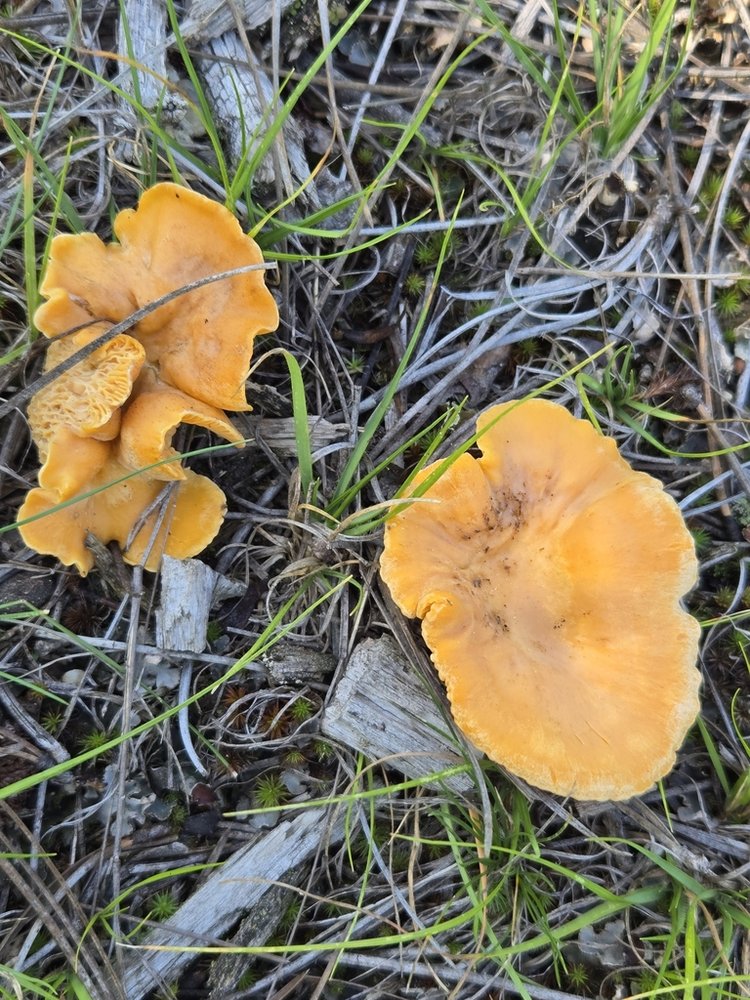
Chanterelles (Cantharellus) are firm, yellow to orange mushrooms with a wavy-edged cap and, underneath, blunt, forking ridges that run down the stem instead of true gills. The Black Hills Parks and Forests Association's listing for a 2004 Black Hills mushroom guide says they grow in the Hills, and iNaturalist has 7 Black Hills records, all from July to September, but only one is research grade, so which chanterelle species grow here is uncertain.
Free photos from other sources
| Family | Hydnaceae · Chanterelle |
|---|---|
| Type | Chanterelle |
| Season | July into September on iNaturalist's Black Hills records |
| Size | Cap 1–15 cm (½–6 in) wide; mushroom 2.5–15 cm (1–6 in) tall |
| Grows on | Soil near trees, never on wood |
| Spore print | White, cream, yellow or pinkish, depending on the species (golden chanterelles) |
| Also called | Golden Chanterelle |
| Toxicity | Chanterelles have made people sick: the North American Mycological Association's poisoning case registry lists vomiting, nausea, cramps and diarrhea from several Cantharellus species, including C. roseocanus in Colorado and Arizona. |
| Eating | This guide doesn't say which mushrooms are safe to eat. |
| Note | Species uncertain: the one research-grade Black Hills record is filed as Cantharellus enelensis, a species that is hard to confirm without DNA. |
How it lives
Chanterelles are mycorrhizal: they trade nutrients with the roots of living trees. The Missouri Department of Conservation notes that they come up in the same places year after year. The ridges under the cap are folds of the spore-bearing surface, not separate gill plates.
How do you identify Chanterelle?
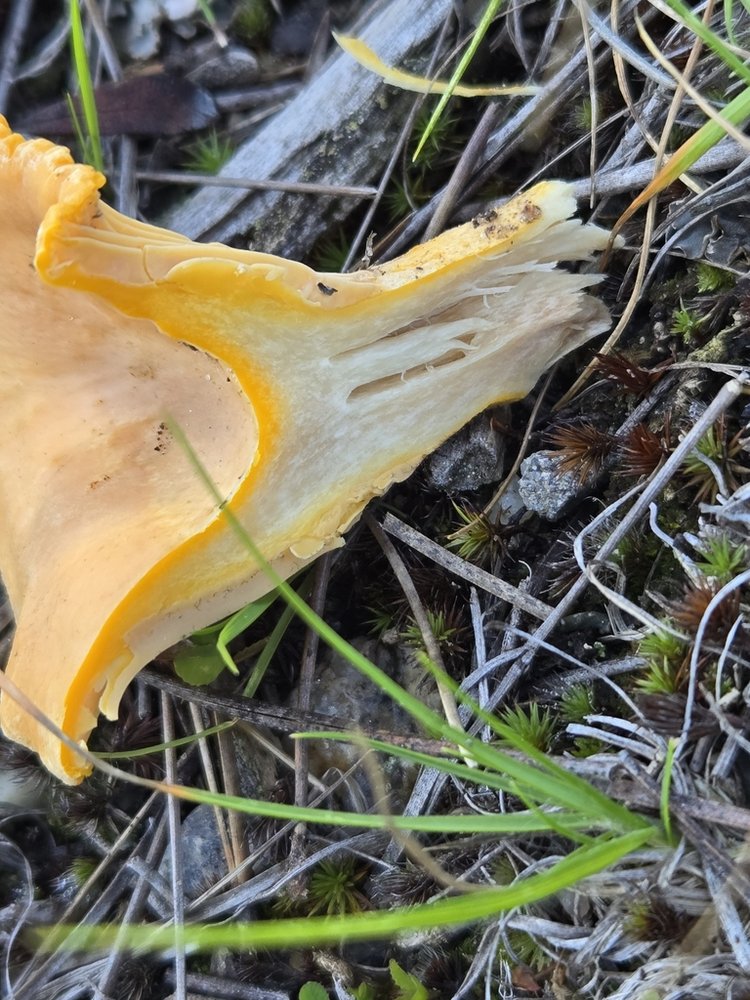
Look on the ground for a firm, yellow to orange-yellow or orange mushroom with a central, fleshy stem and a cap that is broadly convex, flat or shallowly sunken, with a wavy edge. Turn it over: instead of thin, blade-like gills, a chanterelle has blunt-edged ridges that fork, cross-connect and run down the stem. Chanterelles are hard-fleshed and sturdy, and fresh ones smell fruity, like apricots. Spore prints (the dust the ridges drop) of North American golden chanterelles range from white or cream to yellow or pinkish, depending on the species. The False Chanterelle (Hygrophoropsis aurantiaca), with one research-grade Black Hills record on iNaturalist, has true gills that are thin, crowded, repeatedly forked and usually more orange than a chanterelle's; a browner, soft, finely velvety cap; thin, flimsy flesh; and a white spore print, and it sometimes grows from rotten wood. The North American Mycological Association's poisoning registry records vomiting from it. Telling chanterelle species apart is much harder: the IUCN Red List says most golden chanterelles of the Cantharellus cibarius group in eastern North America can't be named to species without a microscope or even DNA.
When can you find it?
July into September on iNaturalist's Black Hills records.
Where does it grow?
On the ground, alone or in scattered groups, near the trees they partner with; chanterelles don't grow on wood. The Black Hills Parks and Forests Association's listing for Gabel and Ebbert's 2004 guide, Mushrooms and Other Fungi of the Black Hills and Surrounding Area, says chanterelles grow in the Black Hills; the book's species entries were not opened for this guide. iNaturalist has 7 Black Hills chanterelle records from July to September, 2019 to 2025. The one research-grade record, from Custer County in September 2025, is filed as Cantharellus enelensis. The other 6, all from Lawrence County, are ones that two or more identifiers agree are chanterelles but that haven't been named to species (one only to the subgenus Cinnabarinus). C. enelensis was described in 2017 from Newfoundland, where it grows mostly under white spruce; DNA has matched it from Michigan and Illinois, and the IUCN Red List calls its range poorly known and says it is hard to tell from its relatives without a DNA sequence. No herbarium specimen that can be placed in the Black Hills turned up in GBIF.
Sources: Cantharellus "cibarius" (M. Kuo, 2015) — MushroomExpert.com; Chanterelles and Trumpets: Cantharellus and Craterellus, with a key (M. Kuo) — MushroomExpert.com; Hygrophoropsis aurantiaca (M. Kuo, 2015) — MushroomExpert.com; Hygrophoropsis aurantiaca, Matchmaker: Mushrooms of the Pacific Northwest — Canadian Forest Service; Chanterelles, Field Guide — Missouri Department of Conservation; Gabel & Ebbert 2004, Mushrooms and Other Fungi of the Black Hills and Surrounding Area (book listing) — Black Hills Parks & Forests Association; Cantharellus enelensis (N. Siegel, 2021), IUCN Red List assessment — Global Fungal Red List Initiative; Thorn et al. 2017, The golden chanterelles of Newfoundland and Labrador, Botany 95: 547-560 (abstract) — Open Polar record; Cantharellus enelensis, the NL chanterelle (Omphalina VIII(4), June 2017) — Foray Newfoundland & Labrador, via MykoWeb; Summary of the Poisoning Reports in the NAMA Case Registry for 2006 through 2017 (M. Beug) — North American Mycological Association; Chanterelle (Cantharellus) records in the six Black Hills places, research grade and needs ID — iNaturalist API; False Chanterelle (Hygrophoropsis aurantiaca) research-grade records in the Black Hills places — iNaturalist API; Cantharellus specimens from South Dakota (one, location not stated) — GBIF.